Customer 360 Strategy & Consulting Services
Build a Customer 360 Strategy Around Your Business, Data and Customer Journey
Customer 360 transformation is not simply a technology implementation. Before connecting CRM, ERP, customer data, marketing, service, automation, and analytics, businesses need to understand what should be connected, why it should be connected, how customer information should move, which processes should be automated, and what the future customer experience should look like.
That requires a strategy. NuageCX helps businesses define and implement Customer 360 strategies based on their customer journeys, business processes, data environment, technology landscape, and growth objectives.
From Customer 360 discovery and assessment to architecture, roadmap, integration, implementation, automation, and optimization, NuageCX helps organizations create a practical path toward a connected customer ecosystem.
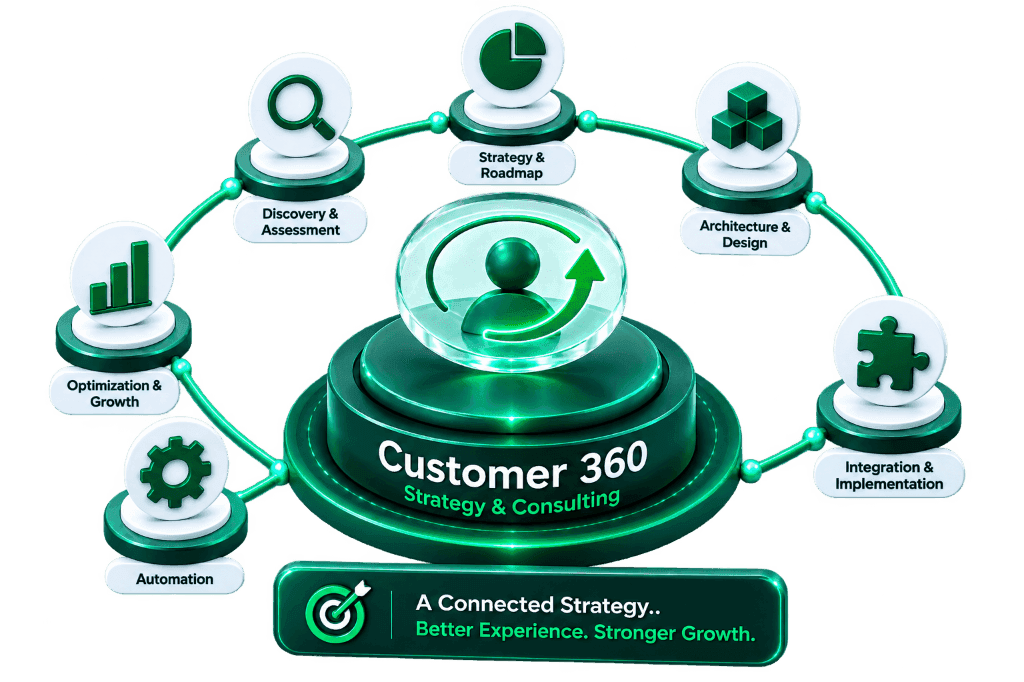
What Is Customer 360 Strategy & Consulting?
Customer 360 Strategy & Consulting is the process of defining how an organization should collect, connect, manage, use, and analyze customer information across its business.
A comprehensive Customer 360 strategy considers 16 key dimensions:
Customer Journeys
End-to-end lifecycle touchpoint progression
Customer Touchpoints
Omnichannel digital and human interaction points
Customer Data
Identity, behavioral, transactional, and service data
CRM Architecture
Lead, pipeline, and account relationship management
ERP Integration
Orders, invoices, inventory, and financial balances
Marketing Strategy
Audience segmentation, campaigns, and lead nurture
Sales Enablement
Contextual pipeline execution and proposal workflows
Customer Service
SLA compliance, case escalation, and resolution
Customer Success
Onboarding health, product adoption, and renewals
Workflow Automation
Eliminating manual handoffs and repetitive tasks
Analytics & Reporting
Executive KPIs, journey metrics, and LTV telemetry
System Integrations
Real-time webhooks, middleware, and API sync
Data Governance
Quality standards, security compliance, and privacy
Tech Architecture
Scalable stack design and application topography
Business Processes
Optimizing operational flows before automation
Customer Experience
Consistent brand perception across every channel
Customer 360 Strategy & Consulting Specialized Clusters
Explore the 6 specialized advisory disciplines comprising the Customer 360 Strategy & Consulting pillar:
Customer 360 Strategy Consulting
Define organizational vision, business alignment, and strategic frameworks for unified customer operations.
Customer 360 Assessment & Audit
Evaluate existing CRM, ERP, customer data sources, operational gaps, and technological readiness.
Customer 360 Roadmap & Transformation
Prioritize multi-phase transformation initiatives, timelines, resource allocation, and milestone governance.
Customer 360 Architecture Consulting
Design scalable data flow models, system topologies, integration blueprints, and identity matching engines.
Customer 360 Digital Transformation
Align people, operational workflows, and technology to transition from siloed tools to a connected operating model.
Customer 360 Technology & Solutions
Select, configure, and optimize software platforms (including Zoho One ecosystem) to match strategic business needs.
Why Do Businesses Need a Customer 360 Strategy?
Many organizations start Customer 360 initiatives by purchasing or configuring software first. Without a defined strategy, businesses encounter 10 critical pitfalls:
Too Many Applications
Software sprawl with overlapping tools
Unnecessary Integrations
Building point-to-point connections with no business value
Duplicate Customer Data
Fragmented records causing severe customer friction
Poor Data Quality
Unvalidated and stale customer records in production
Disconnected Workflows
Department handoffs failing between sales, service, and CS
Complex Architecture
Fragile, hard-to-maintain integrations and technical debt
Low User Adoption
Teams abandoning tools because workflows are convoluted
Expensive Customization
Over-engineering custom code when standard features exist
Limited Reporting
Inability to extract actionable insights or cross-channel KPIs
Unclear Data Ownership
No governance over which system is the single source of truth
*A strategy-first approach ensures businesses determine what they actually need, why they need it, and how it delivers value before committing to technology decisions.
Customer 360 Strategy Starts With Business Problems
A robust Customer 360 strategy answers 9 fundamental questions to establish a practical roadmap:
What customer problem are we solving?
Identify customer friction, repeating information, or poor service response times.
Which business process is creating the problem?
Pinpoint gaps in lead qualification, sales handoffs, onboarding, or support escalation.
Where does the required data currently exist?
Map existing data silos across CRM, ERP, spreadsheets, emails, and custom databases.
Which teams need the information?
Define data access and operational requirements for sales, marketing, operations, and support.
Which systems should own the data?
Establish the authoritative System of Record (SoR) for accounts, orders, and tickets.
Which systems need to communicate?
Specify bilateral and event-driven data synchronization requirements between platforms.
What should be automated?
Determine high-value automation triggers versus processes that require human empathy.
How should success be measured?
Define commercial and operational KPIs (CSAT, churn reduction, cycle time, adoption).
What should the future customer journey look like?
Design seamless omnichannel touchpoints from initial awareness through renewal.
Customer 360 Strategy Framework
A proven 10-step strategic framework turning organizational complexity into scalable customer execution:
Customer 360 Strategy Assessment
NuageCX conducts rigorous assessments across 7 operational and technical pillars:
Customer Experience
- • Customer journeys & milestones
- • Digital & physical touchpoints
- • Customer friction & pain points
- • Channel experience consistency
- • Outbound & inbound communication
Business Processes
- • Lead management & routing
- • Sales qualification & pipeline
- • Customer onboarding workflows
- • Support escalation playbooks
- • Renewal & retention tracking
Customer Data
- • Data sources & silos audit
- • Duplicate records & matching
- • Data quality & enrichment
- • Ownership & governance policy
- • Security & role accessibility
Technology Stack
- • CRM platform capabilities
- • ERP operational modules
- • Marketing automation tools
- • Service desk & helpdesk
- • Legacy & custom applications
Integration Health
- • Existing API connections
- • Required real-time syncs
- • Latency & webhook reliability
- • Middleware & data dependencies
Automation Gaps
- • Manual repetitive processes
- • Cross-team handoff delays
- • Automated notification rules
- • Multi-tier approval workflows
Analytics & KPI Readiness
- • Current reporting blindspots & data gaps
- • Executive leadership visibility requirements
- • Customer health, retention, and LTV telemetry
- • Attribution modeling across multi-touch channels
NuageCX Customer 360 Consulting Services
Targeted advisory and architectural consulting across the entire transformation lifecycle:
Customer 360 Architecture Consulting
Customer 360 architecture defines how customer information moves through the organization:
Customer 360 Data Strategy
Customer data is the foundation of Customer 360. A data strategy defines:
CRM Strategy: Beyond an Isolated Database
Defines lead management, account structures, opportunities, customer lifecycle, and communication cadence. CRM fits into the broader architecture rather than operating as a standalone application.
ERP Strategy: Transactional Context for Customer Teams
Exposes relevant orders, invoices, payments, and product fulfillment information to sales, service, and success teams without unnecessary complexity.
Customer 360 Transformation Roadmap
Prioritizing transformation initiatives into 8 pragmatic phases:
Phase 1: Discovery
Understand business objectives, customer journeys, processes, and current systems.
Phase 2: Assessment
Evaluate customer data quality, technology stack, integrations, and operational gaps.
Phase 3: Strategy
Define the target Customer 360 operating model, business rules, and ownership.
Phase 4: Architecture
Design data flow blueprints, middleware integrations, and identity matching logic.
Phase 5: Prioritization
Identify quick wins and prioritize high-value initiatives based on ROI and complexity.
Phase 6: Implementation
Configure systems, build custom modules, migrate data, and execute integrations.
Phase 7: Adoption
Train cross-functional teams, conduct workshops, and embed operational processes.
Phase 8: Optimization
Measure performance against KPIs, capture telemetry, and continuously improve.
Customer 360 Strategy Across Business Models
Adapting the strategic architecture to reflect the distinct customer lifecycle of each industry:
B2B Enterprise
Multi-stakeholder complexity:
- • Complex sales cycles & committees
- • Parent-child account hierarchies
- • Sales & service team coordination
- • Contract renewals & expansion
SaaS & Cloud
Product-led growth:
- • Self-serve trials & conversion
- • Digital onboarding sequences
- • Feature adoption telemetry
- • Proactive customer success & ARR
Manufacturing
Operational fulfillment:
- • Custom quotation & BOM pricing
- • ERP production & dispatch tracking
- • On-site installation & commissioning
- • Field maintenance & repeat orders
Professional Services
Knowledge delivery:
- • Consultation, scoping, & proposals
- • Retainer & project milestones
- • Time tracking & automated billing
- • Client satisfaction & account growth
Evaluating Legacy Systems & Modernizing Without Chaos
Businesses do not always need to rip and replace every existing system. NuageCX evaluates:
- Which systems should remain in place and perform core transactional work
- Which systems should be integrated via bi-directional APIs
- Which systems are creating technical debt and should be retired
- Which legacy databases require automated data cleansing and migration
Zoho Ecosystem Architectural Strategy
As a Zoho Premium Partner, NuageCX designs cohesive architectures across 10 core Zoho applications:
8 Common Customer 360 Strategy Mistakes
Avoid these costly missteps that derail enterprise transformation:
Starting With Technology
Choosing applications before understanding the business problem.
Integrating Everything
Creating unnecessary point-to-point connections that increase complexity.
Ignoring Data Quality
Building a connected environment using inaccurate or duplicated data.
Ignoring Customer Journeys
Designing systems without understanding how customers interact with the business.
Automating Poor Processes
Using automation to make an inefficient process fail faster.
Excessive Customization
Customizing software without evaluating standard out-of-the-box features.
Ignoring User Adoption
Building technically sound systems that front-line teams refuse to use.
Measuring Wrong KPIs
Building vanity dashboards disconnected from actual business outcomes.
How to Build a Customer 360 Strategy
A disciplined 12-step roadmap turning strategic vision into operational reality:
Step 1: Business Objectives
Determine what the organization wants Customer 360 to achieve commercially.
Step 2: Target Customers
Define customer segments and tier profiles that generate the greatest enterprise value.
Step 3: Map Journeys
Document interactions from discovery and evaluation to post-purchase retention.
Step 4: Assess Processes
Identify operational bottlenecks and departmental handoff breakdowns.
Step 5: Audit Data
Evaluate data sources, validation rules, duplication, and access security.
Step 6: Audit Technology
Review CRM, ERP, marketing, service, and custom software infrastructure.
Step 7: Target Architecture
Establish how data and applications will synchronize in real-time.
Step 8: Define Automation
Identify high-ROI automated triggers for leads, onboarding, and escalations.
Step 9: Define Analytics
Determine the exact operational KPIs and executive reports required.
Step 10: Build Roadmap
Sequence initiatives based on impact, complexity, and organizational readiness.
Step 11: Implement
Execute configured systems, migrations, custom development, and user training.
Step 12: Optimize
Measure adoption metrics and refine processes based on live telemetry.
When Should a Business Hire a Customer 360 Consultant?
13 strategic inflection points where external consulting ensures transformation success:
Benefits of Customer 360 Strategy Consulting:
Know what should be implemented before investing in expensive licenses.
Build around how customers interact with the organization in reality.
Define single sources of truth and eliminate conflicting records.
Avoid unnecessary applications, redundant subscriptions, and sprawl.
Connect systems based strictly on business ROI and data continuity.
Automate high-value workflows that drive operational efficiency.
Create meaningful analytics tied to customer health and revenue growth.
Build a foundation capable of expanding with future business acquisitions.
Identify architectural dependencies and gaps before deployment begins.
Why Choose NuageCX for Customer 360 Strategy & Consulting?
We approach Customer 360 transformation from the business perspective, not just the software box:
Business-First Consulting
We begin with business objectives and operational requirements rather than software features.
Zoho Ecosystem Mastery
As a Zoho Premium Partner, we optimize cross-application Zoho architectures effortlessly.
CRM & ERP Expertise
We evaluate how customer relationships and transactional ERP systems communicate.
Data & Integration Focus
Data flow, system ownership, and middleware architecture are foundational to our plans.
Custom Solution Engineering
Bespoke development for portals and custom modules when standard apps fall short.
Industry-Specific Thinking
Tailored models for B2B, SaaS, manufacturing, and professional services.
Strategy Through Execution
We support the entire journey from discovery through deployment and training.
Long-Term Optimization
Continuous improvement roadmaps that evolve with changing customer expectations.
Customer 360 Strategy vs. Implementation
Understanding how strategic planning and technical deployment reinforce each other:
Customer 360 Strategy Defines:
- What business outcomes should be achieved
- Which customer journeys and touchpoints matter most
- What customer data is required and who owns it
- Which systems should connect and what architecture is target
- What workflows should be automated vs. human-handled
- What metrics and KPIs should measure success
- What should be implemented first in a sequenced roadmap
Customer 360 Implementation Executes:
- Application configuration (CRM, ERP, Service desk)
- API integrations, webhooks, and middleware setup
- Historical data migration, deduplication, and cleansing
- Workflow orchestration and automated triggers
- Custom development (portals, scripts, custom modules)
- Executive dashboards, analytics reports, and KPI trackers
- User training, change management, and phased go-live
Explore the Customer 360 Pillar Series
All 6 architectural pillars connecting data, systems, automation, and customer experience:
Customer 360 Implementation
Transform defined Customer 360 strategies into an operational reality.
Customer 360 Integration
Connect CRM, ERP, finance, and other relevant systems seamlessly.
Customer 360 Data Management
Manage, cleanse, and unify customer data into a single source of truth.
Customer 360 Analytics & Insights
Turn connected customer data into actionable business intelligence.
Customer 360 Automation & CX
Automate customer processes and deliver personalized experiences.
Customer 360 Strategy & Consulting
Define the strategy, architecture, and roadmap for transformation.
Frequently Asked Questions
Answers to critical questions regarding Customer 360 strategy, architecture, and consulting:
Start Your Customer 360 Strategy
Customer 360 transformation should begin with a clear understanding of your current environment and your desired customer experience. NuageCX can assess your customer journeys, business processes, data, CRM, ERP, integrations, automation, and analytics to create a practical Customer 360 strategy and roadmap around your business requirements.