Customer 360 Analytics & Insights Services for Unified Customer Intelligence
Turn fragmented customer data into actionable insights with Customer 360 Analytics & Insights solutions that connect customer information across CRM, ERP, sales, marketing, customer service, finance, e-commerce, and other business systems.
NuageCX helps businesses build a unified analytical view of customers, accounts, interactions, transactions, journeys, and business relationships so decision makers can understand customers better, identify opportunities, improve customer experience, and make data driven decisions.
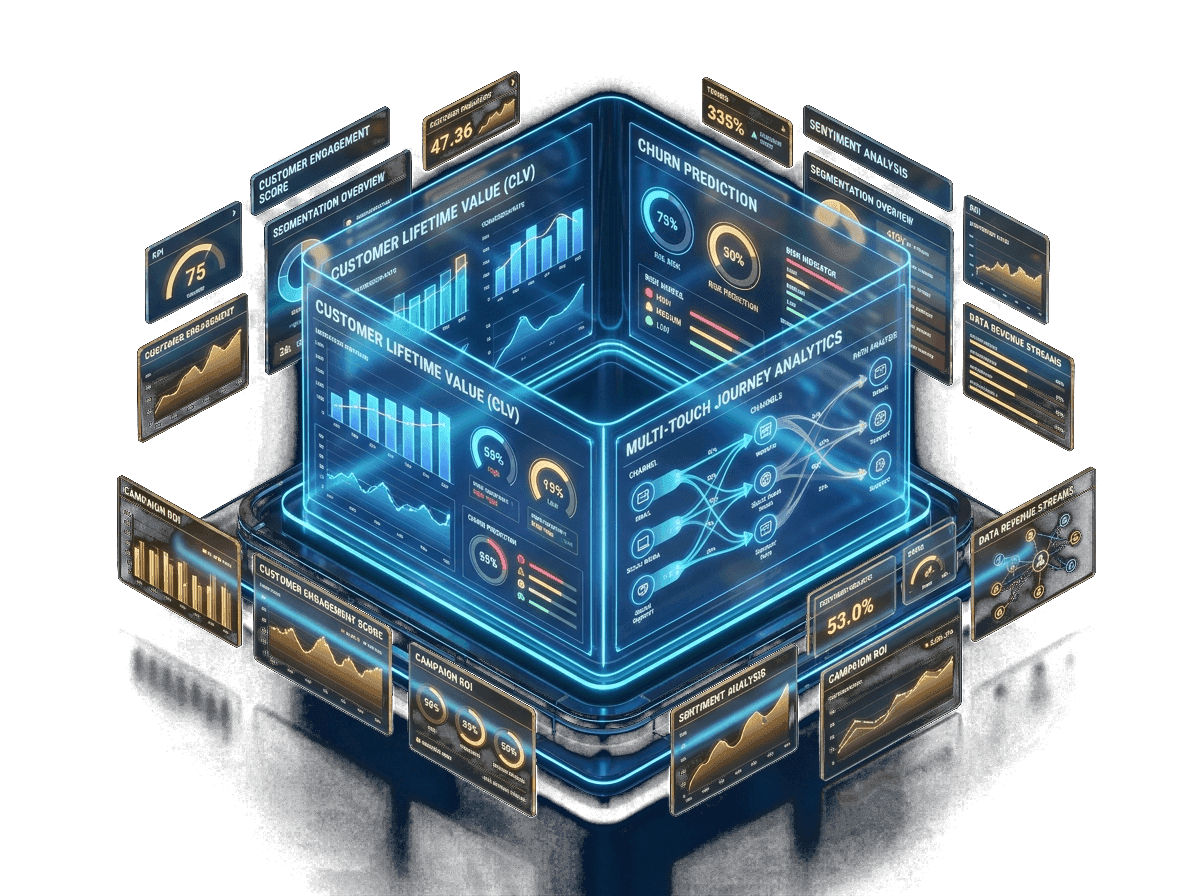
What Is Customer 360 Analytics?
Customer 360 Analytics brings customer information from multiple business systems together to create a comprehensive analytical view of each customer.
Instead of analyzing CRM, ERP, marketing, sales, service, and transaction data separately, Customer 360 Analytics connects relevant information to answer critical commercial questions:
Who are our most valuable customers?
Identify high-margin customer cohorts and top-tier accounts driving organizational profit.
What products or services do they use?
Track complete cross-product adoption and solution combinations across business lines.
How frequently do they purchase?
Analyze transaction velocity, repeat order cadence, and re-engagement cycles.
Which customers are at risk of leaving?
Detect early-warning signals, declining usage, and churn behavior patterns.
Which customers have expansion opportunities?
Surface accounts ripe for cross-sell, upsell, capacity increases, and higher service tiers.
How are customers interacting with our business?
Map touchpoint interactions across portals, apps, customer support, and sales channels.
Which channels generate strongest engagement?
Quantify conversion efficacy across email, web, direct sales, portals, and service.
What is customer lifetime value (CLV)?
Project economic value across the entire multi-year customer relationship lifecycle.
Which customer segments are most profitable?
Evaluate net contribution after accounting for service, acquisition, and delivery costs.
Where are customer experience gaps occurring?
Pinpoint support escalations, onboarding drop-offs, and friction points in journeys.
Why Is Customer 360 Analytics Important?
Customer data is often distributed across different applications, creating analytical barriers that obscure customer value and delay executive action.
Fragmented Customer Information
Data trapped in isolated CRM, ERP, and billing silos prevents an enterprise-wide view.
Duplicate Customer Identities
The same buyer appears as multiple records, distorting churn, revenue, and relationship metrics.
Inconsistent Customer Definitions
Different departments calculate active accounts, churn, and conversion differently.
Disconnected Reporting
Teams make decisions based on conflicting spreadsheet exports and isolated departmental reports.
Limited Cross-Channel Visibility
Blind spots between marketing campaigns, digital activity, and physical sales interactions.
Incomplete Customer Journeys
Inability to track the full progression from initial ad touch to expansion and renewal.
Difficult Segmentation
Audience targeting relies on static demographics rather than dynamic behavioral attributes.
Manual Reporting Overhead
Analysts spend hours stitching CSV files instead of uncovering strategic growth insights.
Delayed Decision Making
Executive teams receive outdated month-end summaries instead of near-real-time intelligence.
Poor Visibility into Customer Value
Inability to differentiate high-profit relationship accounts from high-cost customers.
Customer 360 Analytics creates a connected analytical foundation that helps businesses understand customers across their entire relationship with the organization.
What Does Customer 360 Analytics Include?
A complete Customer 360 analytics framework unifies descriptive, behavioral, commercial, and predictive dimensions.
Customer Profiles
Understand customer attributes, relationships, hierarchies, and characteristics.
Customer Segmentation
Group customers based on relevant business characteristics, RFM scores, and behaviors.
Customer Lifetime Value
Understand the economic value and margin contribution of customer relationships.
Customer Journey Analytics
Analyze customer interactions across all digital channels, portals, and touchpoints.
Sales Analytics
Analyze customer revenue, pipeline opportunities, win rates, and account performance.
Marketing Analytics
Understand campaigns, attribution, engagement, acquisition costs, and conversion rates.
Customer Service Analytics
Analyze tickets, cases, resolution times, satisfaction ratings, and customer friction.
Product Analytics
Understand products purchased, feature adoption, utilization patterns, or requests.
Retention Analytics
Identify behavioral patterns associated with customer retention, renewals, and churn.
Executive Dashboards
Provide decision makers with real-time, consolidated customer intelligence and KPIs.
Customer 360 Analytics Architecture
The architecture transforms raw, multi-system operational data into refined business insights and automated actions.
Source Systems
CRM, ERP, Marketing, Service, E-commerce, Finance & Product Systems
Data Integration
High-speed batch, streaming, and API data ingestion pipelines
Identity Resolution
Deterministic & probabilistic customer matching algorithms
Customer Data Model
Standardized dimensional analytical schema & relationships
Analytics Layer
Metric modeling, statistical aggregations & AI intelligence
Decisions & Actions
Executive dashboards, automated workflows & CX optimization
The actual architecture is designed according to the organization's systems, data model, analytical requirements, and governance framework.
How Does Customer 360 Analytics Work?
A disciplined, 10-step methodology to design, build, and operationalize enterprise customer intelligence.
1. Identify Data Sources
Catalog systems containing relevant customer information across applications.
2. Connect Customer Data
Integrate relevant customer records and interaction events across platforms.
3. Resolve Identity
Determine which records represent the same customer, account, or household.
4. Standardize Data
Normalize customer attributes, taxonomies, and cross-departmental definitions.
5. Build Analytical Model
Model relationships across customers, accounts, transactions, interactions, and products.
6. Define Consistent Metrics
Establish unified calculations for revenue, retention, engagement, conversion, and CLV.
7. Build Dashboards
Create role-specific executive, sales, marketing, and customer service views.
8. Generate Insights
Identify patterns, trends, expansion opportunities, risks, and behavioral signals.
9. Activate Insights
Feed insights into sales workflows, marketing campaigns, and service automation.
10. Continuously Improve
Monitor analytical precision, data quality, dashboard adoption, and business ROI.
Customer 360 Unified Customer View
A unified analytical customer view combines multi-system dimensions into 360-degree customer intelligence:
360 Degree Customer Insight
Information included depends on the organization's available data and business requirements.
Customer 360 Customer Segmentation
Customer 360 Analytics helps organizations segment customers across 12 distinct operational dimensions:
Supports targeted marketing, sales prioritization, customer service routing, and personalized CX initiatives.
Customer 360 Behavioral Analytics
Examines direct customer interactions across 8 touchpoints to uncover intent, friction, and engagement patterns:
Behavioral insights help organizations understand customer intent and engagement patterns before decisions occur.
Customer 360 Customer Journey Analytics
Connects customer interactions across the complete 10-stage lifecycle to pinpoint conversion, drop-off, and expansion triggers.
Specialized Customer 360 Analytics Domains
Tailored analytics suites delivering deep contextual clarity for every business function.
Sales Analytics
Visibility into customer revenue, account performance, pipeline velocity, opportunity conversion, purchase history, cross-sell/upsell potential, and account profitability.
Marketing Analytics
Connects campaigns, leads, customer profiles, engagement, conversions, revenue attribution, segments, and acquisition costs across channels.
Customer Service Analytics
Connects tickets, cases, product profiles, service history, resolution times, escalations, and recurring customer friction points.
Revenue Analytics
Understand revenue by customer, account, product lines, segments, and geography, alongside recurring revenue trends and expansion growth.
Customer Lifetime Value (CLV)
Estimates economic value over the customer lifespan, factoring in revenue, purchase frequency, gross margin, retention rates, and service costs.
Churn & Retention Analytics
Detects early indicators of attrition (reduced logins, declining purchase volume, support escalations) to guide timely intervention workflows.
Cross-Sell & Upsell Analytics
Analyzes purchase combinations, account size, and product utilization to pinpoint expansion readiness for higher tiers and companion offerings.
Account & Product Analytics
B2B hierarchy analysis (parent companies, subsidiaries, contacts, contract values) linked directly to product adoption and utilization health.
Cohort & Attribution Analytics
Groups customers by acquisition month, tracks stage-by-stage lifecycle funnel progression, and attributes closed revenue to marketing touches.
Customer Profitability Analytics
Revenue alone does not represent customer value. Customer profitability analysis incorporates complete cost-to-serve:
Real-Time, Predictive, Prescriptive & AI Analytics
Progressing from historical reporting to forward-looking predictive foresight and automated AI recommendations.
Real-Time Analytics
Near-instantaneous transaction tracking, service event alerts, and live website activity monitoring where business ROI justifies complexity.
Predictive Analytics
Historical modeling to project future churn risk, purchase propensity, lead conversion likelihood, and renewal probabilities.
Prescriptive Analytics
Evaluates risk patterns against business rules to suggest specific next-best actions with highest expected commercial outcomes.
AI Analytics
Natural language query interfaces, automated anomaly detection, pattern summaries, and smart segmentation powered by governed data.
The AI & Analytics Synergy
A reliable AI strategy requires trusted customer data, standardized identity, verified metrics, robust security, and reliable pipelines. Customer 360 Analytics provides this indispensable foundation.
Customer 360 Analytics Dashboards
Role-specific analytical views designed for executive decision-makers and frontline operational teams.
Executive Dashboard
- Enterprise Revenue Trends
- Net Customer Growth Rate
- Retention & Churn Health
- Customer Lifetime Value
- Strategic Account Health
Sales Dashboard
- Account Revenue & Target Pace
- Real-time Pipeline Velocity
- High-Value Opportunities
- Expansion & Cross-Sell Signals
- Client Interaction History
Marketing Dashboard
- Multi-Touch Acquisition
- Cross-Channel Engagement
- Conversion Funnel Analysis
- Campaign ROI & Attribution
- Dynamic Audience Segments
Customer Service Dashboard
- Active Case & Ticket Volume
- Mean Time to Resolution (MTTR)
- Escalation Rates by Tier
- Recurring Product Issues
- CSAT & NPS Feedback
Customer 360 KPI Framework
14 standardized core KPIs configured to reflect your unique business model and operational metrics.
Customer 360 Analytics by Industry
Industry-tailored models tuned for B2B accounts, B2C volume, SaaS retention, e-commerce transactions, manufacturing distribution, and regulated sectors.
B2B Analytics
Account hierarchy, buying committee engagement, pipeline velocity, contract value, and multi-stakeholder health.
B2C Analytics
High-volume purchase trends, behavioral triggers, audience segments, customer value tiers, and promotional response.
E-commerce Analytics
Average order value (AOV), cart abandonment, product affinities, return rates, and repurchase cadences.
SaaS Analytics
MRR/ARR growth, product feature adoption, daily/monthly active usage, expansion readiness, and churn prevention.
Manufacturing Analytics
Order fulfillment history, dealer/distributor accounts, product demand forecasting, and warranty service.
Financial Services & Healthcare
Compliant relationship analysis, interaction history, and segment insights governed by strict privacy standards.
Customer 360 Analytics Challenges
Fragmented Data
Customer records reside in isolated applications with no common identifier.
Duplicate Identities
The same individual or account exists multiple times across business tools.
Inconsistent Metrics
Sales, marketing, and finance calculate churn and revenue using different logic.
Poor Data Quality
Missing email, bad phone numbers, and outdated titles skew analytical models.
Lack of Integration
Disconnected systems cannot reliably exchange analytical records in time.
Legacy System Bottlenecks
Older on-premise systems lack APIs and flexible data export capabilities.
Data Governance Gaps
Undefined data ownership and ambiguous stewardship responsibilities.
Reporting Complexity
Heavy reliance on static spreadsheets and manual spreadsheet compilation.
Lack of User Adoption
Dashboards are ignored because metrics do not reflect everyday workflows.
Customer 360 Analytics Best Practices
Establish a Common Customer Definition
Define precisely what constitutes an active customer, account, and contact.
Create Consistent Metrics
Standardize and document exact calculations for CLV, retention, and ARR.
Resolve Customer Identity First
Unify duplicate identities before running segmentation or predictive models.
Improve Core Data Quality
Cleanse, validate, and standardize data inputs across ingestion pipelines.
Govern Customer Data
Establish clear ownership, role-based access controls, and lifecycle rules.
Design Role-Specific Views
Deliver tailored dashboards for executives, sales, marketing, and support.
Focus on Business Decisions
Build analytical views around strategic decisions rather than vanity charts.
Connect Insights to Action
Trigger automated marketing campaigns and sales alerts from customer insights.
Continuously Validate Models
Audit model accuracy, data freshness, and user adoption on an ongoing basis.
Customer 360 Analytics Implementation Roadmap
A proven 12-phase framework to take your organization from requirements to long-term analytical maturity.
Phase 1: Requirements
Identify commercial decisions, user questions, and target analytical outcomes.
Phase 2: Discovery
Catalog data sources, databases, APIs, and relevant customer attributes.
Phase 3: Assessment
Evaluate data quality, completeness, schema consistency, and availability.
Phase 4: Identity Resolution
Establish customer and account linking rules across source systems.
Phase 5: Data Model
Architect the core dimensional analytical schema and entity relationships.
Phase 6: Integration
Connect CRM, ERP, e-commerce, service, and finance data pipelines.
Phase 7: KPI Framework
Document standardized business metrics, formulas, and aggregation rules.
Phase 8: Analytics & Dashboards
Build predictive models, executive dashboards, and operational views.
Phase 9: Action Activation
Connect analytical triggers to automated workflows and CRM alerts.
Phase 10: Governance
Implement security controls, audit logs, and compliance policies.
Phase 11: User Adoption
Train frontline teams and embed dashboards into daily meeting rhythms.
Phase 12: Optimization
Continuously tune models, data pipelines, and analytical accuracy.
How Much Does It Cost?
There is no universal cost for Customer 360 Analytics. Investment depends on:
- Number of source data applications
- Volume & quality of historical records
- Integration & transformation complexity
- Dashboard & role-based view requirements
- Real-time vs batch pipeline needs
- Predictive AI & governance scope
How Long Does It Take?
Implementation timelines vary based on organizational scope:
- Source system readiness & API access
- Data hygiene & deduplication needs
- Number of analytical use cases
- Executive & frontline stakeholder alignment
A focused departmental pilot (e.g. Sales or Churn Analytics) can be delivered rapidly, whereas an enterprise-wide transformation progresses systematically.
Can It Be Phased?
Yes! A phased maturity roadmap minimizes risk and accelerates time-to-value:
Understanding Key Conceptual Differences
How Customer 360 Analytics relates to and differs from other critical data pillars.
Analytics vs. Data Integration
Connects and moves customer records across source business systems. Provides the foundation.
Uses unified information to generate insights, metrics, trends, and business intelligence.
Analytics vs. Data Management
Organizes, standardizes, governs, and maintains customer data records across applications.
Focuses on analyzing that structured data to generate actionable commercial decisions.
Analytics vs. Data Unification
Creates a single connected representation of customer records from diverse sources.
Interrogates that connected view to uncover behavior, value, opportunities, and risks.
Analytics vs. Business Intelligence (BI)
Covers enterprise-wide operational, supply chain, financial, and inventory reporting.
Hyper-focused on customer relationships, behaviors, lifetime value, and experience.
Why Choose NuageCX for Customer 360 Analytics & Insights?
Deep enterprise specialization in customer intelligence, advanced BI engineering, and end-to-end Zoho Analytics deployment.
Customer Data Analytics
Connect fragmented datasets into strategic business insights.
Advanced Segmentation
Build behavioral, RFM, and revenue-based customer cohorts.
Journey Analytics
Track multi-touchpoint interactions from awareness to expansion.
Sales Analytics
Pipeline velocity, win-rate models, and account expansion tracking.
Marketing Analytics
Full-funnel conversion attribution and acquisition efficiency.
Service Analytics
Support volume patterns, MTTR tracking, and root-cause analysis.
CLV Analytics
Custom lifetime value models tailored to your business model.
Retention & Churn
Predictive attrition warning signals and intervention alerts.
Customer Profitability
Cost-to-serve analysis revealing true net margin by customer.
Dashboard Engineering
Role-specific interactive dashboards for executives and frontline teams.
Predictive Analytics
Propensity scoring, renewal likelihood, and forecast models.
AI Analytics
Governed AI intelligence, anomaly detection, and natural language query.
Zoho Analytics Mastery
Deep ecosystem integration with Zoho CRM, Books, Desk & Creator.
End-to-End Delivery
From assessment and data modeling to dashboards and continuous optimization.
Customer 360 Analytics & Insights Cluster Solutions
Explore specialized cluster architectures that connect, segment, analyze, and activate customer intelligence across business systems.
Customer 360 Customer Journey Analytics
Understand how customers interact across every lifecycle stage, identify friction points, track multi-touch attribution, and optimize conversion.
Customer 360 Customer Segmentation
Turn customer data into actionable cohorts combining profiles, behaviors, transactions, RFM models, lifecycle stages, and AI predictive scoring.
Customer 360 Customer Behavior Analytics
Understand what customers do, detect behavioral shifts, identify churn signals, uncover cross-sell opportunities, and improve customer experience.
Customer 360 Predictive Analytics
Estimate future customer behavior, predict churn, score purchase propensity, anticipate contract renewals, and forecast lifetime value.
Customer Intelligence Dashboard
Centralized analytical views across customer profiles, value, engagement, sales, service, journeys, retention, and growth.
Customer Experience Analytics
Understand customer interactions, identify journey friction, measure engagement, analyze VoC sentiment, and improve relationships.
Frequently Asked Questions
Everything you need to know about Customer 360 Analytics, architecture, pricing, and implementation.
Turn Customer Data Into Actionable Customer Intelligence
Customer 360 Analytics goes beyond creating dashboards. It connects customer information, establishes consistent metrics, reveals customer behavior, identifies opportunities and risks, and helps teams make better customer focused decisions.
NuageCX helps businesses build Customer 360 Analytics solutions across CRM, ERP, sales, marketing, customer service, e-commerce, finance, and other business systems.