Customer 360 Customer Segmentation Services
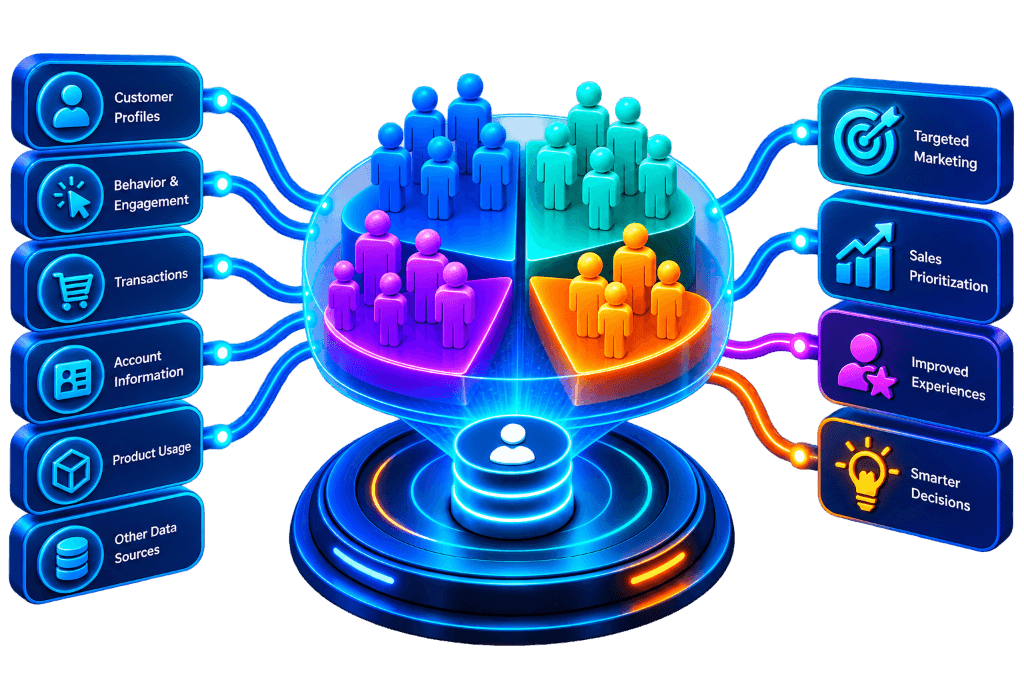
Turn customer data into actionable segments with Customer 360 Customer Segmentation solutions that combine customer profiles, behavior, transactions, engagement, account information, product usage, and other relevant data across business systems.
NuageCX helps businesses build practical customer segmentation frameworks that enable more targeted marketing, better sales prioritization, improved customer experiences, and more informed customer decisions.
What Is Customer 360 Customer Segmentation?
Customer 360 Customer Segmentation is the process of dividing customers into meaningful groups based on shared characteristics, behaviors, needs, value, lifecycle stage, or business relationships.
Instead of treating every customer the same, businesses can use Customer 360 data to understand differences between customers and create segments that support specific business decisions.
Why Is Customer 360 Segmentation Important?
Customers have different needs, behaviors, values, and relationships with a business. Without effective segmentation, businesses face severe operational blind spots:
Generic Marketing
One-size-fits-all promotions lead to low open rates and message fatigue.
Poor Sales Prioritization
Sales reps spend time chasing low-yield accounts instead of high-value prospects.
Weak Personalization
Inability to tailor experiences, messaging, and product recommendations.
Inefficient Customer Targeting
Ad spend wasted on audiences that do not match ideal customer profiles.
Low Campaign Relevance
Customers receive irrelevant collateral that fails to address their specific needs.
Missed Cross-Sell
Inability to detect companion product adoption opportunities in existing accounts.
Missed Upsell
Overlooking high-utilization accounts ready for premium tier upgrades.
Poor Retention Strategies
Failing to distinguish normal churn from preventable at-risk customer drop-offs.
Inconsistent Experiences
Disjointed handoffs between marketing, sales, and service departments.
High-Value Obscurity
Difficulty identifying and protecting your most profitable customer cohorts.
Customer 360 segmentation provides a structured way to differentiate customer groups using connected customer information.
What Does Customer 360 Segmentation Include?
A complete enterprise segmentation framework spanning 10 analytical dimensions:
Profile Segmentation
Group customers based on relevant profile attributes and personal characteristics.
Behavioral Segmentation
Group customers according to observed digital actions, logins, and engagement.
Value-Based Segmentation
Group customers according to revenue, gross margin, profitability, or CLV.
Lifecycle Segmentation
Group customers according to their relationship stage from prospect to advocate.
Engagement Segmentation
Group customers according to email, portal, and campaign engagement levels.
Product Segmentation
Group customers according to products purchased, adopted, or actively utilized.
Geographic Segmentation
Group customers according to country, state, city, sales territory, or market.
Industry Segmentation
Group B2B business customers according to vertical and regulatory framework.
Account Segmentation
Group B2B clients based on enterprise hierarchy, subsidiaries, and health.
Predictive Segmentation
Create high-propensity segments using validated forward-looking AI signals.
How Does Customer 360 Customer Segmentation Work?
A disciplined, 10-step process ensuring that every segment delivers measurable business value.
1. Define Objective
Determine goals: improve retention, increase sales, boost campaign ROI, or elevate CX.
2. Identify Data
Identify relevant customer records across CRM, ERP, marketing, service, and e-commerce.
3. Resolve Identity
Unify fragmented records belonging to the same individual or B2B account.
4. Standardize Data
Create consistent cross-departmental attributes, taxonomies, and metric definitions.
5. Select Variables
Choose attributes, transactions, and behaviors directly relevant to the objective.
6. Build Segments
Construct meaningful, distinct customer groups using multi-criteria rules.
7. Validate Segments
Evaluate whether segments are statistically distinct, measurable, and actionable.
8. Activate Segments
Connect segments directly into marketing, sales, service, and analytics workflows.
9. Monitor Outcomes
Track how each segment behaves and whether targeted commercial outcomes improve.
10. Refresh & Tune
Continuously update segment criteria as market conditions and buyer habits evolve.
Segmentation Data Sources
Connects customer information across business systems:
Data sources depend on the organization's architecture and use cases.
Demographic & Geographic
Groups individuals and accounts by geography and permitted attributes:
- Age group & customer persona type
- Country, State, City, & Regional markets
- Sales territory & service coverage zones
- Household and consumer characteristics
Strictly adheres to business purpose and applicable privacy compliance regulations.
Firmographic Segmentation
Vital for B2B organizations managing complex corporate accounts:
- Company revenue & employee headcount
- Industry vertical & regulatory environment
- Business model (B2B, SaaS, Distribution)
- Parent companies, subsidiaries, & divisions
Aligns territory assignments, account tiers, and enterprise sales motions.
Behavioral & Transactional Segmentation
Groups customers according to observed digital actions, purchase patterns, and transaction histories:
Customer 360 RFM Segmentation
RFM analysis categorizes customers by evaluating three critical transactional dimensions:
Recency
How recently did the customer purchase or interact?
Frequency
How often does the customer complete a transaction?
Monetary Value
How much total economic value does the customer spend?
Value-Based & Lifecycle Segmentation
Aligning commercial priorities with relationship progression across the entire customer journey.
Customer 360 Lifecycle Segmentation Progression
Prospect
Qualified leads undergoing evaluation
New Customer
Recently closed accounts in onboarding
Active Customer
Regular transaction or application usage
Growing Customer
Expanding seats, volume, or services
Mature Customer
Stable, established account partnership
At Risk
Declining usage, tickets, or missed renewal
Inactive / Lost
Dormant accounts needing reactivation
Engagement Segmentation
Classifies accounts based on multichannel activity:
Product Segmentation
Analyzes solutions purchased and adopted:
- Products adopted vs purchased
- Feature utilization depth
- Solution combinations
- Category-level preferences
Service Segmentation
Identifies support volume and friction:
- Support ticket frequency
- High-friction product issues
- Escalation severity rates
- Dedicated SLA requirements
Account Segmentation
Organizes complex B2B relationships:
- Enterprise corporate hierarchy
- Contract values & terms
- Growth & expansion potential
- Overall account relationship health
Predictive & Dynamic Customer Segmentation
Moving beyond static lists into real-time rebalancing and forward-looking AI propensity scoring.
Predictive Customer Segmentation
Uses validated statistical signals to identify cohorts associated with future business outcomes:
Dynamic Real-Time Segmentation
Customer groups update dynamically as customer activity changes:
Static vs. Dynamic Segmentation
Customers remain in a designated segment until lists are manually or periodically updated via batch processes.
Customers automatically move between segments as their behavior, spend, or engagement thresholds trigger rules.
Customer 360 Segmentation Across Business Units
Empowering frontline and operational teams with segment-driven workflows.
Marketing Activation
- Precision campaign audience targeting
- Dynamic email personalization
- Automated lifecycle lead nurturing
- Customer reactivation campaigns
Sales Prioritization
- Focus on top-tier revenue accounts
- Spot immediate expansion opportunities
- High-engagement prospect alerts
- Tailored B2B enterprise proposals
Service & Customer Experience
- Dedicated routing for high-value clients
- Proactive outreach for at-risk accounts
- Tailored onboarding for new buyers
- Personalized communication channels
Retention & Churn Analysis
Compares traits between Retained Customers vs Churned Customers to uncover attrition root causes and deploy targeted save offers.
Cross-Sell Segmentation
Upsell Segmentation
Surfaces accounts with high capacity usage, contract maturity, or team growth ready for higher tiers and premium feature bundles.
Customer 360 Segmentation by Industry
Tailored segmentation models tuned for complex B2B accounts, B2C volume, SaaS product analytics, e-commerce, and manufacturing.
B2B Segmentation
Firmographics, account revenue, parent-subsidiary hierarchy, product adoption, contract value, and buying committees.
B2C Segmentation
Customer persona, buying frequency, brand engagement, product category preferences, lifecycle, and geography.
E-Commerce
Average order value (AOV), cart abandonment, purchase frequency, category affinity, repurchase cadence, and CLV.
SaaS Subscriptions
Subscription plan, seat utilization, daily active usage, feature adoption, renewal date, and churn risk probability.
Manufacturing
Annual volume, dealer/distributor network size, order fulfillment history, product mix, and warranty service.
Customer 360 Segmentation Challenges
Fragmented Data
Customer records trapped across disconnected CRM, ERP, and billing systems.
Duplicate Records
Same contact or account exists multiple times, skewing segment counts.
Poor Data Quality
Missing fields, bad formatting, and outdated attributes degrade accuracy.
Inconsistent Definitions
Sales and marketing define active accounts or lifecycle stages differently.
Over-Segmentation
Creating dozens of micro-segments that are impossible to operationalize.
Weak Business Relevance
Building interesting segments that do not link to any commercial decision.
Static Segments
Failing to update lists as customer behaviors and purchases evolve.
Lack of Activation
Segments remain in analytical reports without triggering sales or marketing workflows.
Customer 360 Segmentation Best Practices
Start With a Business Question
Anchor segment design around specific decisions and target outcomes.
Use Reliable Customer Data
Deduplicate and clean customer identities prior to segment creation.
Keep Segments Actionable
Ensure every segment has an assigned operational owner and workflow.
Avoid Over-Segmentation
Focus on primary cohorts before dividing into micro-subcategories.
Combine Multiple Data Types
Synthesize profile, behavioral, transactional, and value variables.
Define Criteria Transparently
Document the precise boolean logic that qualifies an account for a segment.
Validate Segments
Verify that cohorts are statistically distinct, sizeable, and measurable.
Connect to Automated Actions
Feed segment triggers into CRM alerts, email sequences, and ad syncs.
Monitor Segment Performance
Track conversion, retention, and revenue generation by segment.
Refresh Regularly
Rebalance dynamic segment rules as customer trends evolve over time.
Customer 360 Segmentation Roadmap & Metrics
A proven 10-phase implementation roadmap coupled with 15 essential measurement metrics.
Phase 1: Objective
Define target commercial decision and expected outcome.
Phase 2: Discovery
Catalog data sources, tables, and relevant attributes.
Phase 3: Assessment
Evaluate completeness, accuracy, and hygiene of records.
Phase 4: Identity
Connect records across systems with deterministic matching.
Phase 5: Variables
Select attributes, behaviors, values, and lifecycle metrics.
Phase 6: Segment Design
Formulate and document segment qualification rules.
Phase 7: Validation
Test segment distinctiveness and business usefulness.
Phase 8: Activation
Connect segments to sales, marketing, and service tools.
Phase 9: Measurement
Track conversion, retention, and revenue per segment.
Phase 10: Optimization
Continuously refine criteria as buyer habits change.
15 Key Customer Segmentation Metrics
How Much Does It Cost?
Investment depends on data scope and complexity:
- Number of source data applications
- Volume & quality of customer records
- Number and complexity of segments
- Real-time vs batch dynamic rebalancing
- Predictive machine learning models
How Long Does It Take?
Project delivery duration varies based on organizational readiness:
- System connectivity & API availability
- Data hygiene & deduplication needs
- Number of business use cases
- Marketing & sales activation endpoints
A focused pilot can launch in weeks, while enterprise programs roll out systematically in phased waves.
Phased Rollout Plan
Recommended 6-phase evolution to minimize risk:
When Should a Business Implement Customer 360 Segmentation?
Consider implementing when you observe any of the following commercial triggers:
Understanding Key Conceptual Differences
How customer segmentation relates to profiling, personalization, analytics, and data unification.
Segmentation vs. Profiling
Describes an individual customer or account. Provides attributes and data inputs.
Groups multiple customers together based on shared characteristics, behaviors, or value.
Segmentation vs. Personalization
Divides customer portfolios into defined macro-categories and operational cohorts.
Uses customer information to tailor individual messages, offers, and interactions.
Segmentation vs. Customer Analytics
Broad analysis of customer data to identify enterprise trends, insights, and opportunities.
One specific capability within analytics that constructs actionable target groups.
Segmentation vs. Data Unification
Ingests, matches, and connects customer information from multiple systems into a golden record.
Uses that connected golden view to construct meaningful groups for business action.
Why Choose NuageCX for Customer 360 Customer Segmentation?
Comprehensive technical and analytical engineering across data unification, Zoho Analytics, and CRM activation.
Customer Data Segmentation
Create meaningful segments using connected multi-system data.
Behavioral Analytics
Analyze customer actions, engagement, purchases, and usage.
Value-Based Models
Segment by revenue, margin, CLV, contracts, and profitability.
Lifecycle Segmentation
Map customer journeys from new onboarding to renewal.
B2B Account Segmentation
Segment organizations using firmographics, revenue, and hierarchies.
B2C Segmentation
Large-scale consumer profiling, RFM, and purchase habits.
Dynamic Segmentation
Automated segment transitions triggered by live behavioral changes.
Predictive Analytics
AI-driven churn propensity, purchase likelihood, and renewals.
Marketing Activation
Direct integration with campaigns, email flows, and ad sync.
Sales Prioritization
Arm sales reps with high-value targets and expansion alerts.
Customer Experience
Deliver tailored service routing and personalized experiences.
Zoho Analytics Expertise
Deep ecosystem integration with Zoho CRM, Books, Desk & Creator.
End-to-End Delivery
From data discovery and identity resolution to dashboards and optimization.
Frequently Asked Questions
Everything you need to know about Customer 360 Customer Segmentation strategy, technical capabilities, and execution.
Turn Customer Data Into Actionable Customer Segments
Customer segmentation becomes more valuable when it is connected to reliable Customer 360 data and actual business decisions.
NuageCX helps businesses create Customer 360 segmentation frameworks that connect customer information across CRM, ERP, marketing, sales, service, e-commerce, analytics, and other business systems.