Customer 360 Predictive Analytics Services
Use connected customer data to identify patterns, anticipate customer behavior, and support better decisions across acquisition, sales, retention, customer experience, and revenue growth with Customer 360 Predictive Analytics.
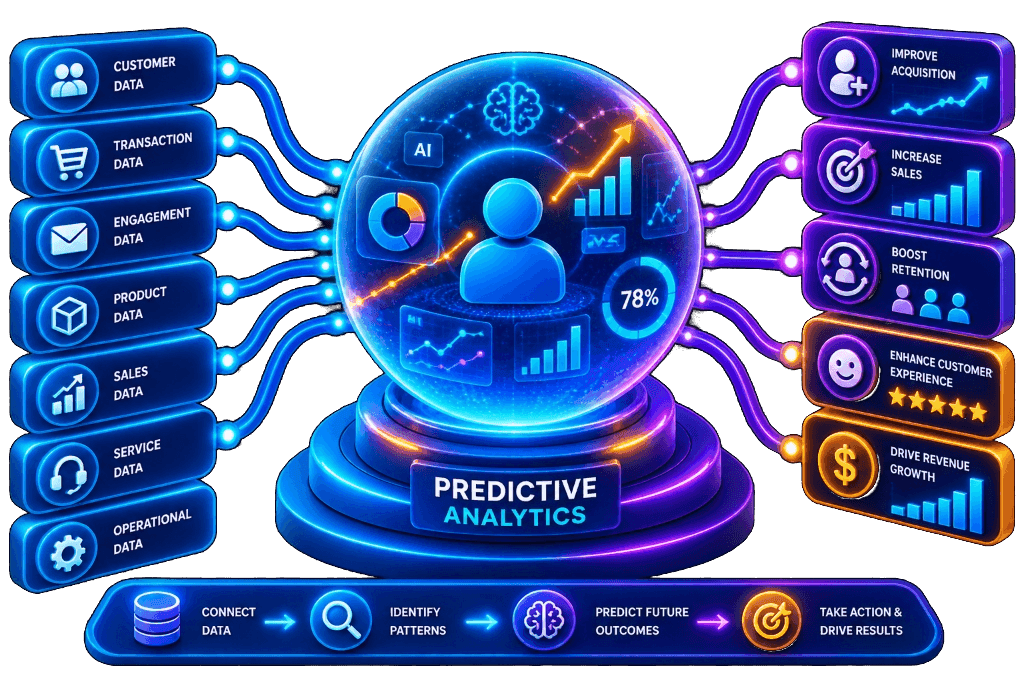
NuageCX helps businesses bring together relevant customer, transaction, engagement, product, sales, service, and operational data to build predictive analytics solutions that help teams understand what is likely to happen next and take appropriate action.
What Is Customer 360 Predictive Analytics?
Customer 360 Predictive Analytics uses historical and current customer data, statistical methods, and machine learning techniques to estimate the likelihood of future customer outcomes.
Customer Churn Prediction
Identify accounts exhibiting disengagement patterns before they cancel.
Purchase Propensity
Estimate the probability of a buyer making a purchase within a specific timeframe.
Renewal Prediction
Forecast contract and recurring subscription renewal likelihood with accuracy.
Lead Conversion Prediction
Rank and prioritize inbound leads based on historical progression odds.
CLV Prediction
Model multi-year revenue and net margin potential per customer account.
Cross Sell Prediction
Identify high-affinity product combinations and customer segments.
Upsell Prediction
Detect accounts reaching usage capacity or ready for premium enterprise tiers.
Engagement Prediction
Forecast future interaction cadence across email, digital channels, and apps.
Product Adoption Prediction
Estimate adoption speed and feature utilization for new releases.
Customer Risk Analysis
Score risk across payment delinquency, service dissatisfaction, and churn.
Demand Related Analysis
Align customer ordering forecasts with inventory, supply chain, and staff.
*Predictive analytics does not guarantee future outcomes. It provides data-driven estimates that should be continuously validated against actual business results.
Why Is Customer 360 Predictive Analytics Important?
Traditional reporting explains what has already happened. Predictive analytics empowers proactive organizational intervention:
Descriptive Analytics
What happened?
Aggregates historical transactions, campaign engagement logs, and past support tickets into backwards-looking reporting.
Diagnostic Analytics
Why did it happen?
Investigates root causes, friction points, and operational anomalies that explain past drop-offs or sales performance.
Predictive Analytics
What is likely to happen next?
Combines connected customer information with machine learning methods to anticipate customer outcomes and trigger proactive workflows.
What Does Customer 360 Predictive Analytics Include?
Ten specialized predictive analytics modules operating on connected customer data:
Customer Churn Prediction
Identify customers who have an increased likelihood of churn.
Purchase Propensity
Estimate the likelihood of a customer making a purchase.
Lead Conversion Prediction
Estimate the likelihood of leads progressing toward conversion.
Renewal Prediction
Analyze factors associated with contract renewal outcomes.
CLV Prediction
Estimate potential future lifetime customer economic value.
Cross Sell Prediction
Identify customers with potential interest in related offerings.
Upsell Prediction
Identify customers with potential for higher value products or tiers.
Product Adoption Prediction
Estimate adoption likelihood based on relevant customer behavior.
Engagement Prediction
Identify patterns associated with future interaction cadence.
Customer Risk Scoring
Prioritize customers according to defined predictive risk indicators.
How Does Customer 360 Predictive Analytics Work?
NuageCX executes a 12-step engineering and data science lifecycle for reliable predictive modeling:
Define Business Problem
Identify the exact commercial outcome the organization wants to predict.
Define Prediction Target
Specify the measurable outcome: Churn, Renewal, Purchase, Conversion, Expansion, Adoption.
Identify Relevant Data
Locate transaction, engagement, product, sales, and service logs across systems.
Integrate Customer Data
Connect relevant data sources into an authoritative modeling repository.
Resolve Customer Identity
Ensure all historical events are deterministically linked to the correct account.
Prepare the Data
Clean, standardize, transform, and structure information for algorithmic modeling.
Create Predictive Features
Engineer features containing historical predictive signal and domain context.
Build the Predictive Model
Apply appropriate statistical or machine learning classification/regression methods.
Validate the Model
Evaluate performance using out-of-time validation, precision, recall, and ROC AUC.
Deploy the Insights
Make predictions available in Zoho Analytics, CRM records, and automated triggers.
Monitor Performance
Continuously compare predicted probabilities against actual business outcomes.
Continuously Improve
Update features, retrain algorithms, and adjust thresholds as behavior changes.
Core Customer 360 Predictive Analytics Models
Validated statistical modeling across critical commercial transition gates:
Churn Prediction
Evaluates 9 critical historical variables:
- • Customer digital engagement
- • Product usage & login telemetry
- • Purchase frequency changes
- • Order monetary value shifts
- • Support tickets & escalations
- • Contract terms & renewal dates
- • Multi-year renewal history
- • Customer account tenure
- • B2B stakeholder interaction
Retention Prediction Workflow
7-stage operational retention sequence:
Purchase Propensity
Estimates purchase probability using 8 inputs:
- • Previous purchase history
- • Expressed product interests
- • Customer behavioral segment
- • Marketing channel engagement
- • Website session activity
- • In-app product usage
- • Order cadence frequency
- • Lifecycle progression stage
Lead Conversion Prediction
Prioritizes sales leads based on 8 variables:
- • Inbound lead acquisition source
- • Digital touchpoint engagement
- • Company & firmographic profile
- • Historical sales rep touchpoints
- • Sales stage progression velocity
- • Website visit content depth
- • Omnichannel communication cadence
- • B2B qualification criteria
Renewal & CLV Prediction
Forecasts long-term recurring revenue:
- • Contract renewal probability
- • Historical customer tenure
- • Product adoption depth
- • Multi-year purchase value
- • Support case resolution satisfaction
- • Account expansion history
- • Modeled future customer value
Cross-Sell & Upsell Prediction
Identifies expansion opportunities:
- • Product affinity clustering
- • Cross-sell propensity modeling
- • Premium plan adoption triggers
- • Additional license capacity demand
- • Expanded contract potential
- • Advanced functionality adoption
- • Account organizational growth
Predictive Analytics Across Departments
Tailored predictive intelligence for Marketing, Sales, Customer Service, and CX:
For Marketing
Prioritizes audiences by conversion propensity:
- • Predictive lead scoring
- • Purchase propensity targeting
- • Precision campaign targeting
- • Predictive customer segmentation
- • Future engagement prediction
- • Proactive retention campaigns
- • Targeted cross-sell offers
For Sales
Directs rep attention to high-probability deals:
- • Inbound lead prioritization
- • Deal opportunity prioritization
- • Conversion velocity prediction
- • Purchase propensity scoring
- • Account expansion alerts
- • Cross-sell opportunity leads
- • Upsell tier readiness
- • Account churn risk alerts
For Customer Service
Anticipates service bottlenecks and risk:
- • Customer churn risk detection
- • Escalation prioritization
- • Chronic repeat issue analysis
- • Proactive retention workflows
- • Support demand forecasting
- • Service experience enhancement
For Customer Experience
Removes friction before customers drop off:
- • Experience friction risk
- • Engagement decline detection
- • Service escalation risk
- • Dissatisfaction warning signals
- • Predicted customer churn
- • Predictive journey drop-off
Industry-Specific Predictive Analytics
Tailoring statistical methods to the unique commercial realities of different verticals:
E-commerce
Consumer digital transactions:
- • Purchase propensity
- • Next-best recommendations
- • Repeat purchase timing
- • Customer lifetime value
- • Cart abandonment prediction
- • Churn prediction
SaaS Businesses
Product telemetry models:
- • Free trial conversion
- • Feature adoption curves
- • Renewal probability
- • Churn risk alerts
- • License expansion potential
- • Usage drop-off risk
Manufacturing
Supply & fulfillment cycles:
- • Repeat order forecasting
- • Account retention risk
- • Customer demand patterns
- • Contract renewal timing
- • Account lifetime value
- • Service demand modeling
B2B Accounts
Dual Contact & Account Level:
- • Account stakeholder depth
- • Opportunity progression
- • Enterprise renewal odds
- • Multi-stakeholder intent
- • Contract expansion value
B2C Consumers
High-volume consumer trends:
- • Purchase cadence behavior
- • Product preferences
- • Consumer lifecycle transitions
- • Repeat re-order velocity
- • Individual churn scoring
Predictive Analytics in the Customer 360 Ecosystem
Connecting predictions with journey mapping, behavioral telemetry, segmentation, and automated workflows:
Journey & Behavioral Connections
Journey Analytics maps customer movement across stages.
Behavior Analytics identifies observed actions and event frequencies.
Predictive Analytics takes these inputs to forecast future outcomes:
Segmentation & Data Unification
Predictive scores create dynamic business cohorts (e.g. High Conversion Likelihood, High Churn Risk).
Data Unification ensures predictive algorithms train on accurate, non-duplicated Golden Records spanning CRM, ERP, Desk, and Product databases.
7 Machine Learning Approaches
Selecting the optimal algorithm based on data distributions and interpretability requirements:
Automated Predictive Workflows
Predictions become actionable when linked directly to business rules and execution engines:
*Automation is carefully governed, ensuring human oversight when predictions impact commercial commitments or customer contracts.
Predictive Dashboards & Core KPIs
Role-specific visual reporting command centers built on predictive scoring pipelines:
Executive Predictive Dashboard
- Aggregate customer risk
- Churn probability forecasting
- Contract renewal risk
- Customer lifetime value
- Forward revenue expansion
Marketing Predictive Dashboard
- Lead conversion likelihood
- Purchase propensity tiers
- Predictive audience segments
- Campaign revenue opportunity
- Engagement probability
Sales Predictive Dashboard
- Predictive lead scoring
- Opportunity close likelihood
- Account expansion propensity
- Cross-sell recommendations
- Upsell readiness indicators
Customer Success Dashboard
- Account churn risk alerts
- Feature adoption drop risk
- Renewal likelihood scores
- Customer engagement health
- Expansion opportunity flags
16 Core Predictive Analytics Evaluation KPIs:
Predictive Analytics Challenges
Predictive Analytics Best Practices
Predictive Analytics Implementation Roadmap
NuageCX executes structured, validated 11-phase predictive engineering roadmaps:
Phase 1: Use Case Definition
Select and define the specific commercial problem to solve.
Phase 2: Outcome Definition
Specify the exact prediction target and time horizon.
Phase 3: Data Discovery
Audit and catalog relevant customer and transaction records.
Phase 4: Data Integration
Harmonize data flows into a unified analytical repository.
Phase 5: Data Preparation
Clean, transform, impute, and structure data for model training.
Phase 6: Feature Development
Engineer predictive variables and domain-specific ratios.
Phase 7: Model Development
Build and compare multiple machine learning algorithms.
Phase 8: Model Validation
Evaluate performance against held-out validation datasets.
Phase 9: Business Integration
Connect predictions to Zoho Analytics, CRM fields, and alerts.
Phase 10: Monitoring
Track predictions vs real outcomes and monitor for model drift.
Phase 11: Continuous Optimization
Iterate algorithms, update features, and refine business rules.
How Much Does It Cost?
Investment is tailored based on model requirements and technical depth:
- Number of source data systems
- Historical data volume & quality
- Prediction use cases required
- Model complexity & AI methods
- Real-time scoring infrastructure
How Long Does It Take?
Deployment duration depends on organizational data readiness:
- Historical outcome data availability
- Customer identity resolution state
- Integration & feature engineering depth
- Operational workflow integration
A focused churn or lead scoring model can be delivered rapidly, expanding systematically into multi-model predictive automation.
7-Phase Iterative Rollout
When Should a Business Implement Predictive Analytics?
Key Conceptual Differences & FAQs
Clarifying core technical concepts:
Predictive vs. Customer Analytics
Customer Analytics primarily analyzes customer information to understand past behavior, performance, and trends.
Predictive Analytics focuses on estimating defined future outcomes using statistical modeling on historical and current data.
Predictive vs. Journey Analytics
Customer Journey Analytics analyzes how customers move through sequential lifecycle stages.
Predictive Analytics estimates future outcomes and drop-off risks based on relevant customer and journey telemetry.
Predictive vs. Behavior Analytics
Customer Behavior Analytics identifies and quantifies observed actions and event frequencies.
Predictive Analytics takes those behavioral patterns as inputs to predict defined future outcomes.
Predictive Analytics vs. Segmentation
Customer Segmentation groups customers according to shared historical attributes.
Predictive Analytics estimates the likelihood of future outcomes, creating forward-looking predictive segments.
Why Choose NuageCX for Predictive Analytics?
End-to-end data science engineering, unified data architecture, and turnkey Zoho Analytics deployment:
Connected Customer Data
Bring relevant customer information together across CRM, ERP, and operational tools.
Behavioral Intelligence
Use deep customer behavior logs as essential predictive modeling features.
Predictive Analytics
Support defined future outcome estimation models for acquisition, retention, and growth.
Churn & Retention Models
Analyze early attrition risk signals and trigger proactive customer workflows.
Purchase Propensity
Accurately score purchase likelihood across products, categories, and channels.
Lead & Conversion Scoring
Empower sales reps to focus on deals with the highest probability of closing.
Renewal Analytics
Support contract and subscription renewal forecasting with historical accuracy.
Cross-Sell & Upsell Models
Identify customers exhibiting strong propensity for account expansion.
Customer Lifetime Value (CLV)
Forecast long-term multi-year customer economic value and profitability.
AI & Machine Learning
Deploy appropriate classification, regression, and ensemble methods.
Zoho Analytics Expertise
Build interactive predictive dashboards and reports inside the Zoho ecosystem.
Turnkey Implementation
Full lifecycle support from use case discovery to deployment and continuous optimization.
Frequently Asked Questions
Everything you need to know about Customer 360 Predictive Analytics, modeling, and ROI.
Turn Customer Data Into Predictive Customer Intelligence
Customer data becomes significantly more valuable when businesses can use it to understand behavior, identify patterns, estimate future outcomes, and take timely action.