Customer 360 Customer Behavior Analytics Services
Understand what customers do, why their behavior changes, and how those behavioral patterns affect acquisition, conversion, retention, revenue, and customer experience with Customer 360 Customer Behavior Analytics.
NuageCX helps businesses analyze customer behavior across CRM, ERP, marketing, sales, customer service, e-commerce, websites, applications, portals, and other relevant business systems to create a connected view of customer interactions and behavior.
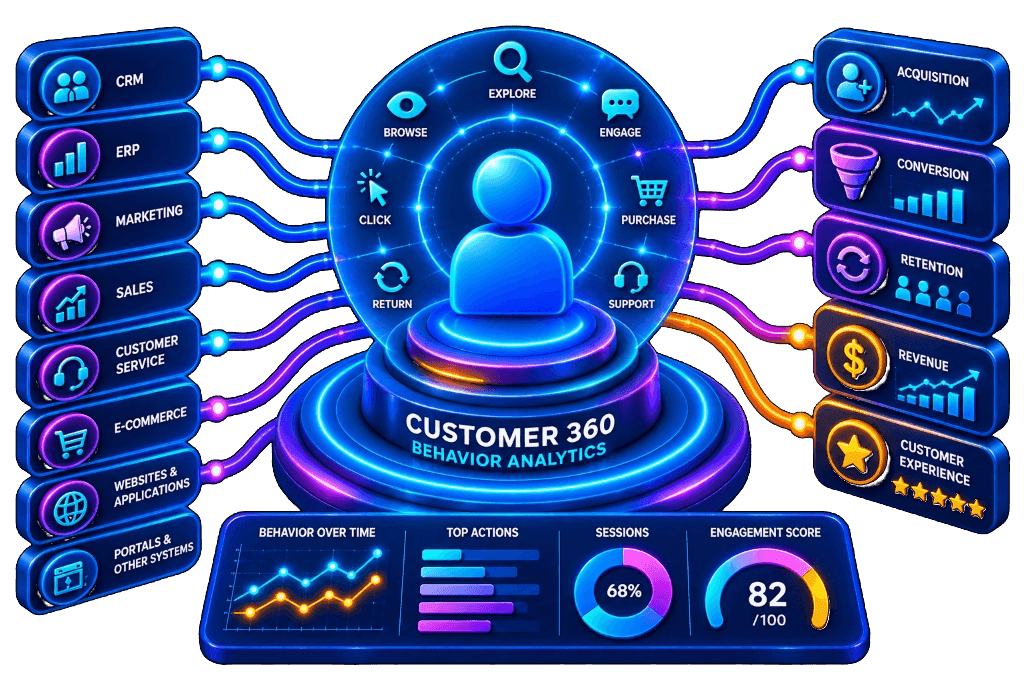
What Is Customer 360 Customer Behavior Analytics?
Customer 360 Customer Behavior Analytics is the analysis of customer actions and interactions using connected customer data from multiple business systems and touchpoints.
What Customers Do
Track exact interactions across web, mobile, and portals.
How Customers Interact
Evaluate response times, touchpoint cadence, and channels.
What Products They Use
Monitor feature engagement, active sessions, and depth.
What Customers Purchase
Analyze basket composition, order sizes, and velocity.
How Engagement Changes
Detect sudden shifts, usage surges, or inactivity.
Journey Progression
Understand movement through lifecycle gates.
Conversion Behaviors
Isolate actions strongly linked to completed deals.
Retention Behaviors
Observe healthy ongoing interaction benchmarks.
Churn Indicators
Identify silent attrition patterns before cancellation.
Expansion Signals
Detect usage capacity limits and cross-sell intent.
The objective is to turn customer behavior data into actionable business insights that drive acquisition, retention, and growth.
Why Is Customer Behavior Analytics Important?
Customer behavior is fragmented across transactional, commercial, and operational systems. Unifying these streams delivers holistic analytical clarity:
Customer & sales rep activity
Transaction & financial records
Campaign engagement & clicks
Support tickets & cases
Feature usage & session telemetry
Customer 360 Behavior Analytics Empowers Organizations To:
What Does Customer 360 Behavior Analytics Include?
A comprehensive Customer 360 behavior analytics framework encompasses 12 operational dimensions:
Purchase Behavior
Analyze customer purchasing patterns, order volume, and payment recency.
Product Usage
Analyze feature adoption, session frequency, and active utilization depth.
Engagement Behavior
Analyze customer engagement across email, portals, and direct touchpoints.
Website Behavior
Analyze digital navigation, search queries, form fills, and clicks.
Marketing Behavior
Analyze campaign responses, webinar attendance, and content consumption.
Sales Behavior
Analyze customer interactions with account executives and sales engineers.
Service Behavior
Analyze support ticket frequency, escalation rates, and sentiment.
Account Behavior
Analyze multi-contact organizational activity across B2B account hierarchies.
Lifecycle Behavior
Analyze behavioral changes throughout the progression of the customer lifecycle.
Retention Behavior
Identify recurring patterns strongly associated with retained customers.
Churn Behavior
Identify early attrition patterns associated with disengagement and churn.
Expansion Behavior
Analyze behavior associated with cross sell and upsell opportunities.
How Does Customer 360 Behavior Analytics Work?
An 11-step structured operational approach for continuous behavioral intelligence:
Define Business Objective
Determine what specific customer behavior needs to be understood or influenced.
Identify Relevant Behaviors
Define key customer actions, interactions, and events that matter to KPIs.
Identify Data Sources
Locate relevant behavioral event logs across CRM, ERP, web, and apps.
Connect Customer Records
Resolve customer identities across fragmented cookies, emails, and accounts.
Standardize Behavioral Events
Create consistent definitions and timestamps for customer actions.
Organize Behavioral Data
Structure information by customer, account, product, channel, and stage.
Analyze Behavioral Patterns
Identify trends, cohort differences, statistical correlations, and anomalies.
Segment Customers
Create meaningful operational groups based on shared behavioral characteristics.
Build Analytics & Dashboards
Deploy dashboards, executive reports, and frontline operational views.
Activate Insights
Use behavioral insights in marketing campaigns, sales triggers, and CX actions.
Continuously Monitor
Track shifts in customer behavioral patterns over time and refine algorithms.
Types of Customer Behavior Analytics
Five core analytical categories covering transactions, digital usage, engagement, and support:
Purchase Behavior
- Purchase frequency
- Purchase monetary value
- Recency of transaction
- Product combinations
- Repeat purchase rates
- Order cadence patterns
- Average order value (AOV)
Product Usage
- Specific feature usage
- Product adoption curves
- Session usage frequency
- Usage duration / time
- Advanced feature engagement
- Longitudinal adoption shifts
Engagement Behavior
- Email opens & clicks
- Website browse sessions
- Campaign interactions
- Portal self-service usage
- Mobile application usage
- Direct communications
Service Behavior
- Support case frequency
- Case filing velocity
- First-contact resolutions
- Escalation requests
- Service request patterns
- Chronic repeat issues
Sales Interactions
- Sales meeting attendance
- Phone call frequency
- Product demonstrations
- Proposal reviews
- Opportunity velocity
- Account stakeholder depth
Customer 360 Behavioral Segmentation
Behavioral analytics creates operational customer segments defined by measurable action criteria:
Highly Engaged Customers
Customers demonstrating consistently high engagement across touchpoints.
Growing Customers
Customers whose activity, seat count, or transaction value is steadily increasing.
Declining Customers
Customers showing declining login cadence, fewer transactions, or reduced activity.
Inactive Customers
Customers with limited or zero recent activity over a defined monitoring window.
Frequent Buyers
Customers with high purchase frequency and consistent repeat ordering behavior.
High Value Customers
Customers with high observed historical spend or modeled high lifetime value (CLV).
Expansion Ready Customers
Customers displaying behavioral signals matching potential cross sell or upsell triggers.
At Risk Customers
Customers displaying validated behavioral indicators associated with increased churn risk.
Customer 360 Behavioral Pattern Analysis
Businesses can systematically detect and validate 9 critical behavioral shifts:
*Behavioral patterns are statistically validated against historical business outcomes before being treated as predictors of future behavior.
Customer Behavior Across 9 Journey Stages
Customer behavior evolves across each distinct phase of the customer journey:
Awareness
Analyze initial engagement, search query intent, ad click patterns, and referral sources.
Consideration
Analyze educational content interactions, whitepaper downloads, and product page comparisons.
Evaluation
Analyze product demonstration requests, digital trial usage depth, and sales rep dialogues.
Purchase
Analyze transaction timing, checkout flow completion, payment method, and pricing tier chosen.
Onboarding
Analyze initial setup milestones, configuration velocity, and early user activation.
Adoption
Analyze steady-state feature usage, user license utilization, and workflow habituation.
Retention
Analyze ongoing account health, periodic portal logins, and regular re-ordering.
Renewal
Analyze contract renewal timing, negotiation milestones, and stakeholder continuity.
Expansion
Analyze license capacity exhaustion, API query surges, and cross-sell inquiry signals.
Customer Behavior Analytics for Departments
Tailored behavioral intelligence for Marketing, Sales, Customer Service, and CX:
For Marketing
Enables precision targeting & campaign ROI:
- • Campaign engagement
- • Content consumption
- • Email click behavior
- • Website navigation
- • Inbound lead behavior
- • Cross-channel touchpoints
- • Purchase behavior
- • Behavioral segment response
For Sales
Helps reps prioritize high-intent accounts:
- • Account engagement
- • Opportunity activity
- • Purchase history
- • Product adoption depth
- • Modeled customer value
- • Sales interaction velocity
- • Expansion propensity
For Customer Service
Supplies complete behavioral context:
- • Support case frequency
- • Common issue categories
- • Product problem trends
- • Resolution patterns
- • Escalation triggers
- • Chronic repeat cases
- • Overall customer sentiment
For Customer Experience
Identifies friction & effort barriers:
- • Cross-touchpoint interactions
- • Channel switching patterns
- • Journey progression friction
- • Drop-off velocity
- • Engagement fluctuations
- • Service experience gaps
- • Customer effort indicators
Behavioral Retention Sequence
Illustrative behavioral changes preceding attrition:
7 Historical Churn Variables
Variables evaluated to establish validated churn risk models:
- Digital engagement velocity
- Product usage & login telemetry
- Purchase frequency changes
- Customer service escalation history
- Contract terms & renewal timing
- Key stakeholder communication cadence
- Historical customer value
Cross-Sell & Upsell Signals
Behavioral indicators that trigger expansion campaigns:
Contribution to Customer Lifetime Value (CLV)
Behavioral data—including purchase frequency, transaction value, retention duration, product adoption rate, engagement stability, and expansion history—serves as the primary forward-looking input for enterprise Customer Lifetime Value forecasting.
Industry-Specific Customer Behavior Analytics
Tailored behavioral analytics models designed for specific commercial architectures:
B2B Accounts
Multi-stakeholder buying dynamics:
- • Account engagement
- • Contact activity
- • Opportunity progression
- • Product usage depth
- • Contract renewal activity
B2C Consumers
High-volume consumer trends:
- • Browsing behavior
- • Direct transactions
- • Product preferences
- • Repeat re-orders
- • Customer loyalty & CLV
E-commerce
Online cart & browse funnel:
- • Product views & search
- • Cart abandonment
- • Checkout velocity
- • Average order value
- • Purchase cadence
SaaS Products
Digital feature adoption:
- • Login frequency
- • Feature adoption depth
- • Trial conversion signals
- • Active license seats
- • Subscription renewal
Manufacturing
Industrial re-order cycles:
- • Re-order frequency
- • Product mix evolution
- • Account re-orders
- • Warranty service needs
- • Annual supply contracts
Behavior Analytics in the Customer 360 Ecosystem
How behavior analytics connects with segmentation, journeys, integration, and unification:
Behavioral Analytics & Segmentation
Behavior Analytics understands what customers do.
Behavioral Segmentation groups customers according to shared actions:
Behavior & Journey Analytics
Customer Journey Analytics analyzes how customers move through sequential lifecycle stages.
Customer Behavior Analytics focuses on specific actions performed throughout those stages. Together, they provide holistic intelligence.
Behavior & Data Integration
Connects interaction records from CRM, ERP, Marketing, Sales, Desk, E-commerce, Product telemetry, and Web analytics into an unified behavioral bus.
Behavior & Data Unification
Unification resolves customer identities across cookies, emails, and device IDs so that behavioral events are mapped accurately to the Golden Customer Record.
AI Capabilities
- Behavioral clustering & cohorts
- Anomaly & fraud detection
- Predictive churn modeling
- Personalized recommendations
- Purchase propensity analysis
Predictive Outcomes
- Churn prediction models
- Purchase propensity scoring
- Contract renewal likelihood
- Account expansion potential
- Forward customer value projection
Real-Time Actions
Triggered when behavior changes rapidly:
- Live website browse triggers
- Product usage drop alerts
- Fraud / anomaly flags
- Automated service workflows
Customer Behavior Dashboards & Core KPIs
Role-specific visual reporting command centers built on unified behavioral events:
Executive Behavior Dashboard
- Overall customer engagement
- Customer value trends
- Retention & churn health
- Expansion velocity
- Longitudinal behavioral trends
Marketing Behavior Dashboard
- Campaign engagement rates
- Content interaction depth
- Behavioral segment growth
- Lead-to-customer conversion
- Channel response trends
Sales Behavior Dashboard
- Account engagement score
- Opportunity interaction velocity
- Product adoption depth
- Customer value expansion
- Expansion readiness indicators
Service Behavior Dashboard
- Support ticket volume trends
- Chronic repeat case drivers
- First-contact resolution velocity
- Post-service engagement
- Escalation patterns
16 Core Customer Behavior KPIs:
Customer Behavior Analytics Challenges
Customer Behavior Best Practices
Customer Behavior Analytics Implementation Roadmap
NuageCX executes structured 10-phase implementations to deliver reliable behavioral insights:
Phase 1: Business Use Case
Define specific customer behavioral questions and commercial objectives.
Phase 2: Event Discovery
Catalog critical customer actions across digital, sales, and service channels.
Phase 3: Data Source Mapping
Map where interaction and transaction logs reside across business systems.
Phase 4: Identity Resolution
Connect disjointed user sessions, emails, and account records into one profile.
Phase 5: Data Standardization
Establish consistent event schemas, naming taxonomies, and timestamps.
Phase 6: Behavioral Modeling
Organize structured event tables for multi-dimensional querying.
Phase 7: Segmentation & Analysis
Identify actionable behavioral clusters, correlations, and trends.
Phase 8: Dashboard Deployment
Build tailored reporting command views in Zoho Analytics.
Phase 9: Process Activation
Trigger proactive marketing, sales alerts, and support interventions.
Phase 10: Continuous Optimization
Refine behavioral metrics and predictive scoring models periodically.
How Much Does It Cost?
Investment is tailored based on technical scope and system complexity:
- Number of source data systems
- Event taxonomy volume
- Data hygiene & unification needs
- Real-time vs batch architecture
- Predictive AI & governance requirements
How Long Does It Take?
Project duration depends on operational readiness:
- Data source accessibility & APIs
- Identity resolution complexity
- Number of analytical use cases
- Stakeholder dashboard requirements
A focused behavioral pilot (e.g. Churn or Engagement Analytics) can be delivered rapidly, expanding systematically across the enterprise.
6-Phase Iterative Rollout
When Should a Business Implement Customer Behavior Analytics?
Key Conceptual Differences & Architectural Answers
Differentiating core analytical disciplines:
Behavior vs. Journey Analytics
Behavior Analytics examines specific customer actions, frequency, and event interactions.
Journey Analytics tracks how customers move sequentially through lifecycle stages. They complement each other.
Behavior Analytics vs. Segmentation
Behavior Analytics analyzes customer activities over time.
Behavioral Segmentation groups customers into cohorts based on shared action patterns.
Behavior vs. Experience Analytics (CX)
Behavior Analytics observes measurable actions and system telemetry.
Customer Experience Analytics examines satisfaction, customer effort scores (CES), sentiment, and perceived service quality.
Behavior Analytics vs. Customer Profiling
Customer Profiling describes demographic, firmographic, and static attributes.
Behavior Analytics analyzes dynamic actions and event interactions over time.
Why Choose NuageCX for Customer Behavior Analytics?
Specialized expertise in behavioral data modeling, advanced BI engineering, and turnkey Zoho Analytics deployment:
Connected Customer Behavior
Analyze customer actions across CRM, ERP, web, mobile, and support applications.
Behavioral Segmentation
Create actionable cohorts based on dynamic engagement, RFM, and usage criteria.
Customer Journey Intelligence
Connect behavioral event streams directly with lifecycle progression stages.
Marketing Behavior Analytics
Evaluate full-funnel content engagement, digital attribution, and campaign response.
Sales Behavior Analytics
Analyze B2B account activity, sales interaction cadence, and expansion indicators.
Service Behavior Analytics
Examine support frequency, repeat case drivers, and customer issue resolution patterns.
Retention & Churn Analytics
Detect early attrition warning signals to trigger proactive retention workflows.
Cross-Sell & Upsell Analytics
Identify behavioral patterns strongly correlated with customer expansion propensity.
Predictive Analytics
Deploy validated machine learning models for purchase propensity and churn risk.
Zoho Analytics Mastery
Deep ecosystem integration across Zoho CRM, Zoho Desk, Zoho Books, and Zoho Creator.
Turnkey Implementation
Full lifecycle delivery from event discovery to dashboards and ongoing optimization.
Frequently Asked Questions
Everything you need to know about Customer 360 Customer Behavior Analytics, architecture, and ROI.
Turn Customer Behavior Into Actionable Customer Intelligence
Customer behavior becomes more valuable when it is connected across systems, analyzed in context, and translated into measurable business actions.