Customer 360 Architecture Consulting Services
Design the Architecture Behind a Connected Customer Ecosystem
A Customer 360 strategy defines what an organization wants to achieve. A roadmap defines what should happen and when. Architecture defines how the systems, data, processes and integrations should work together.
Without the right architecture, businesses end up with disconnected applications, duplicated customer data, fragile integrations, and expensive customizations. NuageCX helps businesses design Customer 360 architectures that connect relevant customer, operational, and transactional systems while keeping scalability, data ownership, integration, automation, and customer experience in focus.
The architecture covers CRM, ERP, customer data, marketing, service, customer success, analytics, automation, APIs, data flows, and reporting. The objective is not simply to connect more systems, but to enable reliable customer visibility, efficient processes, and scalable customer experiences.
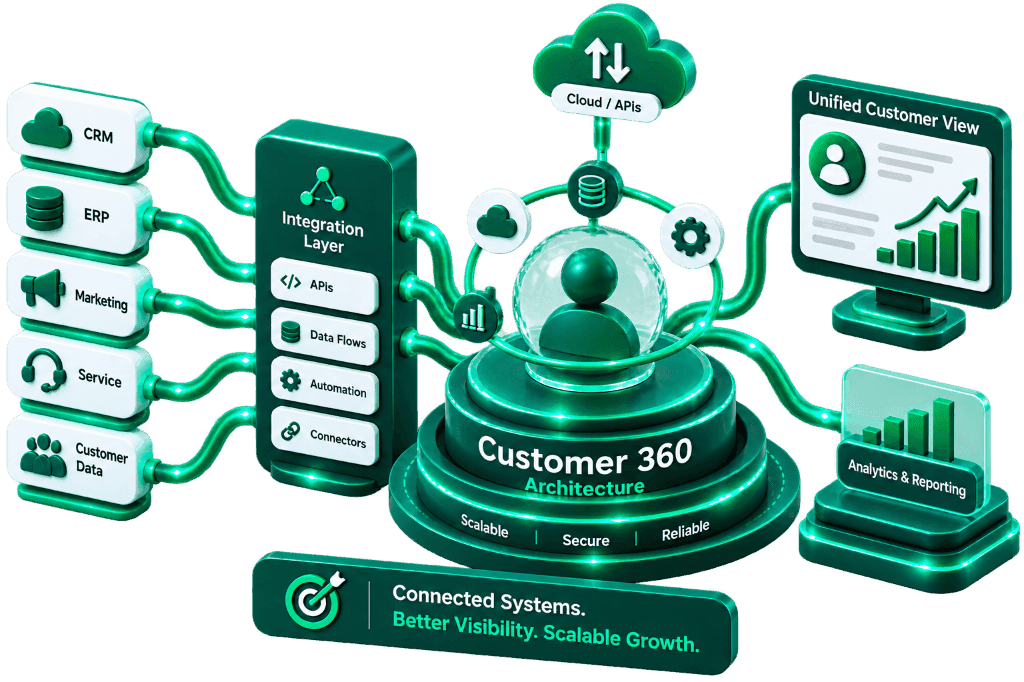
What Is Customer 360 Architecture?
Customer 360 architecture defines how the systems, applications, data, integrations, and processes required to create a connected customer view work together. It establishes the foundational rules governing multi-system cohesion:
9 Core Architectural Principles Established by NuageCX:
System Boundary Definition
Clearly articulating which systems are involved in customer operations.
Domain Data Ownership
Establishing exactly which application is authoritative for specific customer fields.
Data Origination & Ingestion
Mapping where customer records originate across web, rep, or ERP entry.
Transit & Synchronization Flows
Governing how data synchronizes via real-time webhooks or batch sync.
Consumption Points
Defining which downstream apps consume customer profiles and context.
Business Logic Residence
Deciding where validation, pricing rules, and CPQ logic must operate.
Process Automation Topology
Placing workflow triggers in the right engine without duplication.
Analytics Data Access
Enabling reporting engines to extract clean customer intelligence.
Multi-Year Elastic Scaling
Ensuring the architecture absorbs 10x record growth without degradation.
Unifying 6 Disconnected Enterprise System Domains:
Customer information rarely exists in one place. Architecture brings them into alignment:
CRM System
Leads, contacts, accounts, and deal pipelines.
ERP System
Orders, invoices, inventory, and payment transactions.
Customer Service
Support tickets, SLA logs, and customer conversations.
Marketing Stack
Inbound campaigns, behavioral clicks, and form submissions.
Customer Success
Product telemetry, onboarding checklists, and account health.
Analytics & BI
Cross-system executive dashboards and predictive modeling.
What Does Customer 360 Architecture Include?
Our consulting engagements define 8 interconnected technical disciplines:
Customer Data Architecture
Defines how customer information is structured, stored, governed, and accessed across databases.
Application Architecture
Defines which operational applications support specific business capabilities and user personas.
Integration Architecture
Defines how software applications exchange information via point-to-point, middleware, or event brokers.
Data Flow Architecture
Defines how customer records, updates, and events move through ingestion, transformation, and storage.
Automation Architecture
Defines where workflow business logic operates to prevent duplicated execution and conflicting triggers.
Analytics Architecture
Defines how raw transactional and interaction data becomes actionable executive intelligence.
API Architecture
Defines endpoints, authentication protocols, schemas, rate limits, and monitoring pipelines.
Security & Governance
Defines role-based access, data privacy compliance, encryption standards, and audit trails.
The 5 Customer 360 Architecture Layers
A layered architecture prevents systems from devolving into a tangled web of ad-hoc point-to-point integrations:
Where customers directly interact with the brand: Website, forms, chat, email, portals, sales reps, support tickets, and mobile apps.
Specialized platforms executing departmental capabilities: CRM (sales/leads), ERP (finance/orders), Customer Desk (support), and Marketing Automation.
Programmatic connections routing information between systems: REST APIs, webhooks, iPaaS middleware, message queues, and event streams.
Centralized, governed customer data model: Master accounts, unified contacts, historical transactions, support logs, and interaction timelines.
Reporting engines and BI dashboards transforming connected customer data into real-time operational insights and predictive decision-making.
How Do You Design a Customer 360 Architecture?
Our proven 10-step methodology bridges business strategy with high-fidelity technical system architecture:
Business Discovery
Anchor architecture in corporate goals: churn reduction, sales velocity, and scalable CX.
Journey Mapping
Map customer touchpoints across Lead ➔ Sales ➔ Order ➔ Onboarding ➔ Service ➔ Renewal.
Systems Inventory
Document active applications, databases, point-to-point APIs, spreadsheets, and manual steps.
System Ownership
Determine authoritative System of Record (SoR) boundaries for relationship, transactional, and support data.
Data Flow Mapping
Map where records originate, transform, synchronize, and get consumed downstream.
Integration Scoping
Identify true integration requirements, avoiding unnecessary direct connections.
Target Architecture
Draft high-fidelity solution blueprints specifying data schemas, APIs, and middleware.
Scalability Testing
Stress-test topology against 10x customer, user, and transactional volume growth.
Security Governance
Define role-based permissions, data encryption, compliance (GDPR/SOC2), and audit logs.
Roadmap Translation
Convert architectural blueprints into phased, multi-quarter implementation sprints.
Customer 360 Data Architecture & Single Source of Truth
Data is the bedrock of Customer 360. A sound architecture establishes authoritative ownership rather than forcing one tool to be everything:
Customer Identity Resolution
Unique identifiers across accounts, contacts, and lead profiles preventing duplicate entity sprawl.
Authoritative Data Ownership
Explicitly defining which platform owns specific fields (e.g. billing address vs. sales contact).
Data Quality & Deduplication
Rules enforcing format consistency, automated deduplication filters, and mandatory fields.
Bi-Directional Synchronization
Determining sync triggers, field mapping, and conflict resolution rules between platforms.
Team & Role Accessibility
Governing which departments and applications have read, edit, or administrative rights.
Data Governance & Lifecycle
Policies governing archival schedules, data retention periods, and privacy compliance.
The Reality of Single Source of Truth (SSoT)
Different systems are authoritative for different functional domains. Architecture defines clean boundaries:
Customer 360 Integration Architecture
Systems should communicate via the right architectural pattern based on data volume, frequency, and criticality:
CRM & ERP Integration Architecture
Connecting relationship and operational transaction data provides front-line reps with complete financial context:
Customer 360 API & Automation Architecture
Workflows and APIs must be placed at the right tier in the architecture to avoid racing conditions and duplicated execution:
Lead Capture to Rep Engagement
Won Opportunity to Onboarding
Customer 360 Architecture for Zoho
A Zoho architecture determines how multiple Zoho applications work together within the broader enterprise ecosystem:
*We establish which apps are required, authoritative data ownership, integration flows, and analytics models.
Architecture for Existing Technology Environments
We evaluate your existing software stack and classify each platform's strategic disposition:
Architecture Audit vs. Consulting vs. Roadmap
Understanding how architecture services coordinate to deliver enterprise transformation:
Answers:
- • How does the current architecture work?
- • Where are the technical and structural gaps?
- • What integrations are failing or fragile?
- • Where is duplicate data originating?
Answers:
- • What should the target architecture look like?
- • How should systems, data, and APIs connect?
- • Which system owns which customer data?
- • How will the topology scale over 5 years?
Answers:
- • How do we move from current to target state?
- • What technical dependencies come first?
- • What is the multi-phase rollout sequence?
- • How is change managed across teams?
8 Common Customer 360 Architecture Mistakes Avoided by NuageCX:
Why Choose NuageCX for Architecture Consulting?
Business and technology alignment from architects who build and maintain enterprise systems:
Business & Tech Alignment
We connect architecture decisions to revenue goals and customer retention metrics.
CRM & ERP Synergy
We consider customer relationship data and financial transactions together in one topology.
Data-First Thinking
Architecture built around data ownership, hygiene, accessibility, and real-time sync.
Pragmatic Integration
We evaluate how systems communicate without assuming every app needs a direct connection.
Zoho Premium Partner
Deep knowledge designing multi-app architectures across Zoho One, Books, CRM, and Desk.
Custom App Capability
Where standard platforms fail, custom web portals, middlewares, and APIs are evaluated.
Roadmap Alignment
Architecture blueprints connect directly into phased implementation transformation waves.
Zero-Risk Governance
Security, compliance (SOC2/GDPR), and access controls built into the core data fabric.
15 Tangible Deliverables Produced by Architecture Consulting:
Customer 360 Advisory Practices
Explore interconnected consulting disciplines across the Customer 360 Strategy & Consulting pillar:
Customer 360 Strategy & Consulting
Parent Pillar: Strategic planning, architecture, and roadmaps.
Customer 360 Strategy Consulting
Cluster 1: Business operating model & journey alignment.
Customer 360 Assessment & Audit
Cluster 2: Quantitative audit of data, journeys, and systems.
Customer 360 Roadmap & Transformation
Cluster 3: Prioritized transformation sequencing and milestones.
Customer 360 Implementation
Transform defined Customer 360 architectures into operational reality.
Customer 360 Integration
Connect CRM, ERP, finance, and marketing systems seamlessly.
Frequently Asked Questions
Authoritative answers to common questions regarding Customer 360 architecture consulting:
Start Designing Your Customer 360 Architecture
A connected customer experience requires more than connecting applications. It requires the right systems, data ownership, integrations, processes, and architecture. NuageCX can help assess your existing environment and design a Customer 360 architecture aligned with your business objectives, customer journeys, and transformation roadmap.