Customer 360 Assessment & Audit Services
Identify Gaps Across Your Customer Data, Systems, Processes and Customer Journey
A Customer 360 initiative can fail before implementation begins if the current environment is not properly understood. Customer information may exist across CRM, ERP, marketing, service platforms, spreadsheets, and custom applications.
Different teams may follow different processes. Data may be duplicated. Integrations may be incomplete. Reporting may not provide the visibility leadership needs. A Customer 360 Assessment & Audit provides a structured view of the current environment before transformation decisions are made.
NuageCX assesses your customer journeys, business processes, data, applications, integrations, automation, and analytics to identify gaps, risks, and opportunities. The outcome is a clear understanding of: Where you are today, What is preventing a connected customer experience, What should change, What should be prioritized, and What should happen next.
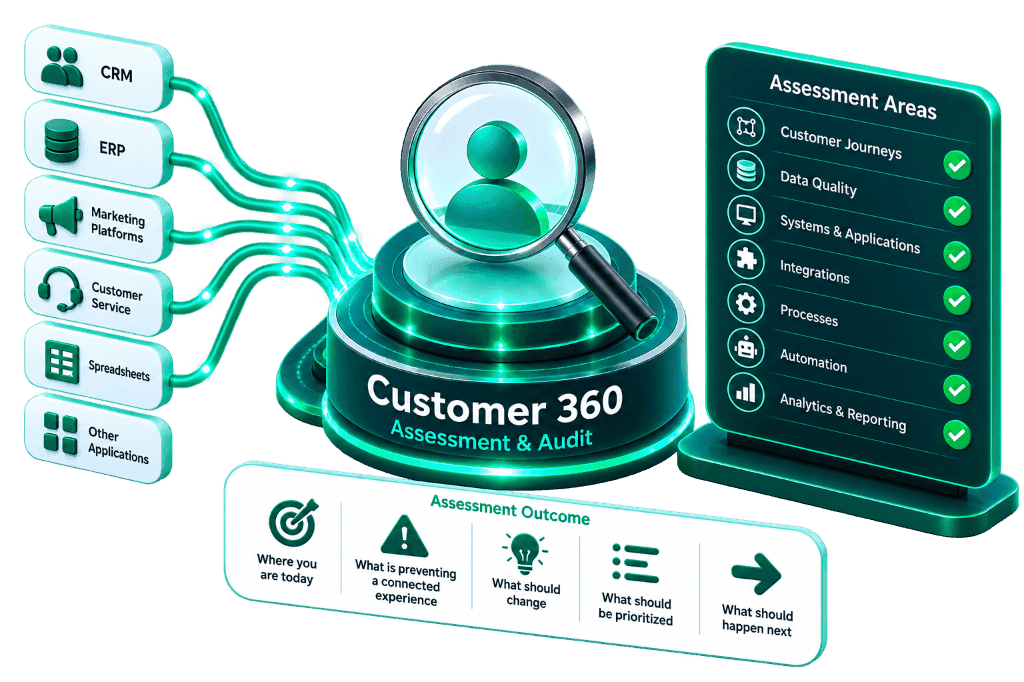
What Is a Customer 360 Assessment & Audit?
A Customer 360 assessment evaluates how effectively an organization currently manages customer information and customer interactions across departments, processes, and technology systems.
15 Key Areas Evaluated During the Assessment:
Data Gaps
Missing, incomplete, or uncollected customer fields.
Duplicate Records
Redundant customer, lead, and account entities.
Process Bottlenecks
Inefficient manual handoffs between departments.
System Silos
Isolated CRM, ERP, and service applications.
Integration Gaps
Missing, failing, or slow batch data sync flows.
Automation Omissions
High-value tasks still executed manually.
Reporting Limits
Lack of executive cross-departmental dashboards.
CX Inconsistencies
Fragmented customer touchpoints and communication.
Tech Redundancies
Overlapping software licenses and subscriptions.
Governance Risks
Undefined ownership, security, and privacy compliance.
Scalability Risks
Architecture unable to absorb 5x–10x transaction growth.
Target State Blueprint
Clear transformation path from current to desired state.
*The purpose of an audit is to identify the precise difference between the current state and the desired Customer 360 environment before committing budget to software or custom development.
Why Conduct an Assessment Before Implementation?
Implementing technology without assessing the current environment can create costly technical debt. An assessment prevents 8 major implementation blunders:
Unnecessary Integrations
Connecting systems that should never have exchanged data, creating maintenance debt.
Premature System Replacement
Replacing software that could have easily been optimized through reconfiguration.
Automating Broken Processes
Speeding up broken workflows, making departmental errors occur faster.
Migrating Dirty Data
Moving duplicate, outdated, and unformatted records into a clean target platform.
Duplicate Entity Sprawl
Creating split records for the same customer due to lack of match rules.
Costly Customizations
Writing expensive custom code when standard off-the-shelf features existed.
Missed Journey Gaps
Fixing software features while ignoring critical customer drop-off points.
Wrong Tech Selection
Buying platforms based on vendor demos rather than actual operational requirements.
What Does a Customer 360 Assessment Cover?
Our deep diagnostic covers 11 interconnected operational layers:
Customer Journey Mapping
We examine how customers move across Awareness ➔ Lead ➔ Sales ➔ Purchase ➔ Onboarding ➔ Service ➔ Success ➔ Renewal ➔ Expansion.
Customer Touchpoint Audit
Identification of all digital and physical channels: Website, forms, email, sales calls, chat, support tickets, portals, and account reviews.
Business Process Assessment
End-to-end review of operational workflows: Lead management, CPQ, order fulfillment, customer onboarding, SLA tracking, and renewal management.
Customer Data Inventory
Cataloging customer records, contacts, parent accounts, transactional records, interaction logs, support tickets, and marketing signals.
Data Quality & Hygiene
Quantitative audit identifying duplicate records, missing fields, non-standard formats, obsolete contacts, and conflicting profile data.
Data Ownership & Lineage
Determining System of Record (SoR) for each attribute, which team updates it, where records originate, and how downstream apps consume it.
CRM Configuration & Usage
Reviewing pipeline stages, contact modules, workflow rules, blueprint transitions, user adoption rates, and sales reporting accuracy.
ERP Operational Context
Auditing order fulfillment, item masters, stock inventory, invoices, accounts receivable, and credit limits relevant to customer-facing teams.
Integration & API Topology
Evaluating existing API connections, batch schedules, webhooks, point-to-point dependencies, sync delays, and integration failures.
Automation Opportunities
Pinpointing repetitive manual tasks suitable for automation: Lead distribution, status updates, SLA notifications, and customer surveys.
Analytics & Telemetry
Reviewing executive visibility into customer acquisition cost (CAC), lifetime value (LTV), retention velocity, churn signals, and pipeline health.
Architecture & Scalability
Holistic evaluation of software stack elasticity, security compliance, data privacy readiness, and multi-year architectural sustainability.
Customer 360 Gap Analysis & Maturity Framework
Comparing your Current State against the Desired Target State across 5 maturity tiers:
Data Gaps
Information that is missing, inaccessible, or unreliable.
Process Gaps
Activities that create delays, rework, or customer friction.
Technology Gaps
Applications that cannot support current requirements.
Integration Gaps
Disconnected systems operating as isolated islands.
Automation Gaps
Workflows depending unnecessarily on manual labor.
Analytics Gaps
Business questions current reporting cannot answer.
Experience Gaps
Touchpoints that feel disjointed to the customer.
Governance Gaps
Unclear ownership, retention, and security rules.
Customer 360 Maturity Matrix: 5 Progressive Tiers
Fragmented
Customer info distributed across disconnected systems, spreadsheets, and teams with zero unified visibility.
Connected
Some core systems and processes integrated via point-to-point sync, but customer view remains partial.
Unified
Critical customer data connected across CRM, ERP, and service functions into a consolidated single source.
Intelligent
Unified data supports automated triggers, proactive SLA alerts, predictive churn scoring, and advanced analytics.
Optimized
Data, journeys, processes, and tech stacks continuously self-optimize around measurable business revenue outcomes.
*The maturity model serves as a strategic roadmap framework to sequence initiatives rather than a rigid scorecard.
Customer 360 Readiness Assessment
Evaluating organizational preparedness across 8 critical dimensions before rollout:
Business Readiness
Are executive goals and ROI expectations clearly quantified?
Process Readiness
Are customer workflows documented and standardized across teams?
Data Readiness
Is customer data sufficiently accurate, deduplicated, and accessible?
Technology Readiness
Can existing CRM/ERP platforms support modern API integration?
Integration Readiness
Do target systems support webhooks and bi-directional synchronization?
User Readiness
Are front-line reps and agents trained and prepared for change?
Governance Readiness
Are data ownership, security policies, and access controls established?
Measurement Readiness
Are KPIs, telemetry pipelines, and success scorecards defined?
Deep-Dive System & Architecture Audits
Empirical evaluation of each application in your technology landscape:
Technology Audit
Classifying each software application:
CRM Deep Audit
Investigating platform usage & adoption:
ERP & Integration Audit
Auditing cross-system data movement:
Customer 360 Assessment for Zoho Environments
Organizations using multiple Zoho applications require an ecosystem-level audit to assess how they support the customer lifecycle:
Assessment for Existing Technology Environments
Customer 360 assessments evaluate the complete customer ecosystem regardless of your technology stack:
How Is a Customer 360 Assessment Conducted?
Our proven 12-step audit methodology takes organizations from initial discovery to a prioritized roadmap:
Business Discovery
Understand business goals, growth plans, and transformation targets.
Stakeholder Interviews
Gather operational requirements from sales, service, marketing, and IT.
Journey Mapping
Document customer interactions across all stages and touchpoints.
Process Review
Analyze workflows, approvals, handoffs, and customer delay points.
Data Review
Assess data sources, duplicate records, hygiene, and field coverage.
Technology Audit
Evaluate CRM, ERP, finance, service desk, and custom code.
Integration Review
Analyze existing APIs, webhooks, middleware, and sync reliability.
Automation Review
Identify high-value tasks currently consuming manual rep hours.
Gap Analysis
Compare Current State against Target Operating Model.
Impact Prioritization
Rank findings by commercial value, complexity, and quick wins.
Recommendations
Define actionable, technology-agnostic architectural fixes.
Roadmap Delivery
Deliver a phased, multi-quarter Customer 360 transformation plan.
10 Tangible Deliverables Produced by the Assessment:
Customer 360 Assessment vs. Strategy vs. Audit
Understanding how assessment, audit, and strategy interconnect:
Diagnostic Questions:
- • Where are we today?
- • What is working well?
- • What is causing bottlenecks?
- • Where are the critical gaps?
Deep Forensic Focus:
- • Data quality & duplicates audit
- • CRM & ERP module configuration
- • API & webhook reliability logs
- • Security, privacy & governance
Directional Questions:
- • Where should we go next?
- • What systems should change?
- • What should be prioritized?
- • How should future state operate?
15 Triggers Signaling It's Time for a Customer 360 Audit:
Why Choose NuageCX for Customer 360 Assessment?
Business-first diagnostic capabilities with deep multi-system implementation mastery:
Business-First Assessment
We evaluate the operational business problem before recommending any technology changes.
Journey Perspective
We audit the complete customer lifecycle rather than evaluating software apps in isolation.
CRM & ERP Mastery
We consider customer relationship data and transactional ERP balance data together.
Data & Integration Focus
We ensure data foundations and API sync flows are solid before recommending automation.
Zoho Premium Partner
Deep architectural knowledge across Zoho One, Zoho CRM, Zoho Books, and Zoho Analytics.
Custom Engineering
Where standard functionality fails, custom middleware and web portals can be evaluated.
Actionable Outputs
Our recommendations produce an immediate, prioritized transformation roadmap.
Zero Vendor Bias
We optimize existing systems where possible before recommending software replacement.
Customer 360 Architecture & Solutions
Explore the parent pillar and interconnected Customer 360 practices:
Customer 360 Strategy & Consulting
Parent Pillar: Strategic planning, architecture, and roadmaps.
Customer 360 Strategy Consulting
Cluster 1: Business operating model & journey alignment.
Customer 360 Implementation
Transform defined Customer 360 strategies into an operational reality.
Customer 360 Integration
Connect CRM, ERP, finance, and other relevant systems seamlessly.
Customer 360 Data Management
Manage, cleanse, and unify customer data into a single source of truth.
Customer 360 Automation & CX
Automate customer processes and deliver personalized experiences.
Frequently Asked Questions
Authoritative answers to common questions regarding Customer 360 assessment and audits:
Start Your Customer 360 Assessment
Do not start a Customer 360 transformation by guessing what needs to change. Understand your current customer ecosystem first. NuageCX can assess your customer journeys, processes, data, CRM, ERP, integrations, automation, and analytics to identify gaps and define practical next steps.