Customer 360 Strategy Consulting Services
Build a Customer 360 Strategy Around Your Business, Customers and Growth Goals
Customer data may exist across your CRM, ERP, marketing platforms, customer service systems, spreadsheets, and other business applications. But having customer data in multiple systems does not automatically create a Customer 360 view.
The real challenge is understanding: What data should be connected? Which systems should communicate? Which customer journeys should be redesigned? What should be automated? How should customer information be governed? What should be implemented first? How should the business measure success?
NuageCX provides Customer 360 Strategy Consulting to help businesses answer these questions before investing in technology, integrations, and transformation initiatives. We assess your customer journeys, business processes, data environment, and technology landscape to develop a practical Customer 360 strategy aligned with your business objectives.
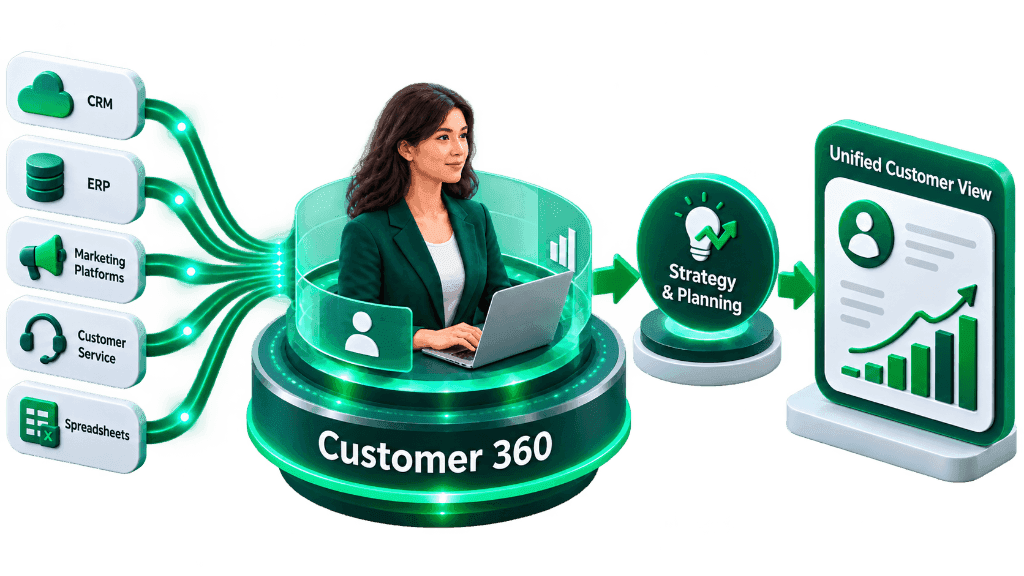
What Is Customer 360 Strategy Consulting?
Customer 360 Strategy Consulting is a structured approach to defining how a business should collect, connect, manage, and use customer information across its entire customer lifecycle.
Customer
Segments, personas, expectations, and lifecycle journeys
Process
Operational workflows, department handoffs, and approvals
Data
Identity resolution, validation, enrichment, and governance
Technology
CRM, ERP, marketing, service, and analytics platforms
Experience
Connected, frictionless touchpoints driving retention and LTV
A comprehensive Customer 360 strategy defines 10 operational pillars:
*The objective is not simply to create more connected systems. The objective is to create a connected customer operating model that supports sustainable business growth.
Why Do Businesses Need Customer 360 Strategy Consulting?
Many businesses begin transformation by asking: "Which CRM should we use? Which applications should we implement? Which integrations should we build?" These questions must come after understanding the business requirement. Without strategy, businesses face 12 critical pitfalls:
Fragmented Customer Data
Customer records scattered across tools with no single source of truth.
Duplicate Customer Records
Multiple conflicting records creating confusion and customer friction.
Disconnected Applications
Isolated software silos that fail to exchange real-time intelligence.
Unnecessary Integrations
Point-to-point connections built without evaluating business ROI.
Manual Workflows
Staff manually re-keying data, updating statuses, and copying emails.
Poor Customer Handoffs
Sales, onboarding, service, and CS failing to pass critical context.
Inconsistent Experiences
Customer receiving disjointed communication across different touchpoints.
Complex Tech Environments
Fragile tech stacks that are expensive to maintain and update.
Low User Adoption
Front-line employees abandoning cumbersome software workflows.
Reporting Limitations
Inability to extract unified customer health, retention, and LTV metrics.
Expensive Customization
Writing custom code when standard features could solve the problem.
Difficult Expansion
Rigid architectures that break when entering new markets or acquiring brands.
What Problems Does Customer 360 Strategy Consulting Solve?
Transforming operational bottlenecks into scalable enterprise advantages:
Fragmented Customer Data
Customer info distributed across CRM, ERP, spreadsheets, and support systems. A strategy identifies where critical data exists and how it should be governed.
Disconnected Customer Journeys
Marketing, sales, onboarding, service, and CS operating independently. The strategy unifies these stages into an orchestrated, frictionless lifecycle.
CRM and ERP Silos
Sales knows relationship history while operations holds order and invoice data. The strategy specifies exactly what transactional context must move between environments.
Manual Processes
Teams manually creating tasks, updating statuses, sending emails, or copying info across apps. The strategy prioritizes high-ROI automation opportunities.
Poor Customer Visibility
Leadership lacks a unified view of customer engagement, revenue health, and retention risk. The strategy defines clear reporting telemetry.
Unclear Technology Direction
Too many overlapping apps without a roadmap. Consulting defines what should be retained, replaced, integrated, or optimized.
How Does Customer 360 Strategy Consulting Work?
Our proven 10-step consulting methodology takes organizations from initial discovery to an actionable transformation roadmap:
Business Discovery
Understand objectives, growth plans, target segments, and transformation goals.
Journey Analysis
Examine customer progression across all 10 key lifecycle stages.
Process Assessment
Identify bottlenecks, manual tasks, approvals, and handoff delays.
Data Assessment
Audit data sources, ownership, quality, duplicates, and accessibility.
Tech Assessment
Review CRM, ERP, marketing, service, and custom software stacks.
Integration Scoping
Identify which systems need to exchange data and why.
Automation Scoping
Identify high-value workflows to eliminate repetitive manual effort.
Target State Definition
Architect the ideal future Customer 360 operating model.
Prioritization
Rank initiatives by business value, ROI, and technical complexity.
Roadmap Delivery
Create a phased path from current state to the target environment.
10-Stage Customer Journey Continuum Analyzed:
Customer 360 Strategy by Customer Lifecycle
Tailoring data flows, automations, and system integrations to every phase of the customer journey:
Acquisition
Identify how prospects discover and engage with the business.
- Marketing attribution
- Website behavioral telemetry
- Targeted advertising
- Lead capture & qualification
Sales Execution
Understand how qualified leads become paying customers.
- Opportunity pipelines
- Sales rep activities
- Dynamic proposals & CPQ
- Approvals & negotiations
Purchase & Fulfillment
Connect customer relationship and transactional context.
- Sales order capture
- Product delivery & dispatch
- Invoices & billing
- Payment reconciliations
Onboarding Transition
Design a smooth transition from sales to active customer.
- Account automated setup
- Welcome sequences
- Product implementation
- CS manager assignment
Customer Service
Ensure complete historical context is available during support.
- Ticketing & SLA tracking
- Support case history
- Purchased products & orders
- Live account context
Retention & Health
Identify early factors affecting customer health and loyalty.
- Feature usage signals
- Support frequency spikes
- NPS & CSAT feedback
- Health scoring formula
Contract Renewal
Create proactive visibility into upcoming renewal dates.
- Contract milestone alerts
- Automated renewal quotes
- Churn risk warnings
- Executive review triggers
Revenue Expansion
Systematically identify upsell and cross-sell opportunities.
- Cross-sell triggers
- Tier upgrade signals
- Additional seats/licenses
- Complementary products
Connecting CRM, ERP and Operational Data Flows
Not every system needs to be connected. The strategic goal is identifying high-value, bi-directional information flows:
Sales to Operational Processing
Won opportunities, customer master data, and bill-to/ship-to addresses flow to ERP for fulfillment and invoice generation.
Transactional Context for Sales
Order status, shipment tracking, payment history, credit limits, and invoice balances exposed directly inside CRM.
Complete Account Context
Customer tier, SLA level, assigned account executive, and recent sales communication displayed during support tickets.
Service History & Sentiment
Open tickets, CSAT scores, and unresolved escalations shared with sales and success managers before renewal calls.
Executive Business Intelligence
Unified customer events, sales velocity, and retention data fed into BI engines for executive reporting and forecasting.
Qualified Lead & Signal Flow
Campaign responses, lead scoring, and engagement history passed to sales reps with zero manual data entry.
Customer 360 Strategy and Data Architecture
Customer 360 is only as useful as the customer information supporting it. Our data strategy addresses 7 core disciplines:
Data Sources
Mapping where customer info exists across CRM, ERP, and databases.
Data Ownership
Designating the authoritative System of Record (SoR) for each field.
Data Quality
Establishing validation rules, address verification, and enrichment.
Data Duplication
Fuzzy matching algorithms to merge duplicate leads and accounts.
Data Accessibility
Role-based permissions ensuring the right teams see relevant data.
Data Synchronization
Bi-directional and event-driven API sync schedules.
Data Governance
Strict policies controlling lifecycle retention and privacy compliance.
Identity Resolution
Unifying email, phone, and account IDs into one golden record.
Customer 360 Strategy Across Business Models
Aligning architecture with the actual operational reality of your industry:
B2B Enterprise
Multi-stakeholder complexity:
- • Multiple buying committee members
- • Long procurement sales cycles
- • Account hierarchy management
- • Cross-department contract renewals
SaaS & Cloud
Product-led progression:
- • Acquisition ➔ Self-serve trial
- • Conversion ➔ Onboarding flow
- • Feature adoption & CS tracking
- • Automated renewal & expansion
Manufacturing
Order-to-delivery continuum:
- • Enquiry ➔ Qualification ➔ Quote
- • Sales order ➔ ERP production
- • Quality check ➔ Delivery dispatch
- • On-site service ➔ Repeat orders
Professional Services
Project & retainer billing:
- • Lead ➔ Consultation ➔ Proposal
- • Contract signing ➔ Project kickoff
- • Time tracking ➔ Milestone billing
- • Support retention ➔ SLA renewal
Customer 360 Strategy With Existing Systems
Customer 360 does not automatically mean replacing existing technology. A strategic assessment evaluates whether each system should be:
Strategic Alignment With Zoho Applications
As a Zoho Premium Partner, NuageCX assesses which Zoho applications are appropriate, how they should connect, and where integration is needed:
Customer 360 Strategy Roadmap & Deliverables
An 8-phase transformation roadmap designed to produce concrete business deliverables:
Phase 1: Discover
Understand business goals, growth targets, and customer journeys.
Phase 2: Assess
Evaluate operational workflows, data silos, and technology infrastructure.
Phase 3: Design
Define the target Customer 360 operating model and architecture.
Phase 4: Prioritize
Rank initiatives by business value, ROI, and technical readiness.
Phase 5: Implement
Execute configured systems, custom development, and integrations.
Phase 6: Adopt
Train users, establish standard operating procedures, and embed change.
Phase 7: Measure
Track customer retention, CSAT, cycle time, and commercial KPIs.
Phase 8: Optimize
Refine processes, upgrade automation, and continuously evolve the stack.
13 Concrete Deliverables Produced by the Strategy:
Customer 360 Strategy Consulting vs. Implementation
Strategy establishes direction; implementation executes that direction:
Strategic Discovery Answers:
- What should we build? Target state operating model
- Why should we build it? Commercial ROI and customer retention
- Which systems should be involved? Core CRM, ERP, and service apps
- What should be prioritized? High-impact quick wins vs. long-term
- How should the customer journey work? Unified omnichannel lifecycle
Technical Deployment Executes:
- How do we configure it? Fields, modules, blueprints, security
- How do we integrate it? APIs, webhooks, and middleware setup
- How do we migrate data? Historical cleansing and deduplication
- How do we automate workflows? Orchestration and triggers
- How do we deploy and train? Change management and adoption
When Should a Business Consider Strategy Consulting?
14 strategic indicators signaling the need for structured consulting:
9 Benefits of Customer 360 Strategy Consulting:
Make informed technology decisions before committing to implementation.
Design processes around actual customer journeys rather than software constraints.
Understand where customer information exists and how it should connect.
Avoid unnecessary applications, tool sprawl, and redundant subscriptions.
Automate processes that genuinely create operational efficiency.
Connect customer relationship and transactional data appropriately.
Define the exact telemetry required for commercial and customer decisions.
Create a technical foundation that evolves seamlessly with business growth.
Identify architectural dependencies and gaps before implementation begins.
Why Choose NuageCX for Strategy Consulting?
Enterprise business acumen combined with deep technical implementation mastery:
Strategy Before Software
We start with business requirements, customer journeys, and operational goals before recommending tools.
Cross-Functional View
We treat CRM, ERP, service, data, automation, and analytics as one connected customer ecosystem.
Zoho Premium Partner
We evaluate the entire Zoho ecosystem within your wider enterprise technology environment.
CRM & ERP Understanding
We understand how customer relationships and operational transactions must move between systems.
Integration Perspective
We identify where systems should connect without introducing unnecessary architectural complexity.
Custom Engineering
Where standard functionality falls short, custom applications and integrations can be designed.
Implementation-Oriented
Our strategies translate into practical implementation rather than theoretical documents.
Long-Term Scalability
We design roadmaps considering future team adoption, measurement, and continuous optimization.
Customer 360 Architecture & Solutions
Explore the parent pillar and interconnected Customer 360 practices:
Customer 360 Strategy & Consulting
Parent Pillar: Strategic planning, architecture, and roadmaps.
Customer 360 Implementation
Transform defined Customer 360 strategies into an operational reality.
Customer 360 Integration
Connect CRM, ERP, finance, and other relevant systems seamlessly.
Customer 360 Data Management
Manage, cleanse, and unify customer data into a single source of truth.
Customer 360 Analytics & Insights
Turn connected customer data into actionable business intelligence.
Customer 360 Automation & CX
Automate customer processes and deliver personalized experiences.
Frequently Asked Questions
Authoritative answers to common questions regarding Customer 360 strategy consulting:
Start Your Customer 360 Strategy
A connected customer experience starts with a clear strategy. If your customer information is fragmented, your systems are disconnected or your teams lack visibility across the customer lifecycle, NuageCX can help you assess the current environment and define a practical Customer 360 strategy.