Customer 360 Technology & Solution Consulting
Choose the Right Technology to Build a Connected Customer Ecosystem
Customer 360 transformation does not start with buying another software platform. It starts with understanding what your business needs, what your customers experience, what your existing systems already do, and where the technology gaps actually exist.
Organizations often operate with a fragmented blend of CRM, ERP, marketing, customer service, analytics, custom applications, and legacy databases. NuageCX helps businesses determine which technology should be retained, which systems should integrate, which processes require automation, where customization is genuinely needed, and which investments must come first.
We evaluate and design solution environments aligned with corporate strategy, user adoption, and 10-year enterprise scalability without forcing unnecessary platform replacements.
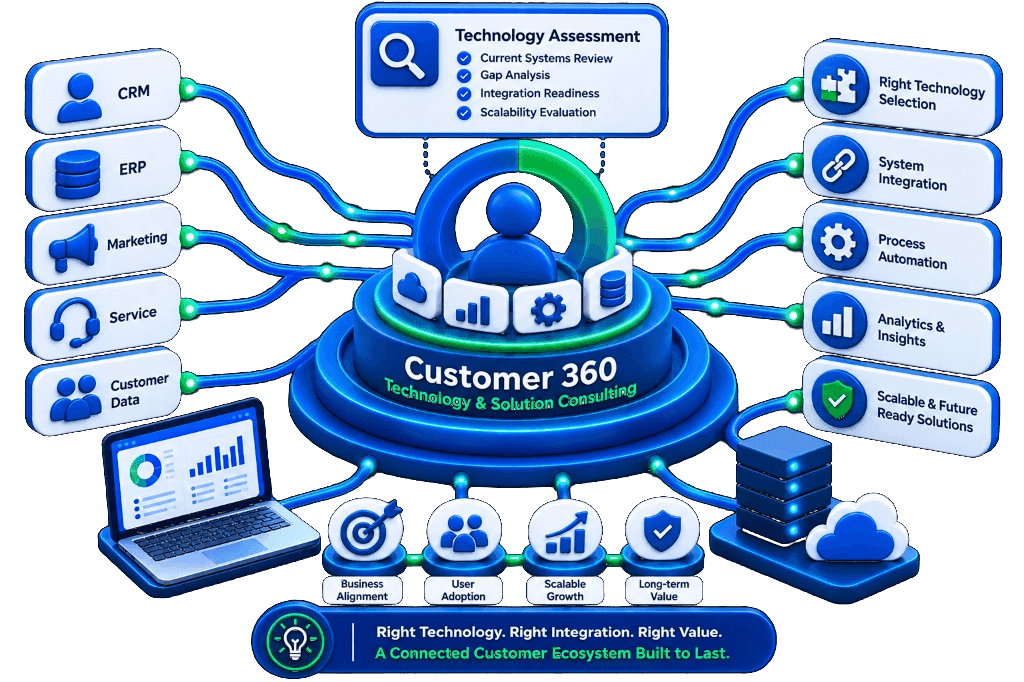
What Is Customer 360 Technology Consulting?
Customer 360 technology and solution consulting focuses on identifying, evaluating, designing, and optimizing the software stack required to create a connected customer ecosystem:
12 Technology & Solution Dimensions Evaluated:
Why Software Selection Matters: Avoiding New Technology Silos
Buying software without architecture creates fresh headaches for leadership:
ERP Data Remains Disconnected
Sales reps cannot verify whether past orders were paid or products shipped.
Support Operates in a Vacuum
Service agents unaware of open sales renewals when handling critical tickets.
Marketing Data Is Isolated
Campaign leads sit unworked because CRM mapping is flawed or manual.
Duplicate Customer Records Sprawl
Different systems store conflicting addresses, billing contacts, and tax IDs.
Reporting Requires Manual Excel
Finance spending days combining exports from 4 databases into spreadsheets.
Fragile Point-to-Point APIs
Custom scripts breaking every time vendor software releases a minor version update.
What Does Customer 360 Technology Consulting Cover?
Our consulting evaluates and designs 7 core technology pillars across your enterprise stack:
CRM Technology
Lead scoring, account hierarchies, opportunity pipelines, lifecycle stages, and rep sales automation.
ERP Technology
Order execution, item masters, stock inventory, billing schedules, and ledger reconciliation.
Customer Service Tech
Omnichannel ticketing, SLA tracking, automated ticket routing, and customer knowledge portals.
Marketing Technology
Behavioral segmentation, automated drip sequences, landing page tracking, and attribution modeling.
Analytics Technology
Executive customer dashboards, cohort LTV analysis, churn probability, and predictive forecasting.
Integration Middleware
REST/GraphQL APIs, webhook brokers, iPaaS synchronization, and automated error recovery queues.
Custom Solutions
B2B client self-service portals, specialized CPQ calculators, and unique operational microservices.
Security & Governance
Field-level role security, data residency, encryption at rest/transit, and SOC2/GDPR compliance.
How Do You Choose Customer 360 Technology?
Our 8-step methodology provides structured, vendor-neutral evaluation to select the best technology fit:
Business Requirements
Quantify corporate goals: revenue velocity, churn reduction, customer response times, and scale.
Journey Mapping
Map technology interactions across Lead ➔ Sales ➔ Order ➔ Onboarding ➔ Service ➔ Renewal.
Audit Active Stack
Document deployed software, custom code, spreadsheets, manual steps, and shadow IT.
Identify Gaps
Isolate where current platforms fail to share customer context, drop SLAs, or duplicate work.
Define Tech Specs
Translate user and business requirements into concrete architectural specifications.
Solution Evaluation
Score candidate platforms against functionality, APIs, usability, security, and total cost.
Target Solution Design
Architect how selected platforms communicate, own data, and automate handoffs.
Phased Priorities
Sequence technology deployments into prioritized implementation waves.
Customer 360 Technology Architecture
A balanced, 5-tier topology connecting external touchpoints with deep financial databases:
Where buyers and clients engage directly: Websites, forms, email, live chat, self-service portals, and inbound phone systems.
Platforms managing buyer relationships: CRM (sales opportunities/leads), Marketing automation, Help desk ticketing, and Customer success health.
Operational engines executing contracts: ERP, financial ledgers, inventory, project management, and automated invoicing.
High-speed connective tissue routing data: REST/GraphQL APIs, message brokers, webhook triggers, and data synchronization queues.
Governed single source of truth and executive intelligence: Master data repository, customer identity graph, and cross-system BI dashboards.
The Customer 360 Build vs. Buy Decision Model
One of the most consequential decisions in enterprise technology is determining how to acquire capabilities:
Technology Consolidation & Optimization
Organizations frequently accumulate redundant SaaS tools. We optimize without replacing when possible:
10 Technology Selection Criteria
NuageCX evaluates candidate software against 10 comprehensive commercial and architectural benchmarks:
Business Fit
Does the software solve the real operating problem?
Customer Fit
Does it support the actual customer journey touchpoints?
Integration
Can it exchange data seamlessly with existing systems?
Data Model
Can customer information be cleanly governed and owned?
Scalability
Can it absorb 10x customer and transaction growth?
Automation
Can it trigger cross-app workflows without custom code?
Analytics
Can it output real-time executive decision intelligence?
Usability
Will internal front-line teams realistically adopt it?
Security
Does it comply with SOC2, GDPR, and field-level encryption?
Total Cost (TCO)
Is license, implementation, and maintenance cost justified?
Signs Your Customer 360 Stack Needs Review
If your organization exhibits these operational warning signs, a technology review is urgently warranted:
9 Common Technology Selection Mistakes Avoided by NuageCX:
Why Choose NuageCX for Technology Consulting?
Pragmatic technology guidance from architects who build and maintain enterprise software:
Business-First Selection
We evaluate tools against revenue velocity, retention, and operating efficiency.
Vendor-Neutral Advisory
We recommend what solves your requirement rather than pushing licenses for their own sake.
Zoho Premium Partner
Unmatched expertise designing multi-app solutions across the Zoho One ecosystem.
CRM & ERP Understanding
We bridge customer relationships and backend financial transaction architectures.
Integration & Automation
Expertise designing resilient API fabrics, webhook queues, and workflow logic.
Custom Software Power
Full-stack development capability for proprietary portals and specialized microservices.
Strategy to Execution
We connect assessment, architecture, software selection, and turnkey implementation.
TCO Justification
Every recommendation includes a clear total cost of ownership and ROI justification.
16 Concrete Deliverables Produced by Technology Consulting:
Customer 360 Advisory Practices
Explore interconnected consulting disciplines across the Customer 360 Strategy & Consulting pillar:
Customer 360 Strategy & Consulting
Parent Pillar: Strategic planning, architecture, and roadmaps.
Customer 360 Strategy Consulting
Cluster 1: Business operating model & journey alignment.
Customer 360 Assessment & Audit
Cluster 2: Quantitative audit of data, journeys, and systems.
Customer 360 Roadmap & Transformation
Cluster 3: Prioritized transformation sequencing and milestones.
Customer 360 Architecture Consulting
Cluster 4: Scalable data topologies and system integration design.
Customer 360 Digital Transformation
Cluster 5: Cross-functional process re-engineering and change management.
Frequently Asked Questions
Authoritative answers to common questions regarding Customer 360 technology and solution consulting:
Start Your Customer 360 Technology Assessment
The right Customer 360 technology is not necessarily the newest technology. It is the technology that fits your business requirements, customer journeys, data, processes, existing systems, and future growth. NuageCX helps organizations evaluate their technology landscape and design practical Customer 360 solutions that connect strategy, architecture, and implementation.