End-to-End Customer 360 Implementation Services for Connected Business Systems
Build a connected customer environment across CRM, ERP, customer data, service, marketing, automation and analytics with Customer 360 implementation services from NuageCX.
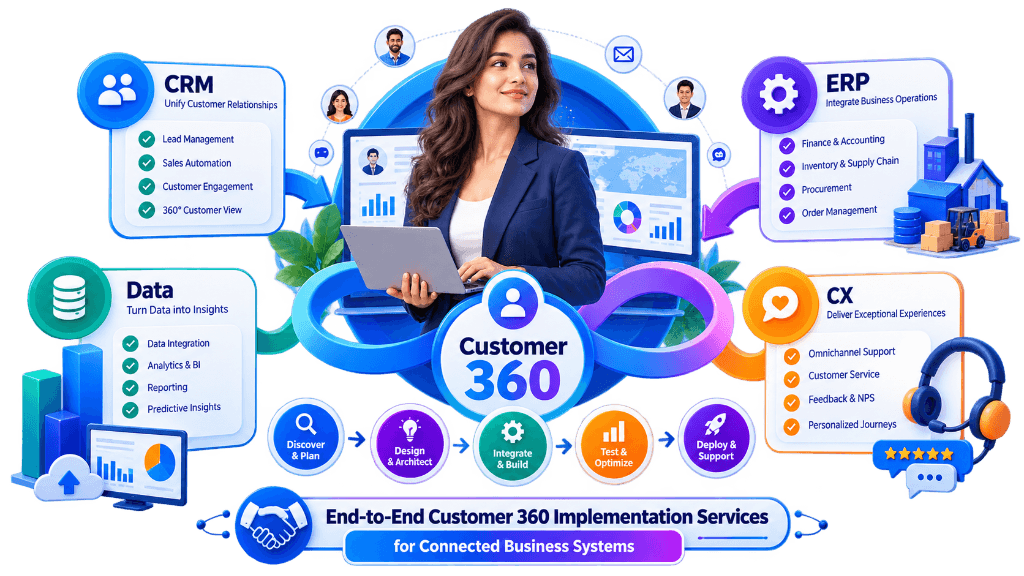
What Are Customer 360 Implementation Services?
Customer 360 implementation services help businesses design, build and optimize a connected environment that brings relevant customer information and business processes together.
Instead of treating CRM, ERP, finance, customer service, marketing and analytics as isolated systems, Customer 360 implementation connects the systems and information required to support the customer lifecycle.
Customer 360 Implementation Services Can Cover:
The scope should be determined by the organization's business requirements, existing systems and customer journey.
What Do Customer 360 Implementation Services Include?
Detailed breakdown of core deliverables executed during an end-to-end implementation project.
Business Discovery
Understand business objectives, customer journeys, departments, processes and technology requirements.
Customer Journey Mapping
Map customer interactions from initial engagement through sales, onboarding, service, expansion and retention.
System Assessment
Review existing CRM, ERP, finance, service, marketing, e-commerce and custom applications.
Data Assessment
Identify customer data sources, duplicates, inconsistencies, missing information and data ownership.
Architecture Design
Define how systems, customer information, integrations and workflows should work together.
Integration
Connect relevant systems through appropriate integration methods (REST APIs, webhooks, middleware).
Data Unification
Create consistent customer identities and relationships across connected systems.
Automation
Automate appropriate customer and business processes based on defined business rules.
Analytics
Build reporting and dashboards around relevant customer information.
Migration
Move required customer information from existing or legacy systems where applicable.
Testing
Validate data, integrations, workflows, permissions and reporting before go-live.
Deployment
Launch the Customer 360 environment and support user adoption.
Optimization
Improve the environment as customer requirements and business processes evolve.
Why Do Businesses Need Customer 360 Implementation Services?
Businesses often accumulate isolated software applications as they grow, resulting in fragmented customer information.
Teams Struggle to Answer These Questions Without Connected Services:
Customer 360 implementation services address the architecture, integration and process requirements needed to create a connected customer environment.
How Do Customer 360 Implementation Services Work?
A typical implementation follows a structured lifecycle tailored to your scope and technology stack.
Discovery
Identify business objectives and problems Customer 360 will solve.
Current-State Assessment
Assess existing technology, applications, spreadsheets and databases.
Customer Journey Mapping
Document customer lifecycle from lead generation to retention.
Data Assessment
Review customer records, duplicate entries, data quality and ownership.
Solution Architecture
Design target Customer 360 environment and system connectivity.
Integration
Connect CRM, ERP, accounting, helpdesk, and marketing platforms.
Data Unification
Establish record matching, identity resolution, and global IDs.
Automation
Automate lead routing, customer creation, onboarding, and escalations.
Analytics
Build executive dashboards around revenue, orders, and customer activity.
Testing
Validate data accuracy, integration webhooks, rules, and permissions.
Deployment
Roll out user access, data migration, training, and production release.
Optimization
Continuously refine integrations, data quality, and business rules.
Specialized Customer 360 Implementation Workstreams
In-depth breakdown of individual service domain capabilities.
Customer 360 CRM Implementation Services
CRM serves as the customer relationship layer, managing sales history and client profiles.
Customer 360 ERP Integration Services
ERP provides operational and transactional context to connect backend operations with sales.
Customer 360 Data Integration Services
Connects appropriate software sources via APIs, connectors, webhooks, and middleware.
Customer 360 Data Unification Services
Creates reliable customer context without simply duplicating fields across apps.
Customer 360 Automation Services (Event-to-Action Triggers)
Customer 360 Analytics Services (Executive Dashboards)
Customer 360 Implementation Services With Zoho
Zoho can form the foundation of a Customer 360 environment depending on your business requirements.
The correct combination depends on business processes, customer journey, existing systems and desired outcomes.
Industry-Specific Customer 360 Implementation Services
Customized implementation service architectures across core business sectors.
Manufacturing
- Account visibility
- Quotation history
- Order tracking
- Production context
- Inventory status
- Invoices & Service
Distribution
- Warehouse visibility
- Logistics coordination
- Order tracking
- Invoice reconciliation
- Margin reporting
SaaS & Software
- Account health scoring
- Subscription ARR/MRR
- Support ticket history
- Automated onboarding
- Expansion alerts
E-commerce
- Omnichannel customer profiles
- Order status automation
- Payment reconciliation
- Targeted remarketing
Professional Services
- Client relationship management
- Project milestone tracking
- Time & expense billing
- Resource allocation
When Should You Choose Implementation Services?
Who Needs Implementation Services?
Key stakeholder roles involved in bringing customer data & tech together:
Implementation Services Cost Factors
- Number of Systems
- Number of Users
- Data Volume & Cleanliness
- Integrations Count
- Integration Complexity
- Data Migration Scope
- Custom Development
- Workflow Automation
- Analytics Dashboards
- QA & System Testing
- User Training
- Geographic Scope
- Business Process Complexity
- Ongoing Support
Implementation Services Timeline
- Number of Applications
- Data Complexity
- Integration Requirements
- Customization Scope
- Migration Requirements
- Automation Rules
- Analytics Scope
- User Testing Pace
- Geographic Scope
Customer 360 Implementation Best Practices
Services Comparisons & Phased Execution
Understanding how Customer 360 services compare to CRM services, integration services, and CDP.
Customer 360 Implementation Services vs CRM Services
Primary focus on customer relationship & sales pipeline management
Broader environment covering CRM + ERP + Data + Finance + Service + Marketing + Automation + Analytics
Used mainly by sales & account management reps
Harmonizes sales context with backend operations, ledgers, and support tickets
Can Customer 360 Be Implemented in Phases?
Yes. A phased roadmap prioritizes high-value customer journeys first while allowing progressive expansion.
Establish core customer identity, contacts, and account management.
Connect relationship tools with operational orders, inventory, and ledgers.
Unify support tickets, helpdesk history, and campaign engagement.
Implement cross-departmental lifecycle triggers and workflow rules.
Deploy consolidated executive dashboards and continuously refine performance.
Why Choose NuageCX for Customer 360 Implementation Services?
We design around customer journeys and business requirements rather than isolated software applications.
Zoho Premium Partner
NuageCX works across the Zoho ecosystem to deliver connected business solutions.
Customer-Centric Architecture
We design around customer journeys and business requirements rather than isolated applications.
CRM and ERP Capability
Connect customer-facing and operational processes where appropriate.
Integration Expertise
Connect relevant systems and data sources via APIs, connectors, and middleware.
Data Management
Address customer identity, structure, quality and record relationships.
Automation
Build workflows around defined business processes and measurable rules.
Analytics
Turn connected information into actionable executive business visibility.
Custom Solutions
Adapt the solution to business-specific requirements.
End-to-End Delivery
Support discovery, architecture, implementation, testing, deployment and optimization.
Frequently Asked Questions
Clear answers to common questions about Customer 360 implementation services, scope, timeline, and pricing.
Build Your Customer 360 Environment With NuageCX
Connect the systems, data and processes your teams need to understand the customer more completely.