Customer 360 Implementation Roadmap for a Structured, Scalable Strategy
Build a practical Customer 360 implementation roadmap that connects customer data, systems, processes, integrations, analytics and automation around measurable business outcomes.
NuageCX helps businesses plan and execute Customer 360 implementations in structured phases, from current state assessment and data architecture to integration, data unification, analytics, automation and continuous optimization.
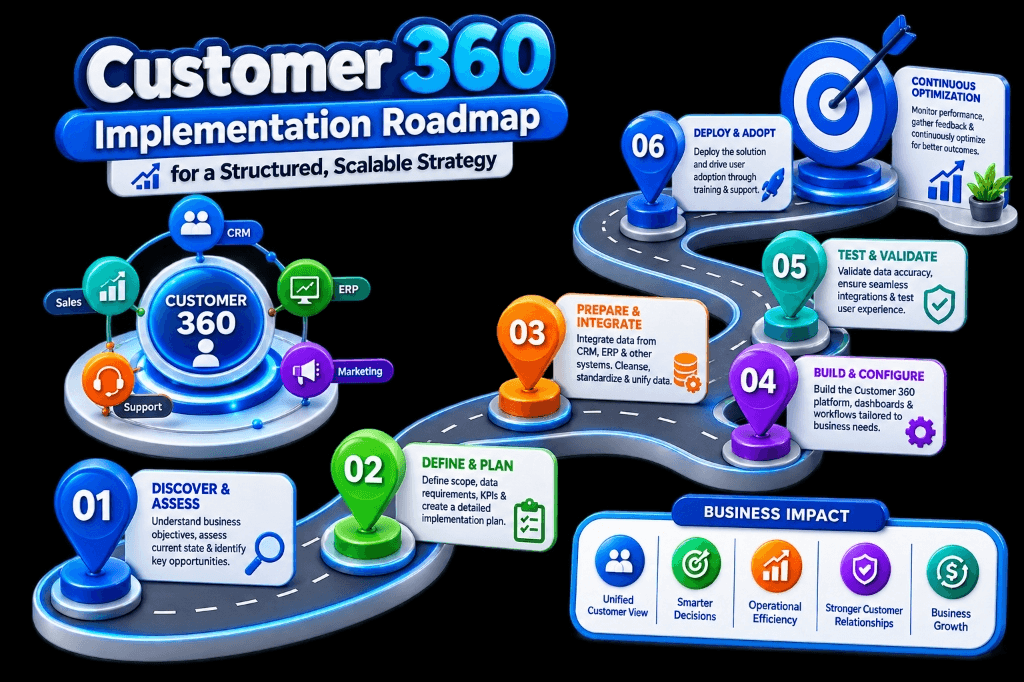
What Is a Customer 360 Implementation Roadmap?
A Customer 360 implementation roadmap is a structured plan for designing, implementing and scaling a unified customer environment across the systems and processes that manage customer information.
A Strategic Roadmap Defines:
A roadmap prevents Customer 360 from becoming an unstructured technology project. The objective is to connect technology, data and business processes around the customer lifecycle.
Why Do Businesses Need a Customer 360 Implementation Roadmap?
Customer 360 involves multiple systems, departments and data sources. Without a roadmap, implementations experience severe pitfalls:
A structured roadmap establishes priorities and provides a predictable, low-risk sequence for implementation.
What Does a Customer 360 Roadmap Include?
A comprehensive roadmap covers all 22 strategic dimensions required for enterprise readiness.
Customer 360 Implementation Phases
An 8-phase structured execution model designed for fast time-to-value and progressive scalability.
Discovery and Assessment
Audit business objectives, systems, data schemas, customer journeys, and existing APIs. Output: Current-State Assessment.
Strategy and Architecture
Define target architecture, data model, identity resolution rules, security, and milestones. Output: Target Architecture Blueprint.
Data Foundation
Cleanse duplicates, configure identifiers, establish data mappings, and define system ownership. Output: Trusted Master Foundation.
System Integration
Connect high-priority systems (CRM, ERP, Finance, Support, Marketing, E-commerce). Output: Synchronized Data Pipelines.
Customer 360 Experience
Deploy unified customer context across sales pipelines, service desks, and account teams. Output: Actionable Customer 360 View.
Analytics and Insights
Build cross-system executive reporting, cohort retention, and customer lifetime value dashboards. Output: Business Intelligence.
Process Automation
Deploy automated lead routing, follow-up notifications, case escalations, and sync triggers. Output: Automated Customer Lifecycle.
Continuous Optimization
Monitor sync health, adoption KPIs, data quality metrics, and expand to emerging use cases. Output: Scalable Operating Model.
What Should Be Implemented First?
Prioritize capabilities based on business value, system dependencies, and low-risk sequencing.
Business Objectives & Current-State Assessment
Anchor the project to commercial goals and audit all existing databases.
Customer Data Model & Identity Strategy
Define how customer master entities and cross-system keys relate.
Critical Data Quality & Duplicate Resolution
Cleanse duplicates before connecting sync middleware pipelines.
High-Value CRM & ERP Integration
Synchronize commercial deals, customer accounts, and order ledger data.
Service Desk, Marketing & External Touchpoints
Connect support tickets, omnichannel interactions, and campaign attribution.
Executive Analytics & Reporting
Build cross-system BI dashboards and customer lifetime value metrics.
Cross-Departmental Automation & Advanced Triggers
Automate task routing, alerts, case escalations, and status updates.
The Customer 360 MVP Blueprint
Businesses do not need to implement every capability simultaneously. A focused Customer 360 MVP targets the highest-value core:
Industry-Specific Implementation Roadmaps
Aligning the Customer 360 roadmap with industry-specific commercial and operational workflows.
Manufacturing
Prioritizes connecting commercial sales quotes with shop-floor manufacturing status, delivery logistics, and warranty claims.
SaaS & Tech
Focuses on uniting recurring MRR subscriptions, product telemetry, support ticket trends, and churn risk scoring.
Professional Services
Bridges proposal generation with project milestone tracking, billable utilization, client invoicing, and renewal retention.
How to Measure Implementation Success
Data Quality KPIs
- Duplicate record rate reduction
- Data completeness percentage
- Cross-system field accuracy
Operational Efficiency
- Manual data entry reduction
- Reconciliation time savings
- Workflow processing speed
Sales Effectiveness
- CRM data completeness
- Pipeline visibility speed
- Faster lead response times
Customer Service
- Instant context availability
- First-contact resolution rate
- Escalation handling speed
Analytics & BI
- Reporting turnaround time
- Cross-system data reliability
- Single source of truth access
User Adoption
- Active daily user percentage
- Feature adoption rate
- Automated workflow usage
Customer 360 Implementation Challenges
Implementation Roadmap Best Practices
When Should a Business Start a Customer 360 Implementation?
Customer 360 Implementation With Zoho & NuageCX
Leveraging the full breadth of Zoho CRM, Zoho ERP, Zoho Books, Zoho Desk, and third-party enterprise platforms.
Business-Led Approach
Start with commercial outcomes, customer journeys, and quantitative KPIs.
Target Architecture
Design target environments tailored to your exact data landscape.
CRM & ERP Expertise
Deep understanding of customer-facing and backend operational ledgers.
Data Unification
Establish consistent customer master identities and account hierarchies.
Robust Integration
Connect relevant applications through reliable API and middleware architectures.
Executive Analytics
Transform connected data into actionable cross-departmental dashboards.
Process Automation
Trigger automated workflows from unified customer context events.
Zoho Ecosystem Power
Leverage native Zoho suite connectivity to maximize platform investments.
Phased Execution
Prioritize high-value MVP horizons to deliver rapid time-to-value.
End-to-End Support
Support assessment, design, data mapping, testing, training, and ongoing support.
Roadmap Cost Factors
- Number of Systems
- Customer Record Count
- Data Quality Baseline
- Integration Complexity
- Custom Code Scope
- Data Migration Needs
- Analytics Dashboards
- Workflow Automations
- Data Governance Rules
- Security & RBAC
- User Training Scope
Roadmap Timeline Factors
- Data Source Quantity
- Record Volume Scale
- Existing Cleanliness
- Account Hierarchy
- API Availability
- Governance Readiness
- Data Migration Scope
- Business Testing QA
- Staging Audit Cycles
- User Adoption Pace
Frequently Asked Questions
Answers to common questions about Customer 360 implementation roadmaps, MVP horizons, sequencing, and costs.
Build Your Customer 360 Implementation Roadmap
A successful Customer 360 implementation starts with a clear understanding of what the business needs, where customer data exists, how systems should connect and which capabilities should be implemented first.