Customer 360 Data Unification for a Single, Consistent Customer View
Unify customer information across CRM, ERP, finance, service, marketing and other business systems to create consistent customer identities, relationships and context.
NuageCX helps businesses design Customer 360 data unification around their customer journeys, data architecture and business requirements.
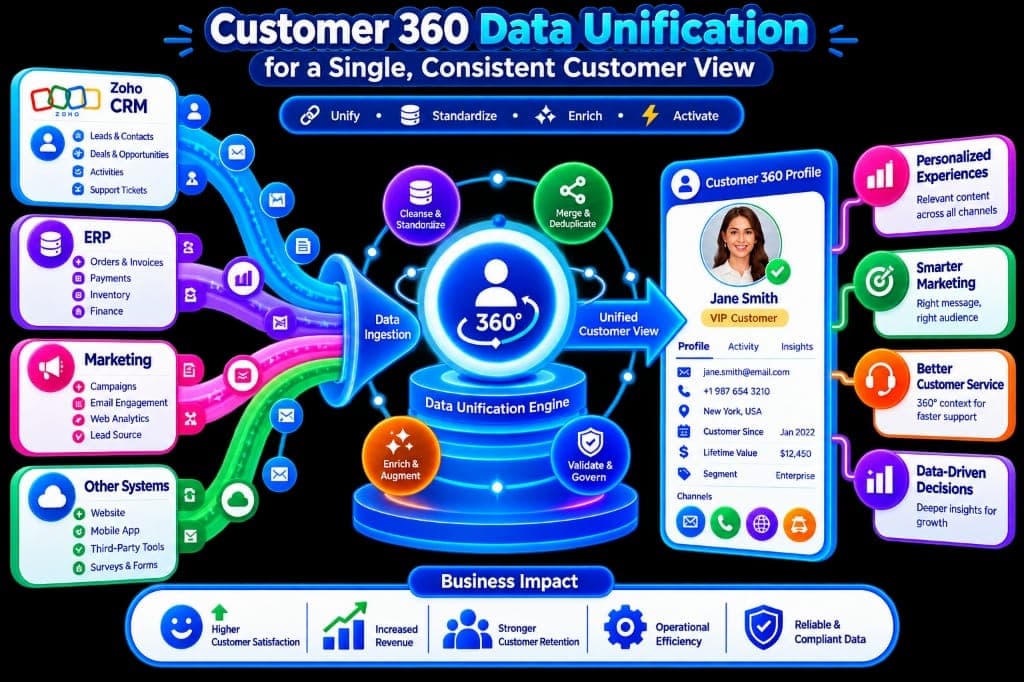
What Is Customer 360 Data Unification?
Customer 360 data unification is the process of bringing customer information from different systems into a consistent customer context.
How the Same Customer Is Represented Across Disparate Systems:
Data unification establishes the relationships and rules required to understand whether these records represent the same customer. The objective is not merely to copy data—it is to create consistent, connected and usable customer context across relevant systems.
Customer Data May Exist Across:
Why Is Customer 360 Data Unification Important?
Disconnected customer records create an incomplete or inconsistent view across sales, finance, and operations.
Data unification establishes relationships between these records and provides a reliable foundation for Customer 360.
Data Integration vs Data Unification
These concepts are closely related, but they serve two distinct architectural functions.
Connects systems
Connects customer identities and records
Moves information across pipelines
Establishes consistent customer context
Focuses on system connectivity
Focuses on data relationships & master entities
Uses APIs, connectors and workflows
Uses matching, mapping and identity rules
Enables synchronization between databases
Creates a unified 360° customer view
Integration connects the systems. Unification connects the customer information within those systems.
Customer 360 Data Unification Process
A 12-phase operational methodology for creating clean master data, identity matching, and golden records.
Discover Data Sources
Identify all databases, CRM, ERP, support, and marketing tools storing customer info.
Profile Customer Data
Audit data fields, account formats, email addresses, tax IDs, and record structures.
Assess Data Quality
Identify duplicates, invalid entries, outdated values, and conflicting field formats.
Define Identifiers
Determine primary keys, account references, emails, and external system IDs.
Create Data Mappings
Map equivalent attributes across applications accounting for naming differences.
Match Customer Records
Execute deterministic and probabilistic rules to connect cross-system profiles.
Resolve Duplicates
Merge and relate duplicate records using defined business rules without data loss.
Establish Relationships
Map parent companies, subsidiaries, branches, buyer groups, and contacts.
Define Data Ownership
Establish authoritative systems of record for CRM deals, ERP orders, and service logs.
Create Unified Context
Compile complete golden customer profiles accessible across all team touchpoints.
Validate Matching Accuracy
Audit true positive matches and address edge cases or false positives in staging.
Monitor & Maintain
Maintain data quality and identity rules continuously as new customer records enter.
Customer 360 Identity Resolution & Matching Methods
Determining whether records from disparate sources refer to the exact same customer or organization.
Identity Resolution In Action
ABC Industries | Pune | contact@abc.com
ABC Industries Pvt. Ltd. | Pune | contact@abc.com
Identity resolution uses identifiers and matching rules to confirm both records represent the same legal organization.
Deterministic Matching
Records are matched using known exact identifiers (e.g. Customer ID = 12345 or Tax Registration Number).
Provides maximum confidence when reliable common identifiers exist.
Probabilistic Matching
Records are matched using multiple weighted attributes: Name, Email, Phone, Address, and Organization.
Used when clean common identifiers are missing across legacy systems.
Customer 360 Golden Record Architecture
A golden record represents the trusted master profile compiled from the best attributes across all connected systems:
Data Unification for Different Business Models & Sectors
Representing complex multi-tiered account hierarchies and sector-specific operational lifecycles.
B2B Account Hierarchies
Represents parent corporations, subsidiaries, branch offices, buying groups, and associated contacts.
B2C Individual Profiles
Unifies individual consumer identities, shopping carts, mobile app logins, and marketing consent.
Manufacturing
Unifies commercial sales relationships with shop floor manufacturing and delivery.
Distribution
Connects buyer relationships with multi-warehouse inventory and logistics.
SaaS & Tech
Connects account health with MRR subscriptions, product usage telemetry, and retention.
Professional Services
Bridges client proposals with project milestones, billable hours, and invoicing.
Customer 360 Data Unification Challenges
Data Unification Best Practices
When Should a Business Invest in Data Unification?
Customer 360 Data Unification With Zoho & NuageCX
Unifying master customer records across Zoho CRM, Zoho ERP, Zoho Desk, and third-party systems.
Customer-Centric Architecture
Design data relationships around customer journeys and business requirements.
CRM & ERP Understanding
Connect customer-facing and operational information where appropriate.
Data Integration Capability
Build technical connections required to exchange and map relevant records.
Identity & Data Modeling
Define customer identifiers, golden record schemas, and account hierarchies.
Zoho Ecosystem Expertise
Work across the Zoho suite as part of a broader master data architecture.
Workflow Automation
Use unified customer context to trigger automated business workflows.
Consolidated Analytics
Create executive reporting from unified and clean customer records.
End-to-End Implementation
Support assessment, architecture, mapping, integration, QA, and optimization.
Unification Cost Factors
- Number of Systems
- Record Volume
- Data Quality
- Data Complexity
- Matching Rules
- Identity Resolution
- Data Migration
- Integration Scope
- Custom Development
- Data Governance
- Analytics & BI
- Ongoing Maintenance
Unification Timeline Factors
- Data Volume
- Number of Sources
- Existing Data Quality
- Matching Complexity
- Customer Hierarchy
- Integration Needs
- Migration Scope
- Business Rules
- QA Testing Pace
- Staging Validation
Frequently Asked Questions
Answers to common questions about Customer 360 data unification, identity resolution, golden records, and costs.
Create a More Consistent Customer 360 Data Foundation
Customer 360 starts with knowing who the customer is, how their records relate and where the relevant information resides.