Customer 360 Data Governance Services for Trusted Enterprise Data
Establish clear ownership, quality standards, access controls, security policies, and governance processes for customer data across CRM, ERP, e-commerce, customer service, marketing, finance, and other business systems.
NuageCX helps businesses build Customer 360 data governance frameworks that improve data quality, accountability, security, consistency, and trust across the customer data lifecycle.
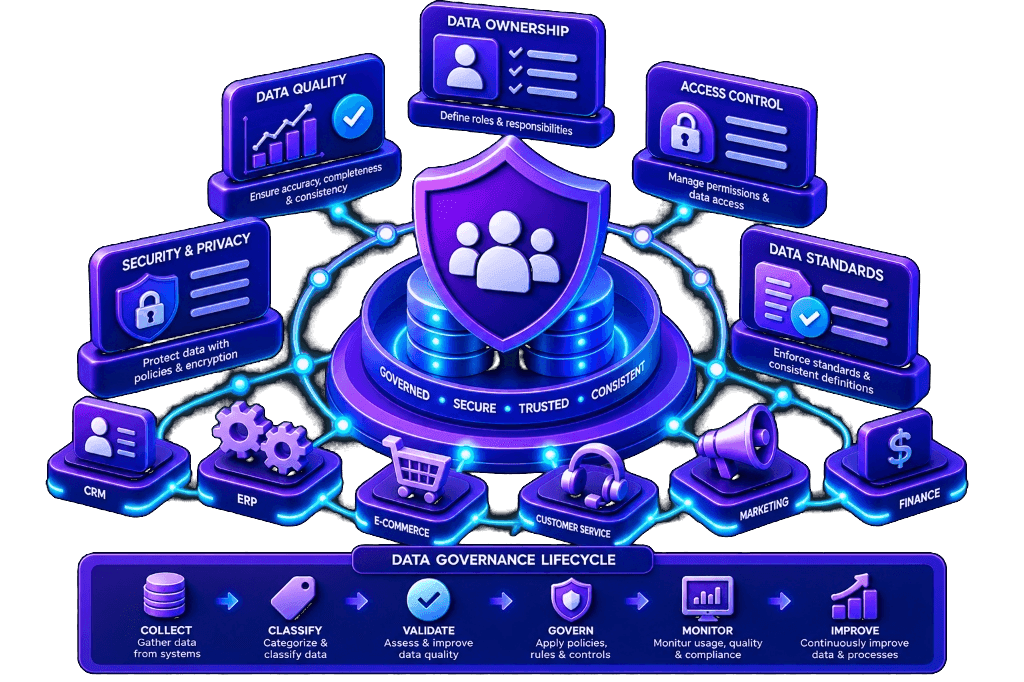
What Is Customer 360 Data Governance?
Customer 360 data governance is the framework used to define how customer information is owned, managed, accessed, protected, maintained, and used across an organization. A Customer 360 environment brings together customer records from multiple systems; without governance, organizations face operational chaos and compliance risk.
9 Critical Risks Organizations Face Without Data Governance:
Why Is Customer 360 Data Governance Important?
Customer 360 initiatives depend on reliable and appropriately managed customer information. Governance establishes:
What Does Customer 360 Data Governance Include?
Ten architectural pillars governing ownership, quality, security, and stewardship.
Data Ownership
Define who is accountable for specific customer datasets.
Data Stewardship
Assign operational responsibility for quality and maintenance.
Data Standards
Define common formats, values, identifiers, and definitions.
Data Quality
Establish rules for accuracy, completeness, and consistency.
Data Access
Define who can access specific customer information and why.
Data Security
Protect customer data with technical and operational controls.
Data Privacy
Enforce consent, minimization, purpose limitation, and deletion.
Lifecycle Management
Control creation, update, retention, archival, and deletion.
Data Lineage
Track where information originates and how it moves across apps.
Issue Management
Standardize processes for resolving customer data problems.
Customer 360 Practical Data Governance Flow
Customer 360 Governance Operating Model & Roles
Data Owner
Defines data requirements, approves access permissions, establishes field standards, resolves ownership disputes.
Data Steward
Monitors daily data quality, investigates duplicate records, coordinates remediation, maintains data definitions.
Data Custodian
Implements access security, oversees storage, database backups, encryption keys, and technical monitoring.
Governance Council
Establishes enterprise policies, prioritizes compliance initiatives, and resolves cross-functional data impasses.
Business Users
Follows defined standard operating procedures when creating, updating, or using customer information.
Data Ownership Matrix & Standards
Establishing single authoritative systems of record and cross-departmental accountability.
Enterprise Customer Data Ownership Matrix
| Data Domain | Authoritative System of Record | Accountable Department Owner |
|---|---|---|
| Customer Profile | CRM System | Customer / CRM Team |
| Account & Commercial Contacts | CRM System | Sales / Commercial Ops |
| Sales Orders & Fulfillment | ERP / Commerce Engine | Operations / ERP Team |
| Invoices & Ledger Balances | Finance / Accounting | Finance Department |
| Support Cases & Tickets | Service Desk | Customer Support |
| Marketing Engagement | Marketing Automation | Marketing Team |
| Product SKUs & Catalog | PIM / ERP System | Product / Operations |
Cross-System Data Standardization
Different systems represent customer status and taxonomies differently:
Automated Data Quality Rules
6 Core Data Quality Dimensions Measured
Is the information correct?
Ensuring customer names, tax IDs, and physical addresses are verified and true.
Are required fields populated?
Preventing orphan records with missing emails, phone numbers, or billing terms.
Does data match across systems?
Ensuring customer status in CRM matches ERP ledgers and support desks.
Are duplicate records controlled?
Detecting and managing duplicate accounts with survivorship merge logic.
Does data comply with rules?
Enforcing strict schema syntaxes, ISO country formats, and allowable values.
Is the data sufficiently current?
Syncing real-time webhooks so customer updates reflect instantly across tools.
Access Governance, RBAC & Data Security
Restricting customer information according to business roles and global privacy regulations.
Sales User
Customer profile, contact directory, commercial opportunities, and communication logs.
Finance User
Customer billing records, payment history, approved credit limits, and invoice balances.
Service User
Customer account context, open support tickets, SLA milestones, and resolution history.
Marketing User
Approved customer profiles, engagement telemetry, consent status, and lifecycle tags.
Security Governance Controls
Data Privacy Governance
Customer Data Lifecycle & Lineage Tracking
Governing customer information across its complete organizational lifecycle.
8-Stage Customer Data Lifecycle Management
Data Lineage Tracking Example
Tracking exact transformations and source dependencies:
Data Classification Framework
Categorizing customer data according to sensitivity:
CRM & ERP Governance
Prevents conflicting customer definitions between commercial sales accounts and financial ledgers.
E-commerce Governance
Standardizes high-volume web customer profiles, cart checkouts, payment receipts, and returns.
Customer Service Governance
Regulates agent visibility into customer accounts, update rights, ticket standards, and retention.
Marketing Governance
Enforces explicit opt-in consent, purpose limitation, audience segmentation, and suppression.
Analytics Governance
Establishes trusted metric definitions, single data sources, and lineage for executive BI reporting.
Master Data Governance
Ensures uniform customer, account, and product master definitions across all enterprise applications.
Data Governance Challenges
Data Governance Best Practices
Data Governance Implementation Roadmap & Metrics
A 12-phase execution roadmap and measurable metrics to track governance maturity.
Governance Assessment
Review existing customer data, connected systems, data policies, and departmental ownership.
Data Inventory & Catalog
Identify all important customer data sources, entity types, and classification categories.
Ownership & Stewardship
Formally assign accountable data owners and operational data stewards across departments.
Data Classification
Classify customer records into Public, Internal, Confidential, and Restricted tiers.
Data Standards Definition
Define uniform customer definitions, ISO country/state codes, status values, and global IDs.
Data Quality Framework
Establish measurable quality rules for accuracy, completeness, consistency, and uniqueness.
Access Governance & RBAC
Implement role-based access control, least-privilege principles, and periodic review policies.
Security & Privacy Safeguards
Deploy AES-256 encryption, API tokenization, GDPR/CCPA consent tracking, and audit logging.
Data Lifecycle Policies
Define explicit schedules for customer data retention, legal holds, archival, and secure deletion.
Data Lineage Documentation
Document end-to-end data flows from e-commerce capture to CRM, ERP, and executive BI.
Monitoring & KPI Dashboards
Continuously track quality scores, duplicate rates, issue resolution times, and policy compliance.
Continuous Improvement
Regularly iterate governance standards based on audit findings, business evolution, and new apps.
Customer 360 Governance Metrics Monitored
Governance vs Management
1: Governance defines the policies, rules, and ownership.
2: Management executes the operational tasks to maintain data.
Governance vs Quality
1: Governance establishes the framework and standards.
2: Quality measures and enforces adherence to those standards.
Governance vs Security
1: Governance covers broader lifecycle and accountability.
2: Security protects data from unauthorized access or breaches.
Governance vs Privacy
1: Governance manages organizational data broadly.
2: Privacy focuses on personal PII rights and regulatory consent.
Why Choose NuageCX for Customer 360 Data Governance?
Customer-Centric Governance
Build governance frameworks around real-world business workflows and buyer touchpoints.
Clear Ownership & Stewardship
Establish explicit departmental ownership and operational data stewards.
Practical Quality Frameworks
Define measurable standards for accuracy, completeness, consistency, and uniqueness.
Unified Data Standards
Create common customer data definitions, standardized taxonomies, and identifiers.
Robust Security & RBAC
Design least-privilege role-based access control and technical data safeguards.
Comprehensive Data Lifecycle
Establish formal processes for customer data creation, retention, archival, and deletion.
End-to-End Data Lineage
Document and track customer data flows across all connected business applications.
Multi-System Governance
Govern data across CRM, ERP, e-commerce, customer service, marketing, and finance.
Zoho Ecosystem Specialization
Apply governance across Zoho CRM, Zoho Books, Zoho Analytics, and Zoho Desk.
Analytics Readiness
Provide consistently defined customer data models for executive BI reporting.
End-to-End Implementation
Complete support: assessment, governance design, standards, quality, security, and tuning.
Frequently Asked Questions
Everything you need to know about Customer 360 data governance, ownership, quality, security, and stewardship.
Build a Trusted Customer 360 Data Governance Framework
Customer 360 is only as reliable as the data behind it.
When customer information is distributed across CRM, ERP, e-commerce, service, marketing, finance, and analytics systems, clear governance is essential for maintaining data quality, ownership, security, access, privacy, and accountability.