Customer 360 Data Governance Services & Enterprise Framework
Establish the policies, ownership, standards, controls, and processes required to keep customer data accurate, consistent, secure, compliant, and trustworthy across CRM, ERP, e-commerce, customer service, marketing, finance, and analytics systems.
NuageCX helps businesses design and implement Customer 360 data governance frameworks that establish accountability, improve data quality, control customer data usage, and create a sustainable foundation for Customer 360 initiatives.
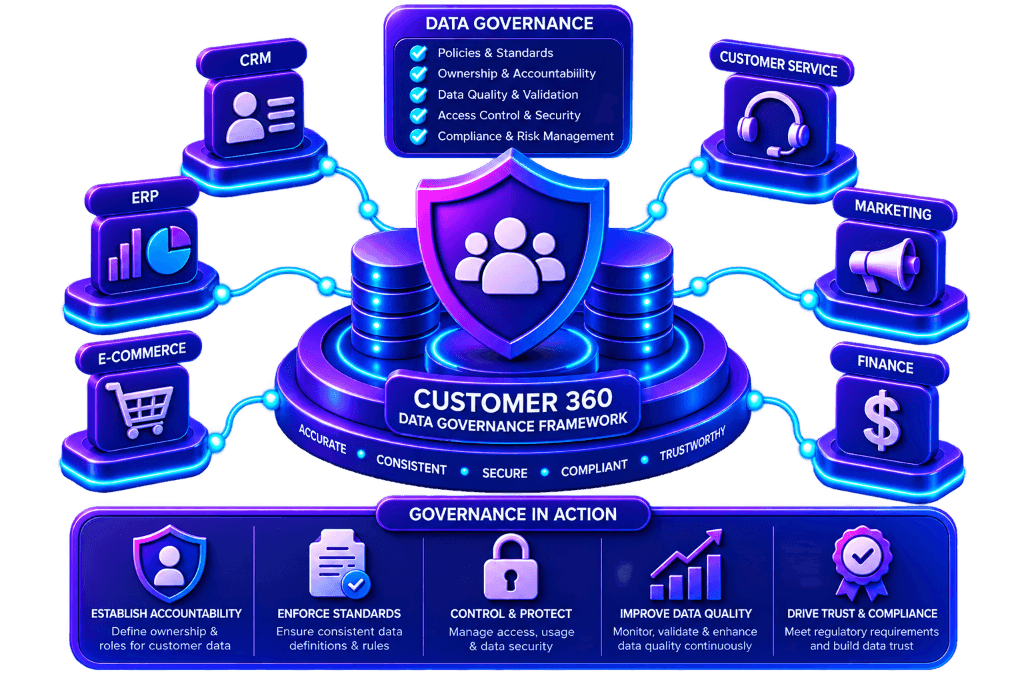
What Is Customer 360 Data Governance?
Customer 360 data governance is the framework used to define how customer information is owned, managed, accessed, maintained, protected, standardized, and used across an organization. It establishes ownership, stewardship, standards, policies, quality requirements, access controls, lifecycle rules, accountability, security requirements, and monitoring.
10 Operational Risks Prevented by Customer Data Governance:
What Does Customer 360 Data Governance Cover?
A comprehensive framework covers 9 core pillars across the enterprise customer lifecycle:
Data Ownership
Defines accountable data owners who define business rules, quality thresholds, and approval chains.
Data Stewardship
Appoints operational stewards who monitor data health, resolve exceptions, and enforce standards.
Data Standards
Establishes uniform customer naming conventions, ISO country/currency codes, and field formats.
Data Quality Governance
Measures and improves customer data accuracy, completeness, consistency, validity, and timeliness.
Data Access Controls
Enforces role-based permissions defining who can view, create, update, export, or delete customer records.
Data Lifecycle Management
Governs end-to-end customer record progression from creation to validation, archival, and disposal.
Data Security Requirements
Protects customer information through encryption, masked fields, audit logging, and intrusion controls.
Data Privacy & Compliance
Maintains consent preferences, opt-outs, and lawful data processing according to applicable privacy laws.
Continuous Monitoring
Tracks automated data health monitors, policy violations, and anomaly alerts across master databases.
Customer 360 Data Governance Framework
A disciplined, continuous governance lifecycle connecting business strategy to everyday execution.
Practical Data Governance Progression:
Assess Existing Data
Identify customer data sources, systems, workflows, current owners, and existing controls.
Define Objectives
Establish quantifiable goals and milestones for Customer 360 data governance across the business.
Identify Data Domains
Structure customer, account, contact, address, transaction, service, and marketing domains.
Assign Ownership
Define accountable business data owners and day-to-day operational stewards.
Establish Standards
Document common customer definitions, taxonomies, field lengths, and validation rules.
Define Quality Rules
Formulate measurable quality dimensions, acceptance thresholds, and escalation paths.
Define Access Controls
Determine who can view, create, update, export, or delete customer information.
Establish Lifecycle Rules
Define how customer records are validated, retained, archived, and securely purged.
Implement Monitoring
Deploy real-time dashboards to track quality compliance, access events, and drift.
Continuously Improve
Regularly review audit logs and optimize upstream data workflows to eliminate dirty inputs.
Customer Data Ownership
Data owners hold business accountability for customer datasets, policy decisions, quality standards, and access approvals.
- Approves data definitions and business rules
- Sets access authorization policies and tiers
- Defines data quality thresholds and SLAs
- Establishes retention and compliance schedules
Customer Data Stewardship
Data stewards manage the day-to-day operational health, standardization, duplicate resolution, and exception reviews.
- Monitors data quality health and error logs
- Resolves duplicate customer match exceptions
- Applies cross-system standardization rules
- Supports business users on data entry best practices
10 Enforceable Data Policies
8 Standardized Customer Dimensions
Role-Based Access Governance
8-Stage Customer Data Lifecycle
7-Stage Data Issue Management
Customer 360 Governance Across Business Systems
Applying unified governance policies across enterprise operational touchpoints and digital platforms.
CRM Governance
Governs lead conversion standards, contact validation, account ownership, and pipeline integrity.
ERP Governance
Standardizes customer master ledgers, tax IDs, credit limits, invoices, and operational billing addresses.
E-commerce Governance
Regulates online customer accounts, guest checkouts, transaction logs, and delivery address rules.
Customer Service Governance
Protects ticket records, customer interaction notes, warranty entitlement, and sensitive feedback.
Marketing Governance
Controls audience segmentation, opt-in consent records, unsubscribe requests, and campaign tracking.
Analytics, AI & Automation
Enforces data provenance, metric consistency, model training quality, and authorized AI prompts.
Governance & Data Quality
Governance defines the rules and standards; Data Quality measures compliance and executes automated cleansing against those rules.
Governance & Master Data (MDM)
MDM consolidates and maintains the trusted Golden Record; Governance establishes ownership, survivorship, and stewardship policies around it.
Governance & Data Integration
Integration connects data pipelines between systems; Governance determines which payloads can be moved, who can update them, and how errors are handled.
10 Data Governance Challenges
10 Governance Best Practices
Governance Implementation Roadmap & Metrics
A 12-phase roadmap and measurable metrics to monitor data governance performance.
Current-State Assessment
Assess systems, data sources, current stewardship processes, and existing security controls.
Governance Strategy
Establish business-aligned governance objectives, compliance requirements, and implementation priorities.
Data Domain Definition
Define customer, account, contact, address, transaction, service, and marketing domains.
Ownership Model
Appoint accountable data owners and operational data stewards with documented responsibilities.
Standards & Taxonomies
Define uniform customer naming conventions, phone/address formats, and reference data vocabularies.
Quality Framework
Formulate measurable quality dimensions, baseline thresholds, error escalations, and remediation.
Access Governance
Configure role-based access permissions, privacy controls, and secure data sharing policies.
Lifecycle Governance
Establish policies governing creation, validation, storage, retention, archival, and data disposal.
System Implementation
Embed automated governance validations and stewardship queues directly into CRM, ERP, and apps.
Continuous Monitoring
Deploy audit dashboards tracking data quality scores, access events, and policy exception logs.
Adoption & Enablement
Conduct organization-wide training and establish operational data accountability across business teams.
Continuous Improvement
Periodically review governance performance metrics and adapt controls to evolving regulations.
Customer 360 Governance Dashboard Metrics
Governance vs Quality
1: Governance defines policies, ownership, and standards.
2: Quality measures and improves data condition.
Governance vs MDM
1: Governance defines rules and control frameworks.
2: MDM creates and maintains trusted master records.
Governance vs Management
1: Governance sets policies and decision structures.
2: Management executes technical storage and piping.
Governance vs Security
1: Governance manages data usage and accountability.
2: Security protects data from cyber breaches and loss.
Why Choose NuageCX for Customer 360 Data Governance?
Customer Governance Strategy
Design practical governance roadmaps aligned with enterprise business goals and system architectures.
Data Ownership Architecture
Establish clear operational data ownership and stewardship responsibilities across all teams.
Data Standards & Taxonomies
Create uniform customer definitions, standardized naming syntax, and international reference schemas.
Data Quality Governance
Define measurable quality dimensions, automated profiling, threshold alerts, and remediation queues.
Master Data Governance
Support trusted customer master data creation, survivorship logic, and change management.
Access & Privacy Controls
Define role-based access permissions, confidential field masking, and GDPR/CCPA compliance.
Lifecycle Management
Establish end-to-end customer data creation, storage, retention, archival, and disposal rules.
CRM & ERP Harmonization
Govern customer entities across Salesforce, Zoho CRM, SAP, NetSuite, and operational databases.
Integration Governance
Define data ownership, schemas, and payload validation across API, ETL, and webhook flows.
Analytics & AI Governance
Establish reliable customer definitions, lineage, and authorized data provenance for AI models.
Zoho Ecosystem Expertise
Deep operational governance across Zoho CRM, Zoho Books, Zoho Analytics, and Zoho Desk.
End-to-End Implementation
Full lifecycle support from initial readiness audit to policy definition, rollout, and automated monitoring.
Frequently Asked Questions
Everything you need to know about Customer 360 data governance, stewardship, policies, access control, and compliance.
Build a Governed Foundation for Customer 360
Customer 360 is not only a technology initiative.
It requires clear ownership, consistent standards, reliable data quality, controlled access, lifecycle management, and accountability across the enterprise.