Customer 360 Personalization Services
Deliver more relevant customer experiences by using unified customer data, behavior, preferences, lifecycle context, and business intelligence to personalize interactions across marketing, sales, service, customer success, and engagement.
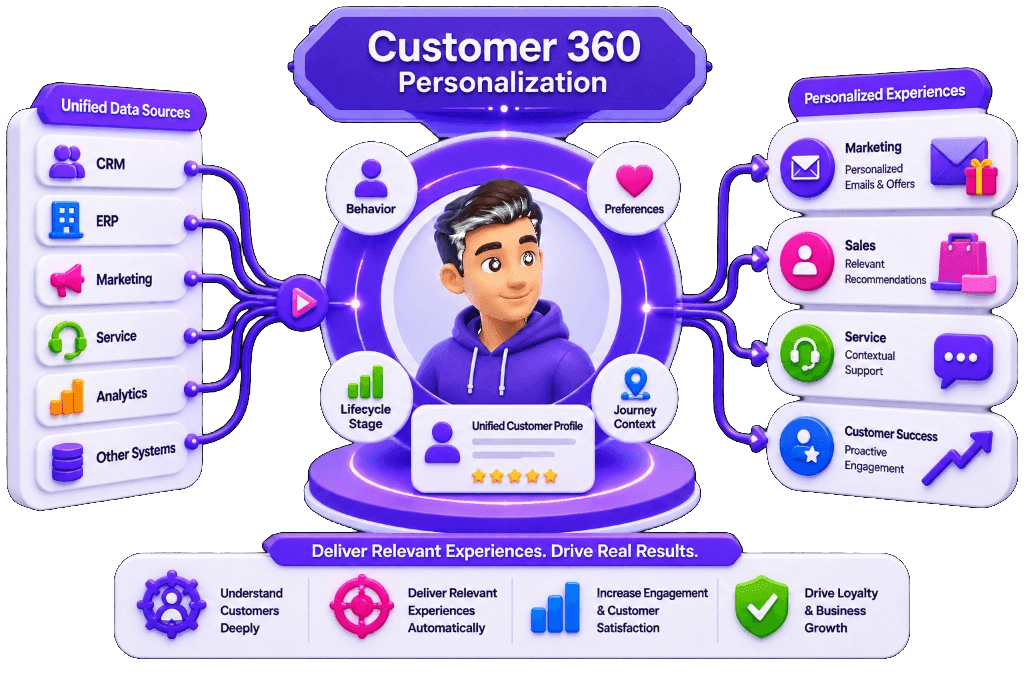
NuageCX helps businesses design and implement Customer 360 personalization solutions that connect customer information across CRM, ERP, marketing, service, analytics, and other business systems.
Instead of treating every customer the same, Customer 360 personalization helps organizations understand customer context and deliver relevant experiences based on who the customer is, what they have done, where they are in their journey, and what they may need next.
What Is Customer 360 Personalization?
Customer 360 personalization is the process of using connected customer information to create more relevant and contextual customer interactions across all channels.
A comprehensive Customer 360 personalization framework considers 14 core context inputs:
Customer Profile
Demographic data, roles, titles, and verified contact profiles
Account Information
Organization hierarchy, parent accounts, and operational units
Customer Preferences
Communication channels, privacy consents, and UI settings
Purchase History
Past orders, software tiers, renewal cycles, and historical values
Product Usage
Active feature telemetry, cloud portal logins, and session frequency
Website Behavior
Browsing activity, page visits, whitepaper downloads, and searches
Marketing Engagement
Email open velocity, click rates, webinar presence, and content reads
Service History
Support ticket volume, unresolved bugs, and escalation logs
Lifecycle Stage
Awareness, lead, onboarding, active adoption, renewal, or advocate
Customer Health
Telemetry-backed health index, NPS feedback, and churn risk status
Customer Interests
Topics explored, product category affinities, and solution roadmaps
Previous Interactions
Executive meeting logs, calls, chats, and omnichannel notes
Customer Value
Current annual contract value (ACV), margin, and projected LTV
Business Rules
Governance logic, SLA obligations, eligibility criteria, and guardrails
*The objective is to use relevant customer context to determine what experience, message, offer, recommendation, or action is appropriate.
Why Is Customer 360 Personalization Important?
Customers expect businesses to understand their needs across channels, but customer information is frequently scattered across 8 disconnected platforms:
The Problem: When these systems operate independently, personalization becomes limited, inconsistent, repetitive, or outright contradictory. Customer 360 personalization connects this context to power 10 business outcomes:
How Does Customer 360 Personalization Work?
An 11-step continuum turning fragmented records into verified, personalized customer outcomes:
Customer 360 Personalization Framework
A disciplined, 9-stage engineering framework for establishing scalable, governance-backed personalization:
Collect Customer Data
Identify and harvest relevant customer data across all connected internal and external systems.
Unify Customer Information
Connect relevant records, transactions, engagement feeds, and contextual customer attributes.
Resolve Customer Identity
Reconcile customer, contact, and account records across systems with precision matching rules.
Build Customer Context
Combine profile, behavioral, transactional, engagement, and lifecycle stage telemetry.
Segment Customers
Create meaningful dynamic customer cohorts based on defined business and intent criteria.
Define Personalization Rules
Determine how customer context should trigger specific messages, offers, and actions.
Deliver Personalized CX
Apply real-time personalization across supported web, mobile, email, sales, and service channels.
Measure Customer Response
Track conversion, engagement velocity, CSAT, retention rates, and business outcomes.
Optimize Continually
Improve rules, segments, recommendations, and journeys using evidence and machine learning.
Personalization Across the Customer Lifecycle
Tailoring communication, recommendations, and workflows throughout every customer milestone:
Awareness
Provide relevant content based on initial customer or prospect context.
Lead
Tailor communication based on lead source, captured attributes, and engagement.
Qualification
Help sales teams understand specific customer needs, pain points, and prior visits.
Purchase
Provide relevant information, tailored proposals, and transparent buying flows.
Onboarding
Customize onboarding paths, implementation checklists, and communications.
Adoption
Provide relevant education and feature engagement based on product usage telemetry.
Support
Give service teams complete customer context to resolve issues rapidly.
Customer Success
Personalize success activities, health reviews, and milestone check-ins.
Retention
Identify at-risk accounts early and deploy personalized retention interventions.
Renewal
Deliver contextually relevant renewal communications, timing, and terms.
Expansion
Present relevant cross sell or upsell options based on proven product usage.
Advocacy
Identify highly satisfied customers and invite them to become public advocates.
Customer 360 Personalization Use Cases
NuageCX configures Customer 360 personalization across 10 high-impact operational use cases:
Personalized Marketing
Use customer context to deliver relevant lifecycle campaigns and communications.
Personalized Sales
Give sales teams customer information relevant to current opportunities or accounts.
Personalized Onboarding
Adapt onboarding tasks according to customer profile, tier, and business goals.
Personalized Service
Arm service desks with full customer purchase and interaction history.
Personalized CS
Tailor customer success workflows to health scores, adoption, and engagement.
Personalized Retention
Use behavioral telemetry to trigger timely retention interventions before churn.
Personalized Renewal
Create renewal experiences tailored to contract history and relationship status.
Personalized Cross Sell
Identify relevant add-ons and services based on usage and business needs.
Personalized Upsell
Identify expansion potential and tier upgrades based on telemetry growth.
Personalized Engagement
Adapt ongoing customer communication based on responsiveness and intent.
Personalization Across Specialized Departments
Providing customer-facing teams with context so customers are never treated as generic records:
Personalized Marketing
- • Lifecycle campaigns
- • Lead nurturing tracks
- • Targeted education
- • Re-engagement blasts
- • Cross-sell & upsell
- • Win-back workflows
Personalized Sales
- • Prior meeting context
- • Active products/tiers
- • Account stakeholder maps
- • Real-time service logs
- • Purchase propensity
- • Expansion timing
Personalized Service
- • Zero customer repetition
- • Full purchase context
- • Open & resolved cases
- • Account health status
- • SLA entitlement levels
- • Empathetic routing
Personalized CS
- • Customer success goals
- • Feature adoption rate
- • Health index telemetry
- • Engagement cadence
- • Renewal milestone prep
- • Strategic reviews
Personalized Onboarding
- • Role-based training
- • Tailored educational guides
- • Implementation tasks
- • In-product guidance
- • CS check-in schedules
- • Milestone milestones
Behavioral, Real-Time & Account-Based Personalization
Multi-dimensional methodologies moving past basic demographic rules:
Behavioral Signals
Interprets customer actions in context:
- • Website activity & clicks
- • Product feature usage
- • Email response velocity
- • Purchase transaction cadence
- • Inactivity warnings
Real-Time Personalization
Low-latency response during interactions:
- • Dynamic website changes
- • In-session recommendations
- • Live agent screen pops
- • Instant event triggers
- • Adaptive journey routing
Contextual Personalization
Considers current circumstances:
- • Current journey milestone
- • Active support incident
- • Recent order status
- • Real-time account health
- • Contract renewal window
Account-Based (ABM)
Personalization for B2B accounts:
- • Company tier & industry
- • Multi-stakeholder maps
- • Aggregate usage volume
- • Enterprise contract terms
- • Account expansion potential
Industry Personalization Architectures
Tailoring personalization algorithms to the operational realities of different business verticals:
B2B Personalization
Connect account information, contact roles, stakeholder goals, sales opportunities, service, contracts, and ERP transactions.
SaaS Personalization
Personalize based on subscription tier, feature usage, user telemetry, health index, lifecycle stage, and expansion signals.
E-commerce
Dynamic product recommendations, browsing affinity, repeat purchase journeys, post-purchase education, and win-back offers.
Manufacturing
Account contracts, order history, spare parts replenishment, service warranty claims, technical specs, and commercial terms.
Customer Segmentation & Dynamic Segmentation
Moving from static lists to real-time cohorts that evolve as customer behaviors and telemetry shift:
11 Core Segmentation Dimensions
Automated Dynamic Cohort Migration
Dynamic segmentation allows customer segments to adjust automatically when attributes or behaviors change:
Next Best Action Framework
A disciplined sequence determining what interaction is most appropriate for each account:
Recommendation Engine Architecture
Uses unified customer context to identify and recommend 6 types of relevant assets and actions:
*Recommendations are validated against actual customer outcomes to eliminate irrelevant suggestions.
AI & Predictive Personalization
Leveraging machine learning to anticipate customer requirements with high confidence:
Dynamic Segmentation AI
Machine learning models clustering accounts by intent and behavioral traits.
Predictive Next Best Action
Recommends optimal interventions based on historical cohort progression.
Churn Risk Prediction
Identifies early warning indicators before friction escalates to customer churn.
Expansion Scoring
Calculates upsell and cross-sell propensity using product adoption velocity.
Sentiment Analysis
Analyzes support ticket notes and surveys to detect underlying customer frustration.
Content Recommendations
Matches guides, whitepapers, and training videos to current lifecycle stage.
*AI operates within strict governance, validation, privacy, and security controls. Predictive models are treated as probabilistic estimates and validated with human-in-the-loop oversight.
Privacy & Governance
Responsible data handling:
- • Data minimization protocols
- • Explicit consent management
- • Role-based access controls
- • Enterprise encryption standards
- • Configurable retention rules
- • Full auditability logs
Data Quality Impact
Prevents poor experiences:
- • Eliminates wrong recommendations
- • Fixes misdirected segmentation
- • Stops duplicate communications
- • Prevents irrelevant offers
- • Corrects broken journey branches
- • Ensures accurate analytics
Identity Resolution
Matches records across silos:
- • Matches Person across systems
- • Reconciles Customer profiles
- • Unifies Account hierarchies
- • Bridges Organization records
- • Resolves contact aliases
- • Provides verified unified ID
CRM and ERP Personalization
Connecting CRM relationship records with ERP commercial transactions unites relationship context with commercial realities:
Personalization Automation Workflow
A real-world automated sequence triggered upon customer purchase:
Personalization Across 10 Omnichannel Touchpoints
Maintaining persistent customer context across every interaction channel:
Personalization Analytics & Dashboard
A 6-module command dashboard backed by 13 core performance KPIs:
Customer Segments
Segment size, migration velocity, engagement depth, and customer value
Personalized Engagement
Open rates, personalized interaction velocity, and conversion attribution
Customer Experience
CSAT, customer health indices, sentiment drift, and journey progression
Retention & Churn
Renewal probability, churn prevention velocity, and at-risk accounts
Growth & Expansion
Cross sell rate, upsell qualification, and personalized expansion revenue
Recommendation Engine
Recommendation views, click-through engagement, and assisted conversions
13 Core KPIs for Customer 360 Personalization:
Personalization Challenges
Personalization Best Practices
12-Phase Personalization Implementation Roadmap
NuageCX executes a comprehensive 12-phase delivery roadmap for enterprise personalization:
Phase 1: Strategy
Define objectives, target customer journeys, and commercial outcomes.
Phase 2: Journey Assessment
Identify key touchpoints where personalization improves customer experience.
Phase 3: Data Discovery
Audit and catalog all customer data sources, schemas, and event feeds.
Phase 4: Data Integration
Connect required CRM, ERP, marketing, service desk, and telemetry systems.
Phase 5: Identity Resolution
Establish customer and account matching rules across all platforms.
Phase 6: Segmentation
Design and build meaningful dynamic customer segments and cohorts.
Phase 7: Personalization Rules
Define business logic, eligibility criteria, and recommendation triggers.
Phase 8: Experience Design
Design personalized journey branches, templates, and dynamic screen components.
Phase 9: Automation
Implement workflows, real-time web triggers, and task assignment playbooks.
Phase 10: Testing & QA
Simulate personalization edge cases, audience overlaps, and fallbacks.
Phase 11: Analytics
Deploy real-time dashboards for engagement, conversion, and LTV.
Phase 12: Optimization
Continuously refine personalization rules and AI models based on results.
How Much Does It Cost?
Implementation cost depends on the number of systems, data sources, integration complexity, customer volume, data quality, personalization rules, workflow automation, analytics, AI, real-time requirements, security, and governance.
There is no universal cost. A tailored assessment establishes the exact investment.
How Long Does It Take?
Timelines depend on number of systems, data complexity, customer journeys, integrations, dynamic segmentation, personalization logic, automation workflows, analytics, and governance.
A focused personalization use case can be implemented rapidly in weeks, whereas enterprise-wide programs are deployed in staged milestones.
When Should a Business Implement Customer 360 Personalization?
Conceptual Differences & Why Choose NuageCX
Clarifying foundational concepts and exploring NuageCX’s enterprise implementation capabilities:
C360 vs. Marketing Personalization
Marketing personalization focuses primarily on marketing. Customer 360 personalization extends across marketing, sales, customer service, customer success, retention, renewal, and expansion.
Personalization vs. Segmentation
Customer segmentation groups accounts by defined traits. Customer 360 personalization uses these segments along with broader real-time customer context to determine relevant actions.
Customer 360 vs. Personalization
Customer 360 provides a connected view of relevant customer data. Personalization uses that context to deliver appropriate experiences. Customer 360 serves as the engine for personalization.
Customer 360 Expertise
Build personalization around connected customer context rather than isolated records.
Customer Data Integration
Connect customer data across CRM, ERP, marketing, service, and analytics platforms.
Customer Journey Design
Identify, map, and personalize high-value customer journeys.
Personalization Automation
Implement appropriate triggers, decision rules, and playbooks.
Customer Experience Focus
Create contextual customer experiences across all supported touchpoints.
Customer Analytics
Measure personalization, engagement, retention, customer health, and growth.
AI & Predictive Analytics
Support recommendation, prediction, dynamic segmentation, and next best action.
Zoho Ecosystem Mastery
Leverage Zoho CRM, Zoho Desk, Zoho Flow, and Zoho Analytics for C360 personalization.
End to End Delivery
Support strategy, integration, identity resolution, automation, testing, and optimization.
Frequently Asked Questions
Everything you need to know about Customer 360 Personalization Services:
Create More Relevant Customer Experiences With Customer 360
Personalization becomes more effective when businesses understand the customer beyond a single interaction. NuageCX helps organizations connect customer data, customer identity, CRM, ERP, marketing, service, customer success, analytics, automation, and customer journeys to create more contextual and relevant Customer 360 experiences.