Customer 360 Marketing Integration Services for Connected Customer Journeys
Connect customer, marketing, CRM, sales, service and transaction data to create a connected view of customer interactions across the marketing lifecycle.
NuageCX helps businesses integrate marketing platforms with CRM, ERP, customer service, e-commerce and analytics systems so marketing teams can work with relevant customer information and create more connected customer experiences.
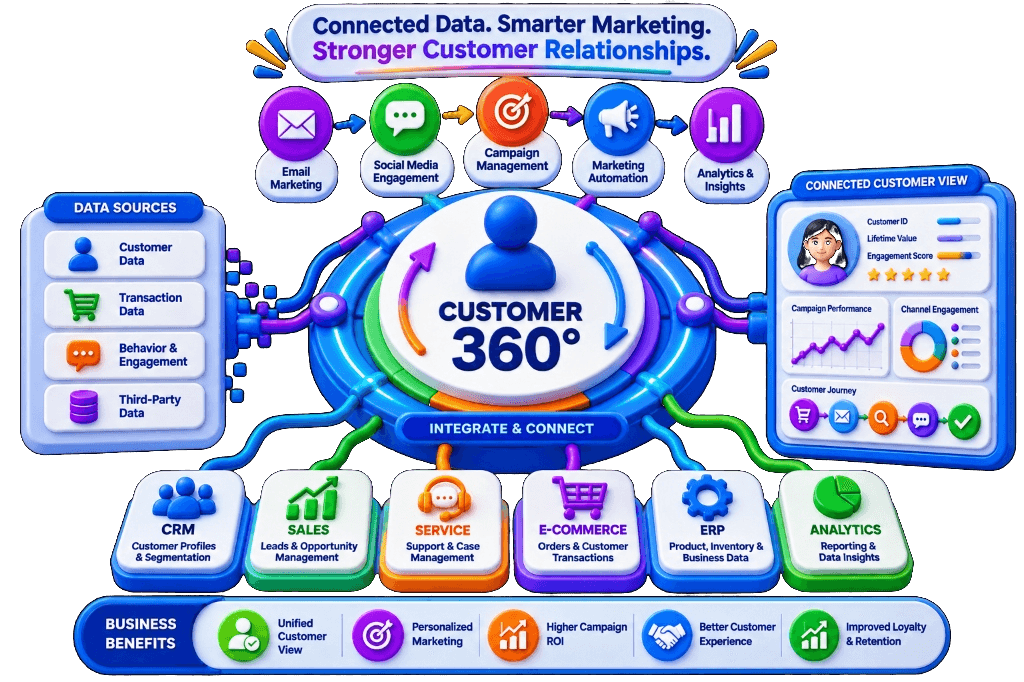
What Is Customer 360 Marketing Integration?
Customer 360 marketing integration connects marketing automation systems with applications that contain customer profiles, sales opportunities, transactions, support history, and digital interactions.
Marketing Data Connected Across 11+ Systems:
Why Is Marketing Integration Important for Customer 360?
Marketing teams frequently require data that lives outside their automation platforms:
Rich Customer Context
Know who the buyer is, their company, and historical touchpoints.
Dynamic Segmentation
Build tailored audience lists based on live purchase and usage data.
Unified Sales Alignment
Hand off qualified leads to sales reps in real-time with full context.
Full Lifecycle Visibility
Track users from initial ad impression to multi-year account loyalty.
Eliminate Manual Sync
Stop exporting CSV files between ad networks, forms, and CRM.
Automated Triggers
Launch onboarding and win-back email sequences from ERP events.
Coordinated Journeys
Ensure customers never receive sales promos for items they just returned.
Consistent Data
Enforce uniform names, emails, and company records across systems.
Multi-Touch Attribution
Prove exact campaign ROI by connecting leads to closed revenue.
Scalable Automation
Deploy intelligent lead nurturing workflows that scale effortlessly.
Connected Systems & Data Scope
Integrating marketing applications with front-office sales, back-office ERP, and customer service desks.
CRM Integration
Exchange leads, buyer contacts, organizational accounts, active deals, activities, and commercial history.
ERP Integration
Sync confirmed sales orders, SKU purchase history, invoices, payment status, and contract renewals.
E-commerce Integration
Exchange storefront accounts, cart activity, product categories, transaction values, and return records.
Customer Service Integration
Sync support tickets, warranty claims, customer complaints, and satisfaction scores with marketing lists.
Analytics & BI Integration
Feed multi-touch attribution models, campaign conversion pipelines, and customer acquisition cost (CAC) reports.
Websites, Forms & Ads
Capture live form submissions, landing page visits, webinar signups, and ad network conversions directly.
6 Core Marketing Data Domains Integrated
Customer Data
Customer ID, Contact details, Company account, Tier, Lifecycle status
Lead Data
Lead source, Qualification score, Form answers, Assignment owner
Campaign Data
Campaign ID, UTM parameters, Clicks, Responses, Conversion metrics
Transaction Data
Orders, Products purchased, Invoiced amounts, Lifetime value (LTV)
Service Data
Support tickets, Open cases, RMA returns, Escalation status
Engagement Data
Web page visits, Email open/click logs, Event attendance, Downloads
Customer 360 Marketing Integration Flow
Customer 360 Marketing Integration Process
A structured 10-stage execution methodology for unified marketing lifecycle workflows.
Map the Customer Journey
Identify marketing touchpoints across awareness, content engagement, form fills, qualification, purchase, onboarding, and retention.
Identify Marketing Systems
Document marketing automation platforms, CRM, e-commerce, ERP, service desk, web forms, and ad tracking channels.
Identify Data Sources
Determine where customer identities, campaign clicks, email open telemetry, order revenues, and support interactions originate.
Define Systems of Record
Establish authoritative ownership for customer accounts (CRM), campaign interactions (Marketing), and purchase ledgers (ERP).
Define Customer Data Model
Connect entities into a unified graph: Customer ➔ Campaign Engagement ➔ Qualified Lead ➔ Sales Deal ➔ Order ➔ Retention Journey.
Map Data Across Systems
Establish schema mapping (Marketing Contact ID ➔ CRM Contact, Campaign ID ➔ CRM Campaign, Order SKU ➔ Purchase History).
Define Synchronization Rules
Configure real-time webhooks for form leads, bidirectional status syncing, conflict resolution, and data transformation rules.
Implement the Integration
Deploy API connectors, webhook listeners, automated lead routing scripts, and event-driven marketing workflows.
Test Workflows & Lead Routing
Validate lead ingestion, sales rep notifications, post-purchase journey triggers, attribution models, and privacy compliance.
Monitor and Optimize
Track synchronization health, API latencies, duplicate record rates, lead conversion velocity, and campaign ROI attribution.
Automated Lifecycle Workflows & Attribution
Transforming raw system events into autonomous, highly coordinated customer journeys.
1. New Lead Routing
2. New Customer Onboarding
3. Existing Customer Cross-Sell
4. Customer Service Context
Customer 360 Marketing Analytics Framework
Acquisition Analytics
Leads by source, UTM campaign attribution, channel conversion rates, and cost per acquisition (CPA).
Customer Analytics
Dynamic audience segment size, engagement telemetry, product adoption, and active buyer frequency.
Revenue Analytics
Opportunity pipeline generated, closed-won contract value, invoice totals, and customer lifetime value (LTV).
Retention Analytics
Repeat purchase velocity, churn risk indicators, CSAT resolution scores, and account expansion revenue.
Marketing Integration Challenges
Marketing Integration Best Practices
Phased Rollout Strategy & Prioritization
A structured multi-phase execution that delivers fast campaign impact while connecting operational systems.
Marketing + CRM
Connect lead capture forms, lead scoring, and sales rep notifications.
Marketing + E-commerce
Sync digital storefront purchase histories, abandoned carts, and buyer tiers.
Marketing + ERP
Connect B2B invoice histories, recurring contracts, and product ownership data.
Marketing + Customer Service
Sync support ticket resolution logs and customer satisfaction ratings.
Marketing + Analytics
Deploy multi-touch attribution models and customer acquisition cost KPIs.
Autonomous Automation
Deploy predictive churn prevention, re-engagement, and VIP loyalty journeys.
Why Choose NuageCX for Customer 360 Marketing Integration?
Customer-Centric Architecture
Design integration around real buyer journeys and business growth metrics.
CRM Integration Mastery
Connect leads, contact profiles, and opportunity pipelines with CRM.
ERP Transactional Connectivity
Connect orders, billing ledgers, and product catalogs with marketing.
E-commerce Stream Synchronization
Connect digital storefront checkouts and product browsing telemetry.
Unified Data Fabric
Synchronize customer identities, campaign UTMs, and engagement data.
Robust API & Webhook Pipelines
Deploy low-latency REST connectors and event-driven webhook listeners.
Autonomous Lifecycle Automation
Trigger automated lead routing, onboarding, and win-back campaigns.
Multi-Touch Attribution
Connect first ad clicks to downstream opportunities and closed revenue.
Strict Data Governance
Establish data ownership, canonical field standards, and validation rules.
Privacy & Compliance Controls
Ensure GDPR, CCPA, and opt-in consent compliance across all pipelines.
Zoho Ecosystem Expertise
Unify Zoho Marketing Automation, Zoho CRM, Zoho Books, and Zoho Desk.
Full-Lifecycle Execution
Provide end-to-end support: assessment, architecture, mapping, testing, and deployment.
Frequently Asked Questions
Everything you need to know about Customer 360 marketing integration, CRM, webhooks, attribution, costs, and timeline.
Connect Marketing With Your Customer 360 Architecture
Marketing should not operate separately from the customer's broader relationship with your business.
NuageCX helps businesses connect marketing platforms with CRM, ERP, e-commerce, customer service and analytics systems through structured Customer 360 integration.