Customer 360 E-commerce Integration Services for Connected Customer Data and Journeys
Connect e-commerce customer, order, product, payment and engagement data with CRM, ERP, marketing, customer service and analytics systems to create a connected customer experience across the commerce lifecycle.
NuageCX helps businesses design and implement Customer 360 e-commerce integrations that connect online customer interactions with sales, operations, service and business data.
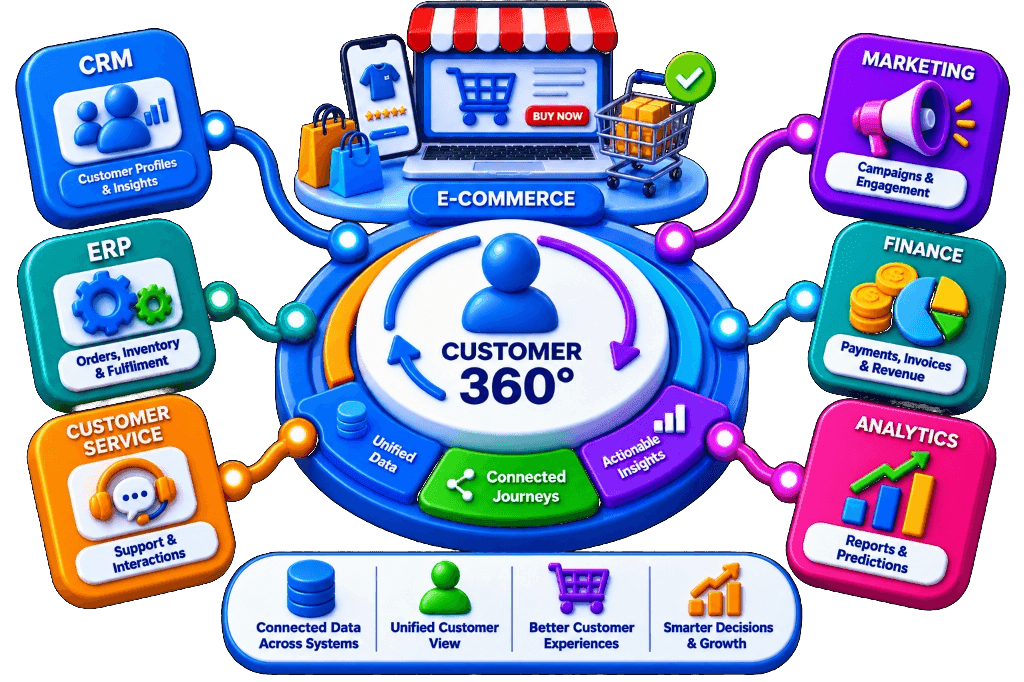
What Is Customer 360 E-commerce Integration?
Customer 360 e-commerce integration connects an e-commerce platform with the systems that manage customer relationships, transactions, operations, marketing and service. The objective is to create connected customer and commerce workflows rather than isolated applications.
Connected Across 10+ Commerce & Enterprise Platforms:
Why Is E-commerce Integration Important for Customer 360?
An online purchase is only one part of the customer relationship. Connected commerce delivers measurable advantages:
Connected Customer Info
Unify browsing behavior, cart contents, and purchase history.
Rich Customer Context
Equip sales and support agents with real-time order visibility.
Live Order Visibility
Track shipment milestones and courier updates from order to door.
Zero Manual Entry
Eliminate re-keying orders into ERP and invoices manually.
Sales & Service Sync
Alert sales reps of high-value online orders and open returns.
Connected Marketing
Trigger personalized post-purchase journeys and review requests.
Lifecycle Management
Identify replenishment cycles and repeat buyer tendencies.
Unified BI Reporting
Consolidate online and offline revenue into single dashboards.
Autonomous Automation
Automate stock deduction, tax calculation, and receipt delivery.
Consistent Data Quality
Standardize customer profiles, addresses, and product catalogs.
Connected Systems & Commerce Data Scope
Integrating storefront operations with CRM customer accounts, ERP inventory, payment gateways, and logistics.
CRM Integration
Connect customers, buyer contacts, organizational accounts, leads, deals, and commercial interaction logs.
ERP Integration
Connect sales orders, product catalogs, live inventory levels, customer master profiles, invoices, and fulfillment.
Marketing Integration
Connect customer profiles, campaign UTM attribution, browsing engagement, and post-purchase lifecycle workflows.
Customer Service Integration
Connect customer accounts, order details, support cases, return merchandise authorizations (RMA), and service history.
Payment Systems Integration
Connect payment gateway authorizations, transaction references, split payouts, and automated refund triggers.
Shipping & Logistics Integration
Connect courier dispatch status, tracking numbers, delivery confirmations, and warehouse packing milestones.
Analytics & BI Integration
Connect revenue, customer acquisition cost (CAC), product margins, and conversion funnel analytics.
7 Core E-commerce Data Domains Integrated
Customer Data
Customer ID, Name, Contact details, Account tier, Buyer type
Product Data
Product ID, Name, SKU, Category, Status, Price variants
Order Data
Order ID, Order date, Line items, Quantity, Value, Status
Payment Data
Payment status, Gateway reference, Approved refund amount
Shipping Data
Shipment status, Courier tracking code, Delivery confirmation
Return Data
Return request, RMA ID, Restock verification, Refund status
Engagement Data
Website browsing, Product interactions, Abandoned cart, Email clicks
Customer 360 E-commerce Architecture Flow
Customer 360 E-commerce Integration Process
A structured 10-stage execution methodology for unified digital commerce workflows.
Map the Commerce Journey
Identify every touchpoint: website visit, product discovery, account creation, cart, checkout, payment, order fulfillment, delivery, return, support, and repeat purchase.
Identify Systems
Document digital storefronts (Shopify, Magento, WooCommerce), CRM, ERP, marketing automation, help desks, payment gateways, couriers, and warehouse inventory.
Identify Data Sources
Determine authoritative origin platforms for customer identities, product SKUs, orders, payment authorizations, returns, shipping telemetry, and website engagement.
Define Systems of Record
Establish master ownership: Storefront (Cart & Checkout), CRM (Customer Relationships), ERP (Products, Inventory, Orders & Invoices), Payment Gateways (Ledger).
Define Customer Data Model
Connect entities into a unified graph: Customer ➔ Account ➔ Orders ➔ Products ➔ Payments ➔ Returns ➔ Service Interactions.
Define Data Mapping
Map field-level entities (E-commerce Customer ID ➔ CRM Contact ID, E-commerce Order ID ➔ ERP Sales Order, Storefront SKU ➔ ERP Item Master).
Define Integration Logic
Configure event triggers, bidirectional sync rules, data transformations, inventory decrement validations, and automatic error handling.
Implement Integration
Deploy API connectors, real-time webhooks, native middleware connectors, and scheduled batch synchronization pipelines.
Test Workflows & Scenarios
Validate new account registration, live order syncing, inventory deduction, payment capture, automated RMA returns, and security access controls.
Monitor and Optimize
Track API latencies, webhook delivery rates, order processing speed, duplicate record rates, and synchronization uptime.
Automated Workflows & Connected Commerce Journey
Powering real-time synchronization from checkout triggers to post-purchase retention.
1. New Customer
2. New Order
3. Repeat Purchase
4. Return & Refund
11-Stage Connected Customer Commerce Journey
E-commerce Integration Challenges
E-commerce Integration Best Practices
Phased Rollout Strategy & Prioritization
A structured 8-phase execution roadmap that delivers fast commercial impact while unifying operational systems.
E-commerce + CRM
Connect buyer accounts, contact history, and sales pipelines.
E-commerce + ERP
Sync product catalogs, live inventory levels, and sales orders.
E-commerce + Payment
Connect payment gateway capture, credit cards, and invoice matching.
E-commerce + Shipping
Connect courier dispatch APIs, tracking numbers, and delivery updates.
E-commerce + Support
Sync order details with help desks for 1-click customer issue triage.
E-commerce + Marketing
Deploy post-purchase journeys, abandoned cart recovery, and VIP tiers.
E-commerce + Analytics
Connect revenue pipelines, product margins, and customer lifetime value.
Autonomous Automation
Deploy automated RMA returns, dynamic pricing, and replenishment triggers.
Why Choose NuageCX for Customer 360 E-commerce Integration?
Customer-Centric Architecture
Design integration around actual buyer journeys and commerce growth metrics.
CRM Integration Mastery
Connect storefront accounts, purchase history, and sales pipelines with CRM.
ERP Operational Connectivity
Connect sales orders, warehouse inventory, and invoices in real time.
Marketing Integration
Connect relevant purchase data and customer lifecycle journeys.
Customer Service Integration
Equip support agents with instant order lookup and return authorization tools.
Robust API & Webhook Pipelines
Deploy sub-second REST connectors and event-driven webhook listeners.
Autonomous Lifecycle Automation
Trigger automated order processing, payment capture, and return flows.
Unified Data Integration
Connect customer identities, SKU catalogs, and interaction logs across systems.
Commerce Analytics & BI
Connect commerce data with customer acquisition cost and revenue reporting.
Strict Data Governance
Establish system of record ownership and canonical data quality standards.
Security & Tokenization
Apply strict PCI-DSS compliance, tokenized payments, and encrypted pipelines.
End-to-End Implementation
Provide full lifecycle support: assessment, architecture, mapping, testing, and deployment.
Frequently Asked Questions
Everything you need to know about Customer 360 e-commerce integration, CRM, ERP, webhooks, payments, costs, and timeline.
Connect E-commerce With Your Customer 360 Architecture
E-commerce is not an isolated transaction channel. It is part of the broader customer relationship.
NuageCX helps businesses integrate e-commerce with CRM, ERP, marketing, customer service, payment, shipping and analytics systems through structured Customer 360 integration.