Customer 360 Data Integration Services for Connected Customer Data
Connect customer data across CRM, ERP, finance, customer service, marketing, e-commerce and other business systems to create a more consistent and connected Customer 360 environment.
NuageCX helps businesses design and implement Customer 360 data integration strategies that connect customer records across systems while addressing data mapping, synchronization, identity resolution, data quality, governance and security.
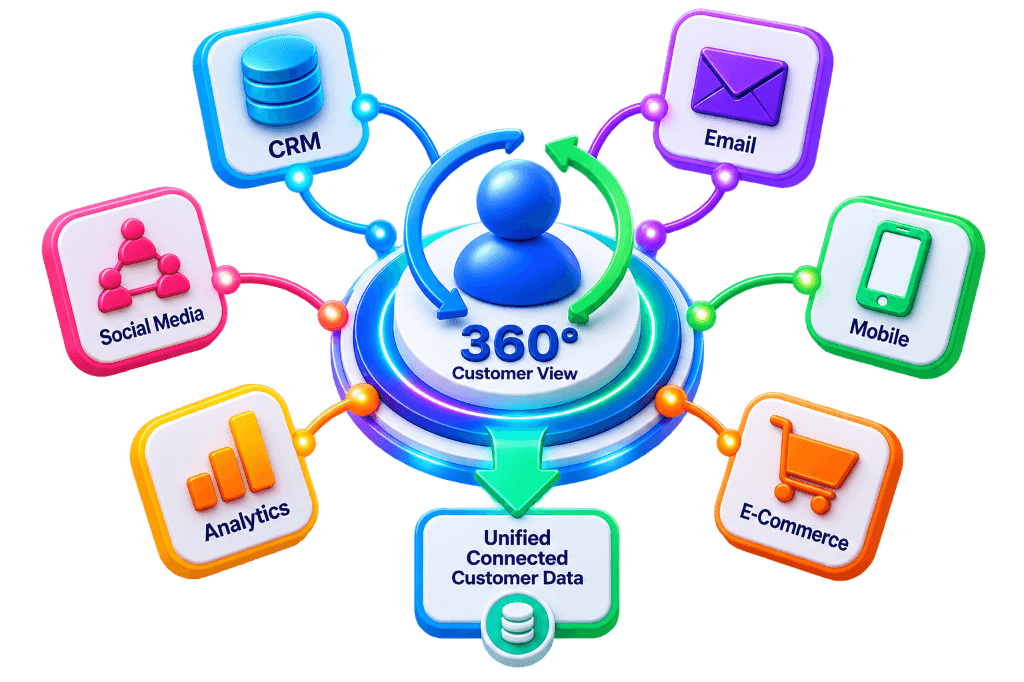
What Is Customer 360 Data Integration?
Customer 360 data integration is the process of connecting relevant customer information from multiple systems so that authorized teams and applications can access the information required for their business processes.
Customer Information May Exist Across 14+ Enterprise Systems:
The objective is not simply to move data between systems. The objective is to create reliable connections between relevant customer information while maintaining appropriate data ownership, quality, security, and governance.
Why Is Customer 360 Data Integration Important?
A customer may exist in several business systems with different identifiers, formats, and levels of completeness. Without appropriate data integration, teams waste hours searching across systems and manually reconciling discrepancies.
Connect Customer Info
Link commercial, operational, and service records into unified customer timelines.
Reduce Data Silos
Break down departmental boundaries between sales, fulfillment, and accounting.
Reduce Repetitive Entry
Eliminate double-entry of client addresses, tax codes, and order details.
Improve Accessibility
Give authorized users instant access to the exact data they need.
Enhance Customer Context
Arm frontline employees with complete historical relationship background.
Support Customer Service
Empower helpdesk agents with instant order, shipment, and warranty tracking.
Improve BI Reporting
Generate trustworthy executive reports from connected enterprise databases.
Enable Workflow Automation
Trigger seamless cross-system business logic from customer lifecycle events.
Improve Data Consistency
Enforce authoritative systems of record and eliminate conflicting values.
Elevate Experiences
Deliver personalized, friction-free interactions across every touchpoint.
What Data Is Included in Customer 360 Data Integration?
The data model should be designed around business requirements rather than attempting to integrate every available field:
Customer Identity
- Customer ID
- Full Name
- Contact Details
- Postal Addresses
- Account Identifiers
- Customer Tier / Type
Sales & Pipeline
- Leads & Sources
- Deals & Opportunities
- Account Hierarchies
- Sales Activities
- Pipeline Stage Info
Transactional & Financial
- Orders & Line Items
- Products & SKUs
- Purchases & Invoices
- Payment Confirmations
- Credit Limits & Balances
Service & Support
- Support Tickets
- Cases & Escalations
- Complaints & SLAs
- Service Interactions
- Resolution History
Marketing & Campaigns
- Campaign Interactions
- Email Engagement
- Communication History
- Audience Segments
- Form Submissions
Digital & Telemetry
- Website Sessions
- Customer Portal Logins
- E-commerce Activity
- Mobile App Events
- Feature Adoption
Customer 360 Data Integration Architecture Flow
Customer 360 Data Integration Process
A proven 12-step engineering methodology for architecting scalable, enterprise-grade customer data fabrics.
Define Customer 360 Objectives
Identify desired business outcomes: sales visibility, service efficiency, automated billing, and unified BI reporting.
Discover Customer Data Sources
Map all repositories across CRM, ERP, Finance, Support, Marketing, E-commerce, Data Warehouses, and Custom Apps.
Classify Customer Data
Categorize datasets into Identity, Contact, Account, Transactional, Product, Service, Engagement, and Financial domains.
Identify Systems of Record
Designate authoritative master sources for each entity (CRM owns leads/deals; ERP owns orders/stock; Finance owns invoices).
Define the Customer Data Model
Establish structured relationships between Customer, Account, Contact, Product, Order, Invoice, and Support Case entities.
Map Data Across Systems
Define comprehensive field-level mappings, naming conventions, data types, required constraints, and transformation rules.
Resolve Customer Identities
Implement deterministic and probabilistic matching algorithms to link multi-system records to a single golden customer entity.
Define Data Synchronization Rules
Establish directional flow rules, event triggers, polling frequencies, conflict resolution logic, and error queues.
Transform & Validate Data
Standardize formatting, normalize postal addresses/phone numbers, validate email syntaxes, and deduplicate records.
Implement Integration Pipelines
Build secure connections using REST APIs, webhooks, enterprise middleware, ETL/ELT pipelines, and event-driven fabrics.
Test Data Flows & Scenarios
Execute end-to-end testing for record creation, schema transformation, high concurrency, failure recovery, and security.
Monitor and Continuously Optimize
Track API latency, data quality SLAs, synchronization integrity, error logs, and schema evolution as business needs scale.
Data Integration
Connects pipelines, APIs, and databases so records flow seamlessly between enterprise systems.
Data Unification
Creates a single, consistent, deduplicated golden customer record across disparate schemas.
Customer 360
Delivers connected, actionable customer context to commercial, operational, and BI teams.
Customer 360 Data Mapping Matrix
| Customer 360 Entity | Authoritative Source System |
|---|---|
| Customer ID | CRM / ERP Master |
| Account Name & Hierarchy | CRM |
| Contact Details & Roles | CRM |
| Sales Order & Fulfillment | ERP |
| Product Catalog & SKUs | ERP |
| Invoices & Billing Records | Finance Ledger / ERP |
| Payment Confirmations | Finance Gateway / ERP |
| Support Case & SLAs | Customer Service Desk |
| Campaign Engagement | Marketing Automation |
| Customer Metrics & LTV | Analytics Platform |
Real-Time Integration
Sub-second event synchronization for critical records: new customer onboarding, payment auth, and urgent support tickets.
Batch Integration
Scheduled high-volume transfers for historical transactions, nightly ledger reconciliation, and heavy data warehouse loads.
Event-Driven Fabric
Webhook-triggered reactive workflows: order dispatched ➔ CRM notify ➔ customer SMS alert.
API-Based Integration
Secure REST/GraphQL programmatic queries for retrieving live customer context across portals and mobile apps.
Industry Data Integration Architectures
Connecting customer records to sector-specific operational frameworks.
Manufacturing & B2B
Connects sales quotes with plant scheduling, raw material inventory, dispatch logistics, and post-sales warranty service.
SaaS & Subscriptions
Synchronizes recurring billing, subscription upgrades, telemetry usage, and customer health scoring.
Digital E-commerce
Connects online shopping carts with automated warehouse fulfillment, inventory reservation, and abandoned cart marketing.
Customer Data Governance Standards
- Data Ownership Rules
- Data Stewardship SOPs
- Authoritative Systems of Record
- Standardized Schemas
- Role-Based Access Controls
- Data Quality SLAs
- Retention Policies
- Integration Governance
Enterprise Data Security Controls
- OAuth 2.0 Authentication
- Granular Role Permissions
- End-to-End Encryption
- API Rate Limiting
- Secure Credential Vaults
- Comprehensive Audit Logs
- Anomaly Monitoring
- Data Access Governance
Customer Data Integration Challenges
Customer Data Integration Best Practices
Phased Rollout Strategy & Prioritization
A structured multi-phase execution that accelerates time-to-value while mitigating technical risk.
CRM & Core Customer Data
Synchronize customer master accounts, contacts, and lead attribution.
ERP & Transaction Data
Connect won deals with sales orders, stock reservation, and fulfillment.
Finance & Billing
Expose invoices, payments, credit limits, and collections status.
Customer Service & Helpdesk
Integrate service cases, SLAs, warranties, and interaction histories.
Marketing & E-commerce
Connect digital commerce checkouts and automated marketing segmentation.
Analytics & Automation
Deploy unified BI dashboards, lifecycle telemetry, and proactive automation.
Why Choose NuageCX for Customer 360 Data Integration?
Customer Data Architecture
Design integration around real customer journeys, operational processes, and tech capabilities.
End-to-End Data Integration
Connect customer records across CRM, ERP, finance, helpdesks, and custom databases.
Canonical Data Mapping
Define precise relationships between fields, records, schemas, and identifiers.
Identity Resolution Engine
Deploy sophisticated deterministic and probabilistic customer matching rules.
Data Quality Management
Eliminate duplicate records, conflicting fields, and invalid customer contact data.
Enterprise Data Governance
Define authoritative systems of record, data standards, and synchronization rules.
CRM and ERP Integration
Bridge front-office revenue teams with back-office fulfillment ledgers.
Executive BI Analytics
Prepare unified customer datasets for advanced lifetime value and cohort reporting.
Cross-System Automation
Use connected data to trigger automated cross-platform workflows.
Zoho Ecosystem Mastery
Integrate Zoho CRM, Zoho Books, Zoho Desk, and Zoho Analytics within broader stacks.
Enterprise Security Controls
Apply OAuth 2.0, role-based access, and end-to-end data encryption.
Full-Lifecycle Implementation
Provide end-to-end support: assessment, architecture, mapping, testing, and optimization.
Frequently Asked Questions
Everything you need to know about Customer 360 data integration, identity resolution, architectures, costs, and timeline.
Build a More Connected Customer Data Environment
Customer 360 depends on more than collecting customer information in one system.
NuageCX helps businesses assess customer data sources, define data architecture, connect systems, improve data quality and build Customer 360 data integration aligned with business requirements.