Customer 360 Master Data Management Services for Trusted Single Source of Truth
Create a trusted, consistent, and governed view of core customer information across CRM, ERP, e-commerce, customer service, finance, marketing, and other business systems.
NuageCX helps businesses establish customer master data structures that reduce duplicate records, standardize customer information, improve data consistency, and create a reliable foundation for Customer 360 initiatives, analytics, automation, and customer experience.
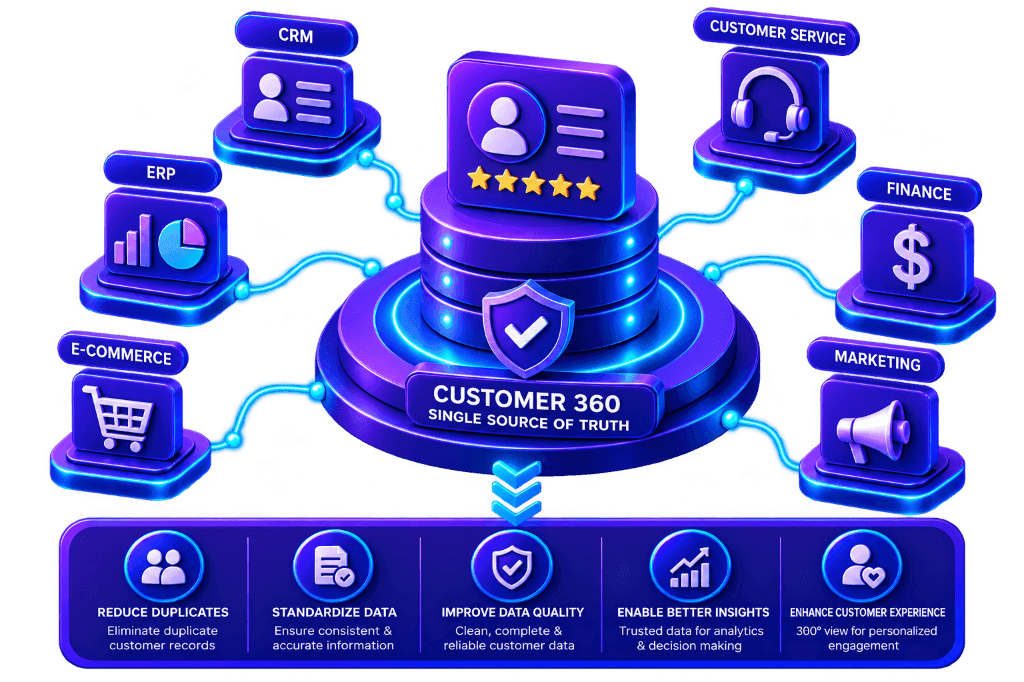
What Is Customer 360 Master Data Management?
Customer 360 Master Data Management (MDM) is the process of creating, maintaining, governing, and distributing a trusted version of core customer information across business systems. Customer master data includes customers, accounts, contacts, organizations, addresses, customer identifiers, customer types, and statuses.
9 Business Consequences of Poorly Managed Master Data:
What Is Customer Master Data?
Customer master data represents relatively stable information used to identify and describe customers or business accounts:
Customer Identity
Full legal name, trade style, Master Customer ID, and unique identifying tax numbers.
Account Information
Account name, account classification, active status, billing terms, and sales ownership.
Contact Details
Verified corporate email, mobile phone, verified physical address, and communication channels.
Organizational Data
Industry NAICS/SIC codes, organization structure, annual revenue band, and company size.
Reference Data
ISO country and state codes, operational currency, customer tiers, and lifecycle categories.
Customer 360 Master Data Management Framework
A disciplined, multi-stage lifecycle to create, govern, and distribute authoritative customer records.
Governed Customer Master Data Lifecycle:
Identify Data Sources
Catalog customer records across CRM, ERP, e-commerce, customer service, marketing, and portals.
Define the Master
Determine which core attributes constitute the organization's authoritative customer master record.
Common Data Model
Define consistent entity attributes, global identifiers, field syntaxes, and cross-table relationships.
Standardize Data
Normalize values, ISO country/state codes, phone numbers, and address formats across source silos.
Match Customer Records
Execute deterministic and probabilistic algorithms to detect records representing the same customer.
Resolve Duplicates
Merge, link, or cluster duplicates using automated survivorship rules and steward approval queues.
Create Golden Record
Synthesize the authoritative Master Customer Profile from the best attributes of each system.
Validate Master Data
Verify that master records satisfy predefined quality, completeness, and compliance standards.
Distribute Master Data
Synchronize approved customer master information outward to connected operational endpoints.
Continuous Monitoring
Continuously audit data health, sync status, duplicate creation rates, and master coverage.
The Customer 360 Golden Record
A single authoritative representation of a customer synthesized from the best attributes across disparate business systems.
Cross-System Golden Record Synthesis
Customer Legal Name + Primary Email + Commercial Contacts
Tax Registration ID + Standard Billing Address + Credit Tier
Verified Mobile Phone + Default Shipping Address + Web UUID
Identity Resolution
Determining which records represent the exact same customer using 7 attributes:
3 Matching Methods
Survivorship Rules
Resolving conflicting values when systems disagree:
Authoritative Systems of Record Definition
Customer & Account Hierarchy Management
Structuring complex enterprise B2B relationships and multi-entity customer models.
Enterprise B2B Customer Hierarchy Structure
Address Management
Standardizes global billing and shipping addresses, postal codes, and city/state ISO schemas.
Contact Management
Maintains names, corporate emails, phone numbers, job titles, roles, and consent preferences.
Identifier Management
Maps disparate system IDs (CRM ID, ERP Account #, E-com UUID) to one Master Customer ID.
Reference Data Management
Governs controlled vocabularies including currencies, country codes, customer stages, and industries.
CRM MDM
Ensures account, contact, and pipeline records are synchronized with financial ledgers.
ERP MDM
Connects operational customer billing and invoicing data with commercial CRM accounts.
E-commerce MDM
Links web transactions, guest checkouts, and shipping profiles to central customer identities.
Customer Service MDM
Provides support agents with verified warranty entitlement and historical ticket context.
Marketing MDM
Associates campaign engagement and opt-in consent with authoritative customer profiles.
Analytics & Automation MDM
Eliminates duplicate entities to deliver precise churn, LTV, and automated routing.
Master Data Management Challenges
Customer MDM Best Practices
Customer MDM Implementation Roadmap & Metrics
A 12-phase execution roadmap and measurable metrics to monitor master data performance.
Master Data Assessment
Assess existing customer master data structures, duplicate rates, and application touchpoints.
Data Discovery & Catalog
Identify customer data entities, attributes, systems of record, and schema dependencies.
Master Data Modeling
Design the uniform customer master schema, account hierarchies, and cross-system entity relationships.
Ownership & Governance
Appoint accountable data owners and operational data stewards with documented approval matrices.
Global Standardization
Define reference datasets, address normalization rules, and ISO-standardized vocabularies.
Identity Resolution Setup
Configure deterministic and probabilistic algorithms to resolve customer identities across silos.
Deduplication & Matching
Execute automated duplicate clustering and establish survivorship merge criteria.
Survivorship Rules
Establish system-of-record priority rules to resolve conflicting field values automatically.
Golden Record Creation
Synthesize the authoritative Master Golden Customer Profile with unified historical lineage.
Multi-System Integration
Connect CRM, ERP, e-commerce, and support platforms via real-time webhooks and APIs.
Governance & Stewardship
Enforce change management policies, approval workflows, and audit logging across master tables.
Continuous Monitoring
Track synchronization health, duplicate creation rates, and master record coverage metrics.
Customer 360 MDM Key Metrics Monitored
MDM vs Data Integration
1: MDM creates, maintains, and governs trusted customer master data.
2: Data Integration moves and synchronizes information between systems.
MDM vs Data Unification
1: MDM establishes the authoritative master data definitions and governance.
2: Data Unification brings cross-channel records into a connected view.
MDM vs Data Quality
1: MDM creates, structures, and distributes trusted master records.
2: Data Quality measures, validates, and cleanses data attributes.
Why Choose NuageCX for Customer 360 Master Data Management?
Customer Master Strategy
Design practical master data architectures tailored to your technology ecosystem and business goals.
Customer Identity Resolution
Connect fragmented touchpoint records across web, mobile, CRM, and ERP to unique Master IDs.
Data Standardization
Create uniform customer data schemas, international address formatting, and reference data values.
Intelligent Deduplication
Deploy automated fuzzy matching and survivorship merge logic to eliminate duplicate accounts.
Golden Record Architecture
Synthesize authoritative Golden Customer Profiles capturing full cross-system audit lineage.
Survivorship Rules Engine
Define explicit system-of-record priority rules to resolve conflicting field values automatically.
Customer & Account Hierarchy
Manage parent organizations, holding companies, subsidiaries, and complex B2B account trees.
CRM & ERP Integration
Harmonize operational customer data between CRM sales pipelines and ERP accounting ledgers.
Comprehensive Data Quality
Measure and enforce accuracy, completeness, consistency, uniqueness, validity, and freshness.
Master Data Governance
Establish operational stewardship, ownership matrices, change management, and security policies.
Zoho Ecosystem Specialization
Seamless master data orchestration across Zoho CRM, Zoho Books, Zoho Analytics, and Zoho Desk.
End-to-End Implementation
Complete support from initial master data audit to golden record design, sync, and continuous tuning.
Frequently Asked Questions
Everything you need to know about Customer 360 Master Data Management, golden records, hierarchies, and synchronization.
Build a Trusted Customer Master for Customer 360
A Customer 360 strategy requires more than connecting systems.
It requires trusted customer identities, consistent master data, controlled relationships, clear ownership, defined standards, and reliable information across the customer lifecycle.