Customer 360 Data Unification Services for Connected Customer Records
Unify customer information from CRM, ERP, e-commerce, customer service, marketing, finance, and other business systems to create a connected and consistent customer view.
NuageCX helps businesses design Customer 360 data unification solutions that connect customer identities, records, transactions, interactions, and business data across fragmented systems.
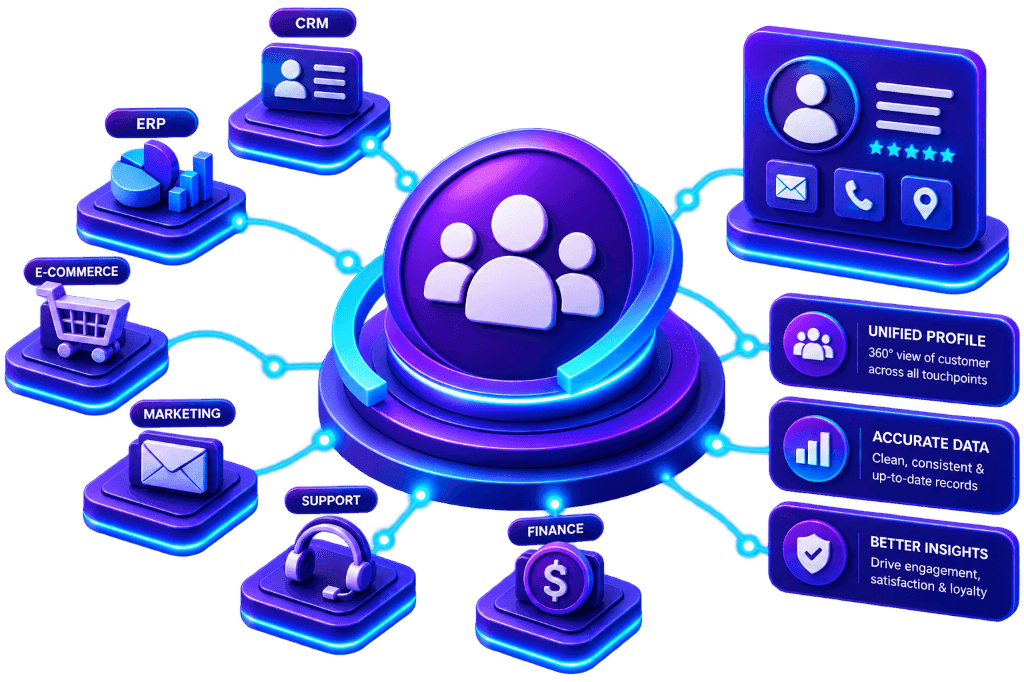
What Is Customer 360 Data Unification?
Customer 360 data unification is the process of bringing relevant customer information from multiple systems together around a common customer identity and data model. Data unification is broader than simply connecting systems: it focuses on creating meaningful relationships between customer records and the information associated with them.
A Single Customer Has Separate Records Across Disconnected Systems:
Unified Customer View (Customer 360)
All identities, purchases, SLA contracts, service tickets, and communication history interconnected around a single verified customer profile.
The Cost of Fragmented Customer Data
Data Unification Business Outcomes
What Does Customer 360 Data Unification Include?
A comprehensive ten-pillar framework to bring disconnected records into a unified data architecture.
Identity Resolution
Determine which records across disparate systems represent the same customer.
Data Integration
Connect relevant CRM, ERP, commerce, support, and financial data sources.
Data Standardization
Create consistent data formats, ISO taxonomies, and normalized field values.
Data Deduplication
Identify and manage duplicate records with intelligent survivorship logic.
Data Modeling
Define customer entities, hierarchies, and multi-relational structures.
Record Matching
Apply deterministic and probabilistic matching rules to link entities.
Data Consolidation
Bring fragmented profiles and transaction histories into a central structure.
Data Governance
Define ownership, data stewardship standards, access controls, and retention.
Data Quality
Monitor accuracy, completeness, consistency, uniqueness, validity, and timeliness.
Data Security
Protect customer PII with role-based access, encryption, and privacy rules.
Customer 360 Data Unification Architecture Flow
How Does Customer 360 Data Unification Work?
A structured 12-step methodology to profile, standardize, resolve, and maintain unified customer intelligence.
Identify Customer Data Sources
Locate where customer information exists across CRM, ERP, e-commerce, customer service, marketing, finance, and portals.
Profile the Data
Assess source data quality, duplicate rates, missing fields, disparate data formats, identifiers, and entity relationships.
Define Customer Identity
Establish authoritative global identity schemes and matching criteria to identify customers uniquely across business systems.
Define the Customer Data Model
Model relationships across: Customer ➔ Account ➔ Contacts ➔ Orders ➔ Products ➔ Transactions ➔ Interactions ➔ Service History.
Map Data Across Sources
Map customer attributes between source and unified schemas, creating uniform mappings for contacts, accounts, and transactions.
Standardize Data Formats
Normalize formats, definitions, values, ISO country/state codes, taxonomies, and entity identifiers across systems.
Resolve Customer Identities
Apply deterministic and probabilistic matching algorithms to connect records belonging to the same individual or organization.
Manage Duplicates & Survivorship
Detect duplicates, execute survivorship rules, and merge or cross-reference records into golden customer entities.
Build Unified Customer Records
Consolidate profiles, purchase histories, open service cases, and marketing touchpoints around the unified customer identity.
Apply Governance & Security
Implement role-based access permissions, system of record ownership, audit trails, and data privacy compliance controls.
Validate the Unified View
Perform rigorous end-to-end testing of customer relationships, data accuracy, false-match rates, and business workflows.
Monitor, Alert & Continuously Improve
Track match accuracy, duplicate generation, synchronization latency, schema drifts, and data quality dimensions continuously.
Identity Resolution, Matching & Golden Records
Determining customer relationships, managing duplicates, and creating an authoritative Single Source of Truth.
Identity Resolution in Action
A customer often appears under different names or syntaxes across systems:
Deterministic vs Probabilistic Matching
Deterministic Matching (Exact Rules)
Uses defined exact attributes (e.g., Same Email + Same Tax ID ➔ 100% Match).
High Control • Zero False MatchesProbabilistic Matching (Similarity Scores)
Uses fuzzy algorithms across name phonetics, postal addresses, and phone numbers.
Fuzzy Logic • Similarity Confidence ScoringData Standardization
Normalizes disparate values into common definitions:
Deduplication Flow
6-Stage Deduplication Process:
The Golden Record
Single trusted customer representation:
Customer 360 Unified Data Model Hierarchy
Domain-Specific Unification & Business Models
Unifying customer data across core operational domains for B2B, B2C, and omnichannel customer journeys.
CRM Data Unification
Unify customer profiles, parent accounts, contacts, open opportunities, and commercial activities across systems.
ERP Data Unification
Unify sales orders, customer product SKUs, warehouse inventory status, customer invoices, and payment balances.
E-commerce Unification
Unify storefront customer profiles, digital cart checkouts, purchase history, and product return data.
Service Data Unification
Unify help desk support cases, customer complaints, resolution logs, agent notes, and SLA contract tiers.
Marketing Data Unification
Unify campaign attribution, audience segments, email click logs, and customer lifecycle progression.
Finance Data Unification
Unify payment receipts, customer credit memos, billing history, and tax ledger accounts.
B2B Data Unification
Model complex corporate relationships:
- • Parent Organizations & Subsidiaries
- • Multiple Buyer Contacts & Buying Roles
- • Regional Office & Warehouse Locations
- • Master Service Agreements & Volume Contracts
B2C Data Unification
Manage high transaction volumes:
- • Individual Consumer Golden Profiles
- • High-Frequency Orders & Return Data
- • Multi-Touch Campaign Attribution
- • Mobile App Telemetry & Browsing Behavior
Omnichannel Journey
Interconnect touchpoints seamlessly:
Data Unification Challenges
Data Unification Best Practices
Phased Rollout Strategy & Architecture Roadmap
A structured 6-phase rollout methodology that delivers rapid operational wins while building enterprise-scale customer context.
CRM & Identity Foundation
Unify CRM accounts, contacts, and global customer identity criteria.
ERP & Transaction Data
Connect ERP sales orders, product SKUs, inventory, and payment ledgers.
E-commerce & Web Purchases
Unify online store checkouts, digital cart items, and return transactions.
Customer Service Integration
Connect support tickets, resolution histories, and SLA contracts.
Marketing & Engagement
Unify campaign attribution, audience segments, and lifecycle stages.
Analytics & Optimization
Deploy unified BI reporting, governance workflows, and automated tuning.
Unification vs Integration
Data Integration: Connects and exchanges information between systems.
Data Unification: Establishes meaningful relationships around a single customer identity.
Unification vs Consolidation
Data Consolidation: Brings data together from multiple sources.
Data Unification: Adds identity resolution, standards, and customer context.
Unified View vs Golden Record
Unified View: Presents connected customer data across touchpoints.
Golden Record: Trusted master entity created with defined survivorship rules.
Why Choose NuageCX for Customer 360 Data Unification?
Customer-Centric Architecture
Design unified customer structures around actual business processes and buyer journeys.
Identity Resolution Mastery
Connect customer records using deterministic, probabilistic, and AI matching rules.
Data Standardization
Create consistent customer data formats, ISO taxonomies, and standardized definitions.
Automated Deduplication
Identify and manage duplicate records with intelligent survivorship merge logic.
Multi-System Integration
Connect CRM, ERP, e-commerce, customer service, marketing, and finance seamlessly.
Robust Data Governance
Establish clear system of record ownership, stewardship roles, and audit trails.
Continuous Data Quality
Improve consistency, completeness, validity, uniqueness, timeliness, and accuracy.
High-Performance APIs
Connect platforms using REST APIs, webhooks, and asynchronous message queues.
Analytics Readiness
Deliver governed customer datasets optimized for executive BI dashboards and AI insights.
Zoho Ecosystem Expertise
Deep specialization in Zoho CRM, Zoho Books, Zoho Analytics, and Zoho Desk.
Enterprise Security
Ensure role-based access control, encrypted data pipelines, and GDPR/CCPA compliance.
End-to-End Implementation
Comprehensive support: assessment, architecture, mapping, testing, deployment, and optimization.
Frequently Asked Questions
Everything you need to know about Customer 360 data unification, identity resolution, golden records, and deduplication.
Create a Unified Customer 360 Data Foundation
Customer information becomes more valuable when it can be connected, understood, and used in the right business context.
NuageCX helps businesses unify customer information across CRM, ERP, e-commerce, customer service, marketing, finance, and other systems through structured data architecture, identity resolution, standardization, deduplication, integration, governance, and monitoring.