Customer 360 Data Integration Services for Connected Systems & Records
Connect customer information across CRM, ERP, e-commerce, customer service, marketing, finance, and other business systems to create a connected and reliable Customer 360 data foundation.
NuageCX helps businesses design and implement Customer 360 data integration solutions that connect customer records, transactions, interactions, and business data across systems.
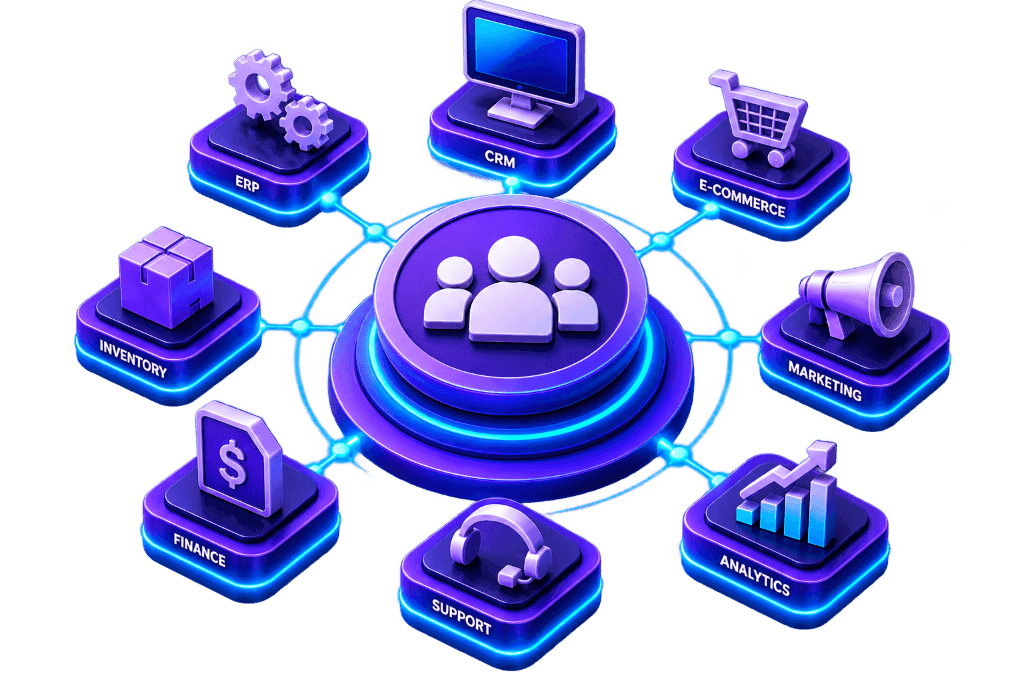
What Is Customer 360 Data Integration?
Customer 360 data integration is the process of connecting relevant customer information from multiple business systems into a consistent and accessible data environment. The objective is not simply to connect applications: it is to create a reliable foundation for understanding and using customer information across the organization.
Connecting Customer Data Across 9+ Enterprise Systems:
Why Is Customer 360 Data Integration Important?
Businesses often store customer information in disconnected silos. Integration bridges operational gaps:
Connected Customer Info
Unify buyer accounts, orders, and interaction histories.
Reduced Data Fragmentation
Eliminate disjointed customer profiles across platforms.
Complete Visibility
Provide sales and support with real-time customer context.
Zero Manual Re-Entry
Automate record creation between CRM, ERP, and commerce.
Workflow Automation
Trigger multi-system actions on order capture or ticket triage.
Accurate BI Reporting
Consolidate revenue and engagement into executive dashboards.
Enhanced Customer Service
Equip service agents with instant purchase and account lookups.
Unified Operations
Align marketing campaigns with operational inventory stock.
Strengthened Data Quality
Enforce uniform schemas, validation checks, and deduplication.
True Customer 360
Lay the authoritative data foundation for scalable digital growth.
What Systems & Data Can Be Integrated?
Comprehensive multi-point synchronization across core operational platforms and data entities.
CRM Integration
Connect customer records, buyer contacts, accounts, inbound leads, commercial opportunities, and sales activities.
ERP Integration
Connect sales orders, product SKUs, warehouse inventory, billing accounts, customer invoices, and payment ledgers.
E-commerce Integration
Connect customer storefront profiles, online orders, digital cart items, gateway payments, and RMA returns.
Customer Service Integration
Connect customer accounts, support cases, ticket resolutions, agent chat logs, and service history.
Marketing Integration
Connect customer profiles, campaign engagement metrics, lifecycle stage tags, and dynamic audience segments.
Finance Integration
Connect customer billing profiles, tax invoices, payment receipts, approved refunds, and credit memos.
Analytics Integration
Connect customer, transactional, and operational metrics into business intelligence warehouses and BI reporting tools.
6 Core Customer Data Categories Integrated
Customer Information
Customer ID, Name, Email, Phone, Customer Type, Account Tier
Account Information
Company, Industry, Account Status, Locations, Relationship Details
Transaction Information
Orders, Products, Purchases, Payments, Invoices, Payment References
Service Information
Cases, Tickets, Complaints, Resolutions, SLA Milestones, Service History
Marketing Information
Campaign Engagement, Lifecycle Stage, Customer Segments, Interaction Touchpoints
Digital Interaction Data
Website Browsing, Portal Activity, Mobile App Usage, Form Submissions
Customer 360 Data Integration Architecture Flow
Customer 360 Data Integration Process
A structured 12-phase execution methodology for connecting enterprise customer datasets.
Discover Customer Data Sources
Identify all systems containing relevant customer information across CRM, ERP, commerce, customer service, marketing, finance, and portals.
Assess Data Quality & Formats
Review source data completeness, duplicate rates, disparate data formats, customer identifier schemes, and data ownership models.
Define Integration Requirements
Determine what data needs to move, between which systems, in which direction, at what frequency, and for which business processes.
Define Systems of Record
Establish authoritative ownership for customer profiles, corporate accounts, contacts, product SKUs, orders, service cases, and invoices.
Create Field-Level Data Mapping
Map fields between source and destination systems (e.g., CRM Contact ID ➔ Customer 360 ID, ERP Customer ID ➔ Customer 360 ID).
Standardize Data Schemas
Create uniform formats for names, postal addresses, ISO country/state codes, customer tiers, industry taxonomies, and entity IDs.
Implement Identity Resolution
Deploy deterministic and probabilistic matching rules to accurately resolve customer identities across disparate systems.
Implement Integration Pipelines
Build connections using REST APIs, event-driven webhooks, native middleware connectors, and scheduled batch synchronization pipelines.
Validate Data Quality & Rules
Enforce automated checks for mandatory fields, valid email/phone syntaxes, identifier uniqueness, and cross-system consistency.
Test End-to-End Business Workflows
Simulate real customer journeys across connected systems: new lead capture, sales order checkout, invoice creation, and support ticket triage.
Deploy to Production
Execute phased cutover with zero downtime, initializing data pipelines and event listeners into the live operating environment.
Monitor, Alert & Optimize
Track API latencies, webhook delivery success rates, duplicate record generation, synchronization queues, and schema anomalies.
Data Mapping, Transformation & Deduplication
Standardizing field schemas, resolving disparate identities, and establishing automated deduplication.
Cross-Platform Field Mapping Example
| Source System & Field | Direction | Customer 360 Target Field |
|---|---|---|
| CRM Contact ID | ➔ | Customer 360 Customer ID |
| CRM Account | ➔ | Customer 360 Account |
| ERP Customer ID | ➔ | Customer 360 Customer ID |
| ERP Order ID | ➔ | Customer 360 Order ID |
| E-commerce SKU | ➔ | Product ID |
| Service Case ID | ➔ | Customer 360 Case ID |
Data Transformation
Normalizes disparate values into common definitions:
Identity Resolution
Connects the same buyer across platforms:
Data Deduplication
6-Stage Deduplication Process:
Data Integration Challenges
Data Integration Best Practices
Phased Rollout Strategy & Prioritization
A structured 6-phase rollout methodology that delivers rapid operational wins while unifying enterprise systems.
CRM Integration
Connect core customer accounts, contact history, and sales pipelines.
ERP Integration
Sync operational sales orders, product SKUs, inventory, and invoices.
E-commerce Integration
Connect online storefront checkouts, digital cart items, and RMA returns.
Customer Service Integration
Sync support tickets and case histories with customer accounts.
Marketing & Finance Sync
Integrate campaign attribution, payment receipts, and refund credits.
Analytics & Optimization
Deploy unified BI reporting, data governance, and automated tuning.
Why Choose NuageCX for Customer 360 Data Integration?
Customer-Centric Architecture
Design data integrations around real buyer touchpoints and organizational workflows.
Multi-System Integration
Connect CRM, ERP, e-commerce, customer service, marketing, and finance seamlessly.
Comprehensive Data Mapping
Define precise field-level transformation rules between disparate application schemas.
Identity Resolution Mastery
Deploy deterministic and probabilistic algorithms to resolve customer identities.
Data Quality Enforcement
Eliminate duplicates, standardize field formats, and implement schema validation.
High-Throughput API Pipelines
Deploy resilient REST API connectors and event-driven webhook listeners.
Autonomous Workflow Automation
Trigger multi-system business processes on checkout, payment, or support events.
Robust Data Governance
Establish clear system of record ownership, stewardship roles, and audit logging.
Security & Encryption
Apply role-based access control, tokenized credentials, and encrypted transport.
Analytics Readiness
Deliver governed data models ready for executive BI reporting and AI customer insights.
Zoho Ecosystem Expertise
Seamlessly integrate Zoho CRM, Zoho Books, Zoho Analytics, and Zoho Desk.
End-to-End Implementation
Provide complete support: assessment, architecture, mapping, testing, and deployment.
Frequently Asked Questions
Everything you need to know about Customer 360 data integration, CRM, ERP, APIs, mapping, costs, and timeline.
Connect Your Customer Data Into a Stronger Customer 360 Foundation
Customer 360 depends on connected and reliable customer information.
NuageCX helps businesses design and implement Customer 360 data integration architectures that connect relevant customer information while addressing data mapping, transformation, identity, quality, governance, security, and scalability.