Customer 360 Customer Journey Services
Design, connect, automate, and optimize customer journeys using a unified Customer 360 view across marketing, sales, service, customer success, CRM, ERP, analytics, and other business systems.
NuageCX helps businesses create connected customer journeys by combining customer data, interactions, lifecycle stages, business processes, automation, and analytics.
Instead of managing isolated touchpoints, Customer 360 customer journey solutions help organizations understand how customers move across the complete relationship and identify opportunities to reduce friction, improve engagement, increase retention, and create better customer experiences.
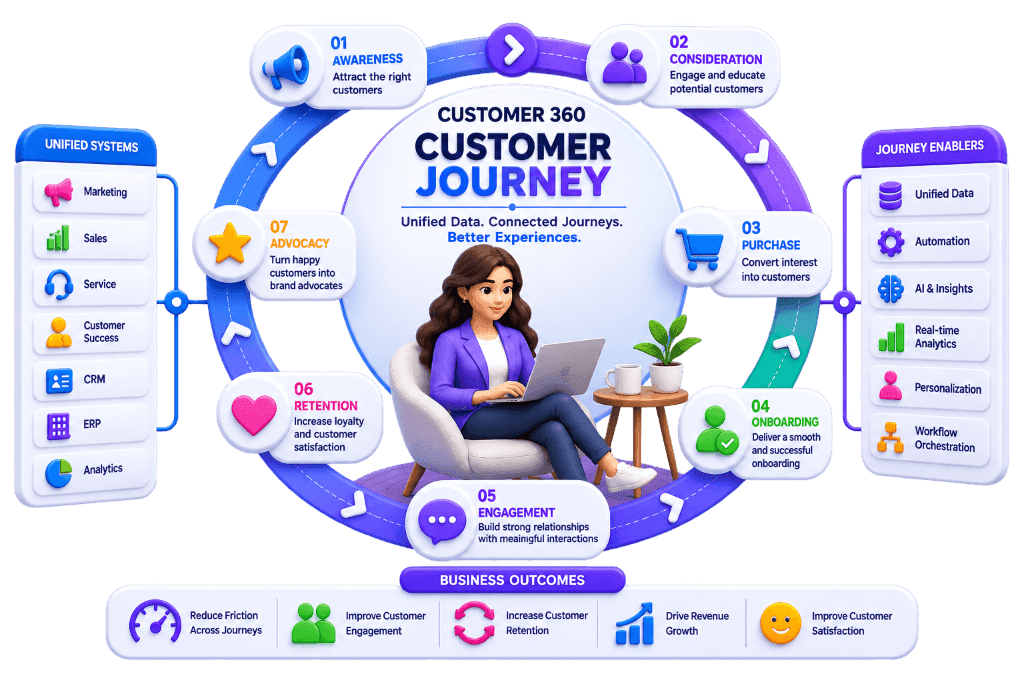
What Is a Customer 360 Customer Journey?
A Customer 360 customer journey is the complete sequence of interactions and experiences a customer has with a business, supported by a connected view of relevant customer information across all touchpoints.
Customer 360 journey management orchestrates 12 foundational touchpoint streams:
Marketing Interactions
Campaign responses, webinar presence, whitepaper downloads, and ads
Website Activity
Browsing trails, product page dwell time, searches, and documentation reads
Sales Conversations
Discovery calls, demo sessions, customized proposals, and negotiations
Purchases
Commercial transactions, signed contracts, orders, and initial invoices
Onboarding
Setup checklists, role-based training, integrations, and milestone sign-offs
Product Usage
Telemetry events, daily active sessions, feature depth, and cloud portal logins
Customer Support
Inbound ticket resolutions, live chats, phone escalations, and technical SLAs
Customer Success
Health reviews, quarterly business reviews (QBRs), and adoption milestones
Billing & ERP
Subscription renewals, payment confirmations, ledger entries, and statements
Renewals
Contract longevity discussions, pricing options, terms, and re-commitments
Expansion
Cross-sell recommendations, tier upgrades, seat expansions, and add-on services
Customer Feedback
NPS surveys, CSAT ratings, product feature votes, and executive interviews
*Customer 360 adds broader customer context to journey management by connecting relevant information across systems.
Why Is Customer Journey Management Important?
Customers interact with businesses across multiple channels and departments throughout their lifecycle:
When these stages operate independently, customers experience severe friction:
*Customer 360 customer journey management eliminates these silos by maintaining persistent context.
How Does Customer 360 Customer Journey Management Work?
A continuous 13-stage engineering pipeline connecting telemetry to measured business outcomes:
*The exact implementation depends on the organization's systems, customer journeys, data architecture, and business requirements.
Customer 360 Customer Journey Framework
A disciplined, 10-step strategic methodology for designing and executing connected customer journeys:
Identify Journeys
Determine the journeys that matter most to customers and the business.
Map Touchpoints
Document interactions across channels, portals, teams, and platforms.
Identify Data
Determine what information is required to understand each journey milestone.
Connect Systems
Integrate relevant CRM, ERP, marketing, service desks, and analytics.
Define Stages
Establish clear lifecycle stages and transition triggers across departments.
Find Experience Gaps
Locate friction points, delays, customer drop-offs, and broken handoffs.
Design Logic
Define how customer context should trigger the next appropriate action.
Automate Actions
Deploy automated workflows and screen-pop triggers where value is added.
Measure Performance
Track engagement, conversion, CSAT, retention, and business growth.
Optimize
Continuously improve the journey using telemetry data and customer feedback.
Customer 360 Customer Journey Stages
An 11-stage journey framework tailored to enterprise customer lifecycles:
Discover
The customer becomes aware of the business, product, or solution.
Engage
The customer interacts with relevant content, marketing channels, or teams.
Evaluate
The customer evaluates available solutions against technical requirements.
Purchase
The customer completes a transaction and enters into a commercial contract.
Onboard
The business guides the customer through setup, training, and initial implementation.
Adopt
The customer begins active usage and derives initial measurable value.
Support
The customer receives fast, contextual assistance when questions arise.
Success
Teams collaborate toward desired business outcomes and value realization.
Renew
The customer continues the relationship with seamless contract renewal.
Expand
The customer adopts additional product modules, tiers, or services.
Advocate
The customer becomes a public advocate, reference, or reviewer.
Customer 360 Customer Journey Mapping
Documents the relationship between customer actions, internal processes, systems, and experiences:
Omnichannel Customer Journey Flow
Customers move between channels during a single journey. Customer 360 preserves context throughout:
15 Key Touchpoints Mapped Across the Customer Journey:
Personalized Customer Journeys
Adapting journeys using profile, segment, lifecycle stage, purchase history, usage telemetry, engagement, health, and service history:
Customer Journey Automation Sequence
Connecting customer signals directly with automated operational execution:
Journey Orchestration & Next Best Action
Moving from rigid campaigns to an adaptive model that responds dynamically to customer behavior:
Journey Orchestration Model
Next Best Action Scenarios
Determines which action is most appropriate based on customer context:
Specialized Customer Journeys
Tailoring journey management across distinct operational functional domains:
Sales Journey
7 sequential sales stages:
Onboarding Journey
8 activation milestones:
Support Journey
7 resolution steps:
Customer Success Journey
Proactive relationship cadence:
Renewal Journey
Proactive contract continuity:
Retention & Churn Journey
Intervention workflow:
Customer Journeys Across Different Business Models
Tailoring journey tracking to the specific operational workflows of each industry:
B2B Customer Journey
Coordinates multiple decision makers, long sales cycles, procurement, ERP order delivery, service SLAs, and multi-year renewals.
SaaS Customer Journey
Connects Trial conversion, Onboarding, in-app Feature Activation, Adoption telemetry, CS health, and expansion triggers.
Manufacturing Journey
Bridges Leads, Quotations, ERP Production orders, Shipping delivery, on-site Installation, preventative Maintenance, and parts replenishment.
E-commerce Journey
Connects Discovery, Product research, Instant purchase, Delivery updates, post-purchase Education, repeat Orders, and retention.
Customer Journey Dashboard & 19 KPIs
A 6-module journey intelligence command center backed by 19 operational KPIs:
Journey Progress
Customers by stage, stage-to-stage conversion, completion rate, and drop-offs
Customer Experience
CSAT, Net Promoter Score (NPS), Customer Effort Score (CES), and sentiment
Customer Engagement
Interaction frequency, marketing response rate, and daily product adoption
Customer Service
Ticket volume, first-contact resolution (FCR), response time, and escalations
Customer Retention
Churn risk indicators, renewal progression, and longitudinal account health
Revenue & Growth
Cross sell rate, upsell conversion, account expansion value, and customer LTV
19 Core KPIs for Customer Journey Management:
Customer Journey Challenges
Customer Journey Best Practices
10-Phase Journey Implementation Roadmap
NuageCX executes a comprehensive 10-phase delivery roadmap for enterprise journey management:
Phase 1: Assessment
Identify existing customer journeys, handoff friction, and experience gaps.
Phase 2: Prioritization
Select high-impact journeys that deliver the fastest commercial returns.
Phase 3: Journey Mapping
Document touchpoints, teams, software systems, and customer expectations.
Phase 4: Data Assessment
Identify all customer telemetry required for each journey milestone.
Phase 5: Integration
Connect relevant CRM, ERP, marketing, service, and analytics tools.
Phase 6: Journey Design
Define optimized, frictionless customer journeys with clear handoff rules.
Phase 7: Automation
Implement appropriate triggers, screen-pop alerts, and task playbooks.
Phase 8: Personalization
Apply contextual customer information to tailor interactions dynamically.
Phase 9: Analytics
Deploy dashboards to track stage conversion, drop-offs, and outcomes.
Phase 10: Optimization
Continuously refine journeys based on operational data and feedback.
How Much Does It Cost?
Implementation cost depends on the number and complexity of journeys, connected systems, data sources, integration complexity, automation requirements, personalization, analytics, customer volume, data quality, security, and governance.
There is no universal cost. A tailored journey assessment establishes the exact investment.
How Long Does It Take?
Timelines depend on the number of journeys, complexity, data availability, system integrations, workflow automation, personalization logic, analytics, testing, and governance.
A focused journey optimization project can be deployed in a few weeks, whereas enterprise-wide journey transformations are executed in structured milestones.
When Should a Business Implement Customer 360 Customer Journey Management?
Conceptual Differences & Why Choose NuageCX
Clarifying foundational concepts and exploring NuageCX’s delivery capabilities:
Customer 360 vs. Journey Management
Customer 360 focuses on creating connected customer context across systems. Customer Journey Management focuses on understanding, designing, managing, and optimizing how customers move through interactions and lifecycle stages. Customer 360 provides the context required for journey management.
Journey Mapping vs. Journey Management
Customer journey mapping documents customer interactions, stages, touchpoints, and experience gaps. Customer journey management goes further by actively designing, operating, measuring, automating, and optimizing journeys.
Customer 360 Expertise
Design customer journeys using connected customer context.
Journey Strategy
Identify, prioritize, map, and optimize high-value customer journeys.
Data Integration
Connect CRM, ERP, marketing, service, and analytics platforms.
Journey Automation
Automate customer journey processes, handoffs, and notifications.
Personalization
Use customer context to create more contextual journeys.
Customer Experience
Reduce friction and improve continuity across touchpoints.
Journey Analytics
Measure conversion, drop-offs, engagement, and retention.
CRM & ERP Integration
Connect relationship and transactional data for broader visibility.
Zoho Ecosystem Mastery
Leverage Zoho CRM, Desk, Analytics, and Flow for journeys.
End-to-End Delivery
Support assessment, mapping, integration, testing, and optimization.
Frequently Asked Questions
Everything you need to know about Customer 360 Customer Journey Services:
Build Connected Customer Journeys With Customer 360
Customer journeys become difficult to manage when customer information, teams, channels, and systems operate independently. NuageCX helps businesses connect customer data, CRM, ERP, marketing, service, customer success, automation, analytics, and customer journey processes to create more connected and measurable customer experiences.