Customer 360 Customer Experience Services
Create connected, personalized, and consistent customer experiences by bringing customer data, interactions, business processes, and teams together through a Customer 360 framework.
NuageCX helps businesses design and implement Customer 360 customer experience solutions that connect customer information across marketing, sales, service, customer success, finance, ERP, CRM, analytics, and other business systems.
Instead of treating every interaction as an isolated event, Customer 360 enables businesses to understand the broader customer relationship and deliver more relevant experiences throughout the customer lifecycle.
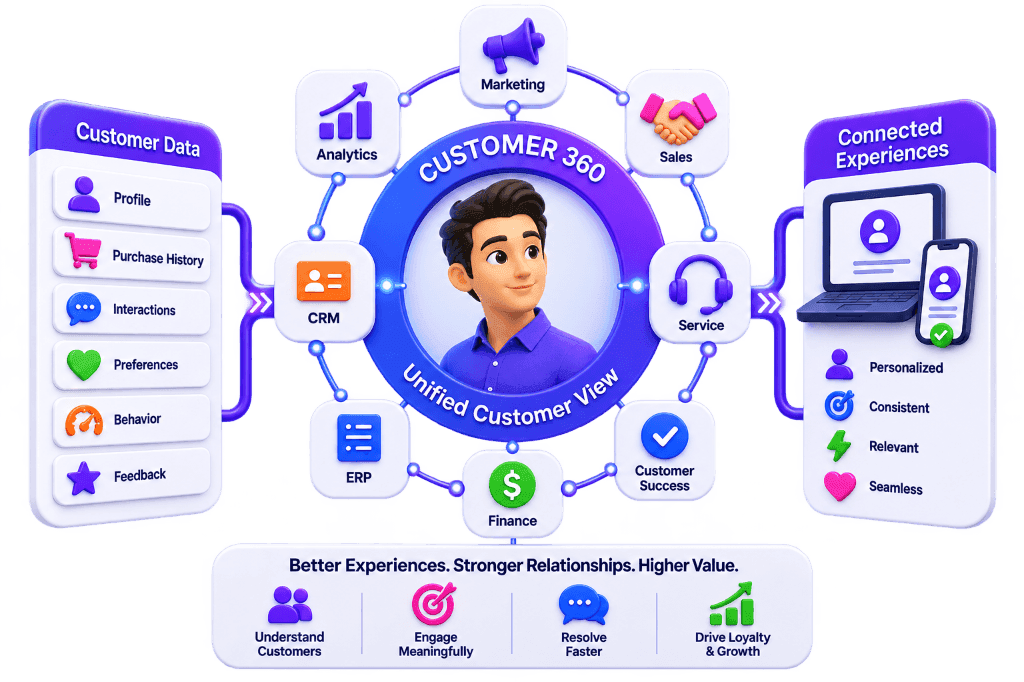
What Is Customer 360 Customer Experience?
Customer 360 Customer Experience is an approach to managing customer interactions using a unified view of relevant customer information across the entire organization.
It empowers every team to understand 9 essential dimensions of the relationship:
Who the customer is
Authoritative customer profile, account hierarchy, and contact roles
What they purchased
Products, software tiers, active subscriptions, and order volumes
Interactions occurred
Omnichannel meeting notes, emails, phone calls, and chats
Services they used
Feature adoption telemetry, cloud portal logins, and consulting sessions
Issues experienced
Support ticket history, unresolved bugs, and escalation logs
Where they are in lifecycle
Onboarding, active adoption, renewal window, or mature advocacy
How engaged they are
Activity velocity, webinar participation, and email response rates
What they need next
Contextual next-best-action, cross-sell eligibility, or training needs
Who is responsible
Clear departmental ownership across Sales, CS, Service, and Account Execs
*The objective is to create a more connected customer experience across every relevant touchpoint.
Why Is Customer 360 Important for Customer Experience?
Customers do not think in terms of internal departments. They expect the business to understand their entire relationship whether interacting with:
The Frustration of Data Fragmentation: When customer information is fragmented, customers have to repeatedly explain their requirements, previous interactions, purchases, or issues. Customer 360 helps organizations create a coordinated experience by making relevant customer context available to the right teams and systems.
How Does Customer 360 Improve Customer Experience?
An 8-tier sequential continuum connecting fragmented customer data into coordinated business outcomes:
Customer 360 Customer Experience Framework
A disciplined, 9-step blueprint for designing, orchestrating, and optimizing connected customer experiences:
Identify Customer
Create a consistent view of the customer or account across relevant systems.
Unify Customer Information
Connect relevant customer data from multiple internal and external sources.
Understand Customer Context
Analyze interactions, transactions, service history, engagement, and lifecycle stage.
Map Customer Journey
Understand how customers move across different stages, channels, and touchpoints.
Identify Experience Gaps
Find friction, delays, disconnected handoffs, and recurring customer complaints.
Design Improvements
Create improved customer journeys, streamlined processes, and unified playbooks.
Automate Actions
Trigger appropriate workflows based on real-time customer events and business rules.
Measure Outcomes
Track customer experience, CSAT, NPS, effort scores, and business KPIs.
Continuously Optimize
Use real-time customer feedback and analytical intelligence to improve the experience.
Customer 360 Across the Customer Lifecycle
Customer experience should be considered continuously across every single stage of the relationship:
Awareness
Provide relevant information based on customer needs and initial context.
Lead
Coordinate early lead interactions and customer information without friction.
Qualification
Give sales teams relevant contextual history to personalize discussions.
Purchase
Create a smooth, transparent transition from prospect to paying customer.
Onboarding
Coordinate onboarding activities, milestone validation, and communications.
Adoption
Monitor product engagement, active usage telemetry, and feature adoption.
Support
Provide service teams with relevant customer history and fast resolution paths.
Success
Identify opportunities to improve customer outcomes and business value.
Retention
Identify early customer friction, dissatisfaction, and experience risks.
Renewal
Coordinate proactive renewal activities, commercial readiness, and reviews.
Expansion
Identify relevant cross sell and upsell opportunities based on product telemetry.
Advocacy
Identify highly satisfied customers who may become public brand advocates.
16 Customer Touchpoints & Omnichannel Continuity
Customer 360 bridges the gap across 16 customer touchpoints, ensuring zero information loss as customers move through channels:
The Connected Omnichannel Experience Sequence:
*The customer should never experience unnecessary information gaps when moving between channels. Customer 360 provides the underlying context for this continuity.
Customer Experience Personalization
Personalization uses relevant customer information to make interactions more appropriate to context:
*Personalization should be relevant, transparent, and aligned with privacy standards.
Customer Experience Automation
Customer experience automation connects real-time customer signals to appropriate actions:
*Automation should improve the customer journey rather than simply increasing automated touch frequency.
Customer 360 Experience Journey & Mapping
Evidence-based journey design connecting every progression milestone with evidence:
12 Stages of the Customer 360 Experience Journey:
10 Elements Revealed Through Evidence-Based Journey Mapping:
Experience Orchestration Engine
Coordinates customer interactions across teams and systems rather than managing isolated tickets:
Customer Experience Management
Customer 360 provides the underlying context required to support 9 core CX management capabilities:
Feedback, Satisfaction & Customer Effort
Contextualizing customer sentiment alongside behavioral, transactional, and operational realities:
Customer Feedback
Connects feedback with broader context:
- • Surveys & NPS forms
- • Online reviews
- • Support ticket feedback
- • Direct customer conversations
- • Customer success notes
- • Complaint logs
Customer Satisfaction
Analyzed alongside commercial data:
- • CSAT (Customer Satisfaction)
- • NPS (Net Promoter Score)
- • CES (Customer Effort Score)
- • Survey responses
- • Support service sentiment
- • Product experience ratings
Customer Effort Score
Eliminates high-effort friction points:
- • Finding relevant info
- • Completing onboarding
- • Getting timely support
- • Resolving technical issues
- • Making repeat purchases
- • Renewing a contract
Departmental Experiences Powered by Customer 360
Providing specialized teams with the comprehensive customer relationship context they need:
Service Experience
- • Customer profile
- • Purchase history
- • Previous cases
- • Open tickets
- • Account health
- • SLA contracts
Success Experience
- • Customer goals
- • Product adoption
- • Engagement telemetry
- • Support activity
- • Customer health
- • Renewal status
Sales Experience
- • Prior interactions
- • Active products
- • Account history
- • Service issues
- • Engagement rates
- • Expansion potential
Marketing Experience
- • Precision segments
- • Lifecycle messaging
- • Re-engagement
- • Cross-sell/Upsell
- • Retention tracks
- • Customer education
Finance Experience
- • Invoicing records
- • Payment timeliness
- • Credit history
- • Billing queries
- • Contract terms
- • Renewal schedules
Customer 360 CRM Experience
CRM systems contain critical customer information that Customer 360 extends across external platforms:
Customer 360 ERP Experience
ERP systems contain transactional information that bridges operational realities with customer sentiment:
Customer Experience Analytics & Dashboard
A unified 6-module dashboard monitoring customer experience indicators and business outcomes:
Customer Health
Health score, engagement velocity, product adoption, and overall satisfaction index
Customer Journey
Journey stage progression, milestone conversions, drop-off points, and completion rates
Service Experience
Open cases, first response times, resolution velocity, escalations, and ticket CSAT
Retention & Churn
Churn rate trends, renewal probability, customer lifetime value, and at-risk accounts
Growth & Expansion
Cross sell propensity, upsell qualification, expansion revenue, and account growth
Experience Sentiment
CSAT, Net Promoter Score (NPS), Customer Effort Score (CES), and review classifications
19 Core Customer Experience KPIs
Connecting customer experience indicators directly with commercial and operational performance:
Customer Experience Challenges
Customer Experience Best Practices
10-Phase Customer Experience Implementation Roadmap
NuageCX executes an enterprise 10-phase delivery roadmap for connected customer experiences:
Phase 1: CX Assessment
Analyze current customer journeys and identify major friction gaps.
Phase 2: Journey Mapping
Document core customer journeys and omnichannel touchpoints.
Phase 3: Data Discovery
Identify customer data sources, schemas, and interaction feeds.
Phase 4: System Assessment
Evaluate CRM, ERP, marketing, service desks, and telemetry portals.
Phase 5: Identity Resolution
Create unified customer and account matching rules across silos.
Phase 6: Experience Design
Design improved customer journeys, workflows, and communication.
Phase 7: Automation
Implement appropriate workflows, event triggers, and playbooks.
Phase 8: Personalization
Use relevant customer context to personalize every interaction.
Phase 9: Analytics
Create real-time experience, CSAT, effort, and business reporting.
Phase 10: Optimization
Continuously improve customer journeys using feedback and AI.
How Much Does It Cost?
Implementation cost depends on systems, data sources, integration complexity, number of customer journeys, data quality, automation needs, personalization, analytics, AI, security, and governance.
There is no fixed cost. A detailed assessment determines scope and investment.
How Long Does It Take?
Implementation timelines depend on customer journey complexity, number of systems, integration requirements, data quality, workflow rules, personalization, and governance.
A focused customer journey can be implemented quickly, whereas an enterprise-wide experience transformation is delivered in phased sprints.
When Should a Business Implement Customer 360 Customer Experience?
Industry Models & Conceptual Differences
Tailoring Customer 360 customer experience architectures for specific business models:
B2B Organizations
Connect account, stakeholder, sales, service, transactional ERP, and customer success information.
SaaS Businesses
Trial conversion, onboarding, product telemetry, customer health, engagement, renewals, and expansion.
Manufacturing
Connect orders, delivery status, service warranty claims, account reps, and transactional ERP data.
E-commerce
Purchase behavior, repeat orders, return tracking, customer profile, lifetime value, and support.
C360 vs. CRM
CRM manages customer records within a CRM software environment. Customer 360 extends beyond CRM by connecting relevant customer data from ERP, marketing, service, finance, and analytics.
C360 vs. Experience Management
Customer 360 focuses on creating a connected view of customer context. Customer Experience Management focuses on understanding and improving interactions. Together, they create holistic CX.
C360 vs. Journey Management
Customer 360 provides unified customer context across systems. Customer Journey Management focuses on designing, governing, and optimizing specific customer journeys.
Why Choose NuageCX for Customer 360 Customer Experience?
End-to-end customer journey design, real-time automation, and Zoho Ecosystem mastery:
Customer 360 Expertise
Build customer experience solutions around connected customer context.
Data Integration
Connect relevant customer information across all enterprise business systems.
Journey Design
Map, streamline, and optimize critical customer journeys.
CX Automation
Automate appropriate customer processes, triggers, and playbooks.
Experience Analytics
Create visibility into customer experience, engagement, and retention.
CRM & ERP Integration
Connect relevant customer relationship records with transactional data.
Customer Success & Retention
Support customer health, engagement, retention, and expansion workflows.
Zoho Ecosystem Expertise
Leverage Zoho CRM, Zoho Desk, Zoho Flow, and Zoho Analytics seamlessly.
End-to-End Implementation
Support assessment, journey mapping, integration, automation, testing, and optimization.
Frequently Asked Questions
Everything you need to know about Customer 360 Customer Experience Services:
Build a Connected Customer Experience With Customer 360
Customer experience improves when businesses can understand the customer relationship beyond individual interactions. NuageCX helps organizations connect customer data, customer journeys, CRM, ERP, service, customer success, automation, analytics, and business processes to build a more connected Customer 360 experience.