Customer 360 Customer Retention & Churn Management Services
Identify customer retention risks, understand churn signals, monitor customer health, and create data driven retention workflows with Customer 360 Customer Retention & Churn Management.
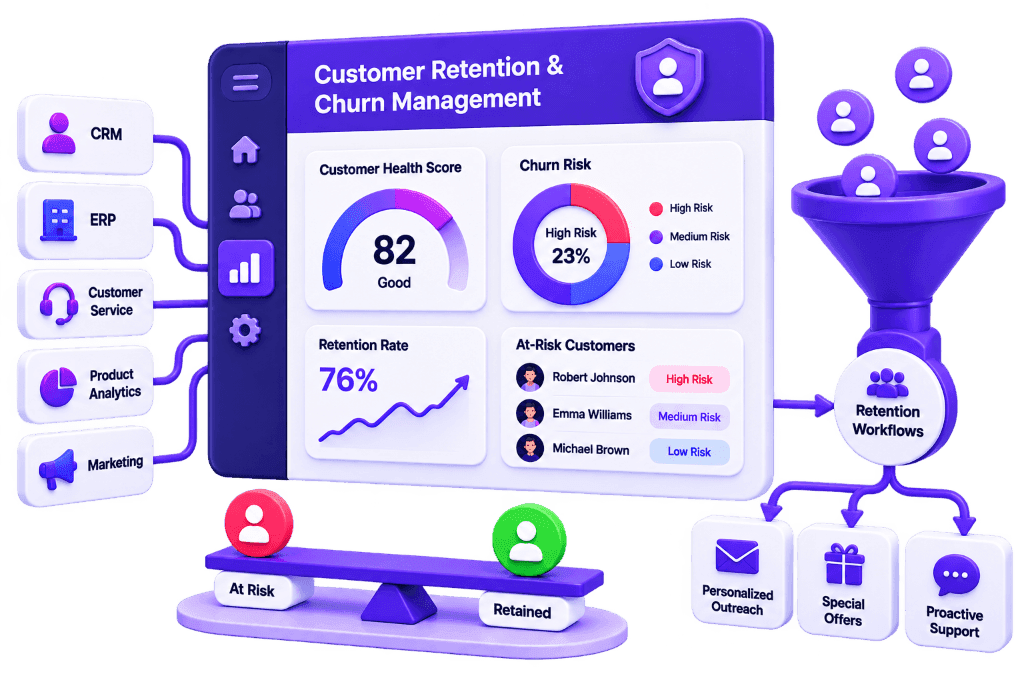
NuageCX helps businesses connect customer data from CRM, ERP, customer service, analytics, product, marketing, and other relevant systems to create a more complete view of customer health and retention.
Customer 360 Retention & Churn Management helps organizations move from reactive customer retention to a structured approach based on customer behavior, engagement, service activity, lifecycle stage, value, and other relevant signals.
What Is Customer 360 Customer Retention & Churn Management?
Customer 360 Customer Retention & Churn Management combines unified customer information, customer analytics, customer health monitoring, churn analysis, and appropriate workflows to help businesses understand and manage customer retention.
It can bring together relevant information across 14 enterprise streams:
Customer Profile
Core demographics, primary industry, and authoritative identity data
Account Information
Hierarchy, subsidiary mapping, and organizational relationship structure
Purchase History
Historical transactions, order frequencies, and commercial contract volume
Sales Activity
Executive sponsorship, pipeline opportunities, and sales check-ins
Product Usage
Active user telemetry, feature engagement depth, and license consumption
Customer Engagement
Portal logins, meeting attendances, webinars, and email responsiveness
Support Interactions
Ticket frequency, issue severity, escalation patterns, and time to resolution
Customer Feedback
NPS, CSAT scores, quarterly reviews, and direct stakeholder interviews
Payment Activity
Invoice timeliness, payment failures, credit terms, and billing friction
Contract Information
Active service level agreements, legal terms, and committed milestones
Renewal Dates
Contract expiration dates and renewal cadence preparation cycles
Customer Health Indicators
Multi-dimensional health scores evaluating engagement & telemetry
Customer Value
Current annual contract value (ARR/ACV) and lifetime value potential
Lifecycle Stage
Current milestone from onboarding through maturity and expansion
*The objective is to identify meaningful retention signals early enough for the business to take appropriate action.
Why Is Customer 360 Retention Management Important?
Customer churn rarely results from a single data point. A customer almost always displays multiple early signals before leaving:
Reduced engagement
Fewer portal visits, unanswered check-ins, and lower communication velocity
Lower product usage
Decreased active users, abandoned advanced modules, or dropped session lengths
Increased support issues
High repeat ticket rates, unresolved technical blockers, or repeated escalations
Delayed payments
Late payment notices, overdue invoices, or requests for invoice disputes
Reduced purchasing
Smaller order volumes, reduced subscription tiers, or paused expansions
Declining satisfaction
Low CSAT survey scores, passive NPS ratings, or direct complaint submissions
Missed onboarding milestones
Protracted time-to-value, delayed initial activation, or stalled training sessions
Reduced stakeholder engagement
Champion job turnover, lack of executive involvement, or organizational shifts
Approaching renewal without activity
Contracts expiring within 90 days with zero proactive discussions or usage
The Risk of Departmental Silos: When these signals remain isolated across different systems, teams fail to recognize the broader customer risk until it is too late. Customer 360 connects relevant information so businesses can analyze customer health more comprehensively.
How Does Customer 360 Churn Management Work?
A disciplined, continuous 12-step methodology turning fragmented customer behavior into systematic churn mitigation:
Define Retention Objectives
Determine which customer outcomes the organization wants to improve.
Define Churn
Establish what churn means for the specific business model.
Identify Customer Signals
Determine which behavioral, operational, financial, service, and engagement signals indicate risk.
Connect Relevant Data
Integrate the required customer information across enterprise systems.
Resolve Customer Identity
Ensure records are associated with the correct customer or account.
Build Health Indicators
Create multi-dimensional customer health measurements.
Segment Customers
Group customers according to meaningful business criteria.
Identify Risk Patterns
Analyze historical and current customer behavior.
Create Risk Workflows
Route relevant customers to sales, customer success, service, or other teams.
Take Retention Action
Execute appropriate customer interventions and playbook recovery.
Measure Outcomes
Track retention, churn, renewal, engagement, and other relevant outcomes.
Continuously Optimize
Improve the retention model and workflows using validated results.
Customer 360 Retention Management Framework
This architecture connects customer intelligence with operational retention processes:
Customer Health Management & Scoring Formula
Customer health provides a structured, multi-dimensional way to monitor account indicators before friction manifests:
10 Core Customer Health Dimensions:
Customer Health Score Formula
*The scoring methodology should be transparent, validated against historical churn, and periodically reviewed.
Churn Prediction & Churn Risk Analysis
Churn prediction uses historical customer information and analytical models to estimate churn likelihood across 4 defined tiers:
Low Risk
Customer behavior remains consistent with expected patterns. Product usage, engagement, and service tickets are healthy.
Medium Risk
One or more indicators show potential deterioration, such as slight usage decline or slower payment velocity.
High Risk
Multiple validated indicators suggest elevated churn risk, including repeat ticket escalations and approaching renewal.
Critical Risk
Customer behavior requires immediate account review and executive intervention according to business rules.
10 Validated Predictive Inputs for Churn Modeling:
Customer 360 Early Warning System
Identifies meaningful changes in customer behavior across 5 distinct signal categories:
Behavioral Signals
- • Reduced activity
- • Lower usage
- • Reduced engagement
- • Feature abandonment
Commercial Signals
- • Reduced purchases
- • Contract changes
- • Renewal risk
- • Payment issues
Service Signals
- • Increased cases
- • Ticket escalations
- • Repeated issues
- • Long resolution times
Experience Signals
- • Declining satisfaction
- • Negative feedback
- • Reduced engagement
Relationship Signals
- • Reduced stakeholder activity
- • Key contact inactivity
- • Reduced account engagement
Segmentation, Cohort & Churn Analytics
Tailoring retention strategies according to lifecycle milestones and behavioral cohorts:
Retention Segmentation
*Different segments require differentiated retention strategies.
Churn Analytics Answers
- • Which customers are churning?
- • When are customers churning?
- • Which segments show higher churn?
- • Which products show higher churn?
- • Which lifecycle stages show higher risk?
- • What behaviors precede churn?
- • Which service issues correlate?
- • Which engagement patterns retain?
Lifecycle Retention
Departmental Drivers of Customer Retention
Connecting customer onboarding, product adoption telemetry, service cases, and feedback:
Onboarding Analytics
Poor onboarding creates downstream churn:
- Onboarding completion
- Time to activation
- Training attendance
- Initial product adoption
- Milestone verification
Product Adoption
Critical for subscription retention:
- Active users (DAU/MAU)
- Feature adoption depth
- Usage frequency
- Adoption milestones
- Capacity limits reached
Customer Service
Support issues correlate with churn:
- Support ticket cases
- Escalation severity
- Resolution velocity
- Repeat issue volume
- Post service satisfaction
Renewal Risk
Context for contract renewal prep:
- Renewal date proximity
- Customer health score
- Survey satisfaction (CSAT)
- Commercial agreement
- Stakeholder engagement
11-Step Churn Prevention Workflow
8 Targeted Retention Campaigns
Customer Win Back Program
Targets customers who have churned or become inactive using structured criteria:
CRM, ERP & Customer Data Integration for Retention
Reliable retention analysis depends on connecting commercial, operational, and customer records:
CRM Retention Data
- • Accounts & Contacts
- • Opportunity records
- • Sales activities
- • Customer communication
- • Renewal opportunities
- • Account notes & owner
ERP Commercial Info
- • Orders & Invoices
- • Payment timeliness
- • Products purchased
- • Credit term breaches
- • Historical transactions
- • Account billing health
8 Source Integrations
- • CRM (Zoho, Salesforce)
- • ERP (SAP, Oracle, NetSuite)
- • Marketing platforms
- • Customer service desks
- • Product analytics telemetry
- • E-commerce stores
Identity Unification
Connects unified records without:
Retention Dashboard & 17 Core KPIs
Real-time monitoring across 5 dashboard modules and enterprise retention metrics:
Customer Health
Healthy, At-risk, High-risk, Critical-risk accounts
Churn Intelligence
Churn rate, trends, churn by segment, product & stage
Retention Analytics
Retention rate, Renewal rate, LTV, Gross/Net revenue retention
Customer Behavior
Engagement index, Product adoption, Support activity
Retention Actions
Open retention tasks, Interventions, Customer response
17 Core Retention & Churn KPIs
AI, Predictive Analytics & Next Best Action
Empowering customer success and retention teams with predictive foresight and automated playbooks:
8 AI Retention Capabilities
Predictive Analytics
Estimates the likelihood of critical outcomes:
Next Best Action Framework
Deterministic response sequence:
Retention & Churn Challenges
Retention Best Practices
Customer 360 Retention Implementation Roadmap
NuageCX executes a disciplined 12-phase delivery roadmap for retention management:
Phase 1: Define Goals
Identify business outcomes and critical retention metrics.
Phase 2: Define Churn
Create a consistent churn definition across departments.
Phase 3: Identify Signals
Determine relevant retention indicators and telemetry points.
Phase 4: Data Discovery
Identify required customer data sources and dependencies.
Phase 5: Data Integration
Connect relevant CRM, ERP, and product systems.
Phase 6: Identity Resolution
Establish customer and account matching logic.
Phase 7: Health Model
Define multi-dimensional customer health indicators.
Phase 8: Risk Model
Create validated churn risk scoring methodology.
Phase 9: Dashboards
Build real-time customer health and retention dashboards.
Phase 10: Workflows
Create appropriate automated retention playbooks.
Phase 11: Validation
Test data integrity, scoring models, and workflows.
Phase 12: Optimization
Continuously improve retention operations with AI.
How Much Does It Cost?
Cost depends on systems, data sources, integration complexity, customer volume, identity requirements, dashboard needs, predictive analytics, AI, and workflow complexity.
There is no universal cost. A business assessment determines the appropriate implementation scope.
How Long Does It Take?
Implementation time depends on data availability, integrations, customer volume, data quality, churn definition, health scoring complexity, dashboards, and workflow needs.
A basic retention dashboard requires significantly less effort than an enterprise predictive churn system.
7-Phase Iterative Rollout
When Should a Business Implement Retention Management?
Industry Models & Conceptual Scope
Tailored retention intelligence engineered for specific business models:
SaaS Businesses
Activation, adoption, engagement, product telemetry, health, support, renewals, expansion, and churn.
B2B Organizations
Account & contact level retention analysis, stakeholder turnover tracking, and contract milestones.
E-commerce
Purchase frequency, repeat orders, customer engagement, return tracking, service reviews, and customer LTV.
Manufacturing
Order frequency, service warranty claims, delivery performance, wholesale engagement, and renewals.
C360 Retention vs. CRM
CRM manages customer relationships and related business processes. Customer 360 Retention focuses on connected customer data, health scoring, predictive churn, and retention workflows.
Retention vs. Churn Management
Retention management focuses on maintaining and strengthening customer relationships. Churn management focuses on identifying, analyzing, and responding to customer loss risk.
Customer Health vs. Churn Risk
Customer health is a broad assessment of customer status. Churn risk focuses specifically on the likelihood of a defined churn event. A customer can have declining health without immediate churn risk.
Why Choose NuageCX for Customer Retention & Churn Management?
Comprehensive customer health modeling, predictive analytics, and turnkey Zoho Ecosystem mastery:
Connected Customer Data
Bring together relevant customer information across all enterprise systems.
Health Intelligence
Create structured, real-time visibility into customer health and engagement.
Churn Risk Analysis
Identify relevant customer risk signals using defined analytical methodologies.
Retention Analytics
Understand retention across segments, cohorts, products, and lifecycle stages.
Customer Success Workflows
Connect customer risk signals with automated customer success actions.
Renewal Management
Monitor customer health, contract dates, and renewal readiness.
Predictive Analytics
Support validated churn and retention prediction modeling use cases.
AI Supported Retention
Use AI for segmentation, sentiment, anomaly detection, and next best action.
Zoho Ecosystem Expertise
Connect Zoho CRM, Zoho Analytics, Zoho Desk, and Zoho Flow seamlessly.
End-to-End Retention
Support discovery, integration, health modeling, dashboards, and ongoing optimization.
Frequently Asked Questions
Everything you need to know about Customer 360 Customer Retention & Churn Management:
Turn Customer Health Into Retention Action
Customer retention becomes more effective when businesses can recognize meaningful customer signals before they become larger problems. NuageCX helps organizations connect Customer 360 data with customer health analytics, churn analysis, retention workflows, renewal management, and customer success processes.